Answering the question, these lithium-compatible boat battery chargers deliver safe, efficient charging for marine lithium packs, AGM, and deep-cycle lead-acid batteries. They’re ideal for boaters who want fast, reliable on-board charging with temperature compensation and overcharge protection. The top picks below vary by bank count and power, so you can choose based on your boat’s battery setup and space constraints. This guide highlights five options best suited for lithium and mixed-battery systems, from compact single-bank units to multi-bank onboard chargers.
| Product | Banks & Total Amps | Best For |
|---|---|---|
| NOCO Genius GEN5X2 | 2 banks, 10 A total (5 A per bank) | Small to mid-size boats needing independent charging for two batteries |
| NOCO Genius GEN5X3 | 3 banks, 15 A total (5 A per bank) | Boats with three batteries or separate start/deep-cycle banks |
| NOCO Genius GEN5X1 | 1 bank, 5 A | Compact boats with a single lithium or lead-acid battery |
| NOCO GENIUS5 | 1 bank, 5 A | Versatile maintenance charger for mixed battery types on small to mid boats |
| NOCO GENIUS10 | 1 bank, 10 A | Owners needing faster on-board charging for larger lithium packs |
NOCO Genius GEN5X2: 2-Bank, 10A Onboard Charger

The GEN5X2 is a compact, two-bank onboard charger rated at 10 amps total (5 A per bank). It supports 12V lithium and lead-acid batteries with selectable modes per bank, including 12V, 12V AGM, 12V Lithium, and a repair mode. Best for boaters needing independent charging for two batteries—start and deep-cycle—while tolerating harsh marine conditions. Caution: ensure correct mode selection for lithium to avoid mischarging in mixed-battery setups.
Why it’s chosen: dual banks allow simultaneous charging without cross-bank interference, and its compact design fits tight compartments. It’s suitable for lithium packs and mixed systems on mid-sized boats. The temperature compensation helps prevent overcharge in hot climates and undercharge in cool nights.
NOCO Genius GEN5X1: 1-Bank, 5A Onboard Charger
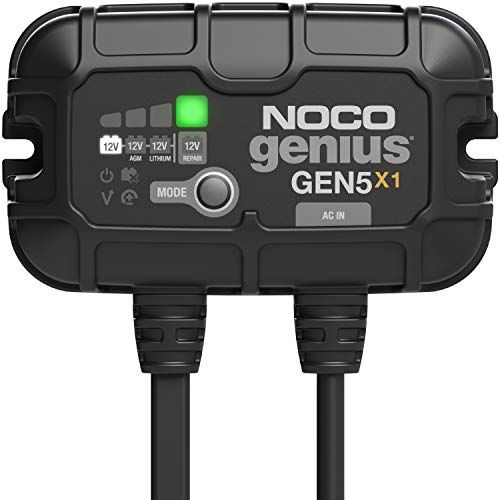
The GEN5X1 provides a single 5-amp bank, delivering precise charging for one battery. It features selectable modes for 12V and lithium, plus temperature compensation for safe charging. This unit is best for small boats or spaces where only one battery needs managed charging, while still maintaining lithium compatibility. Limitation: a single bank offers less flexibility for boats with multiple batteries or separate systems that require independent charging.
Why it’s chosen: its compact footprint makes installation easier in tight bilge spaces, and the dedicated lithium mode supports LiFePO4 batteries reliably when used on a single bank.
NOCO GENIUS5: 5A 6V/12V Smart Charger

GENIUS5 is a 5-amp charger suitable for mixed battery types, offering a maintainer and desulfator with overcharge protection and temperature compensation. It supports lead-acid (AGM, Gel, SLA, VRLA) and lithium-ion (LiFePO4) batteries, making it a flexible choice for boats with evolving battery needs. Best for small to mid boats that prioritize a single robust charger capable of handling various battery chemistries. Caution: though versatile, it is a single-bank unit, so multi-battery setups may need additional charging solutions.
NOCO GENIUS10: 10A 6V/12V Smart Charger
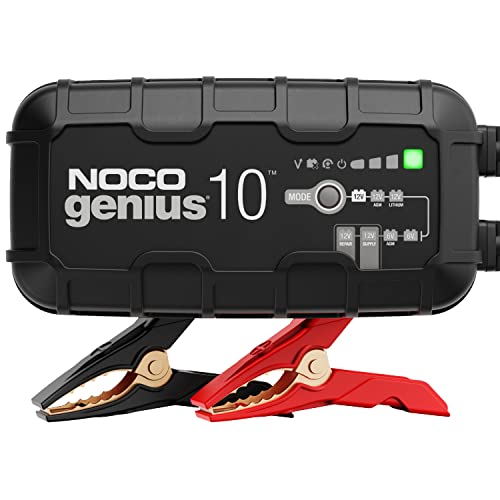
GENIUS10 delivers 10 amps of charging current in a single bank, with temperature compensation for safe LiFePO4 and lead-acid charging. It’s designed for faster charging of larger lithium packs and offers full maintenance capabilities. Best for boaters needing quicker recharge cycles on bigger battery banks. Limitation: higher current draw requires adequate space and proper wiring to avoid heat buildup in cramped bilge areas.
Buying Guide
Key considerations for choosing a lithium boat battery charger:
- Banking needs: How many batteries do you manage? Multi-bank models (2- or 3-bank) allow independent charging and are ideal for boats with separate starting and deep-cycle batteries.
- Charge rate: Higher amps reduce recharge time but require appropriate electrical setup. Match the charger’s total amperage to your boat’s battery capacity and wire gauge.
- Battery type support: Confirm LiFePO4 and other lithium chemistries are supported, along with lead-acid variants if you mix batteries on board.
- Temperature compensation: A charger with thermal sensing avoids overcharging in heat and undercharging in cold, protecting battery health.
- Weatherproofing: Marine environments demand waterproof or water-resistant enclosures. Ensure the unit carries a suitable rating for your installation.
- Mode flexibility: Look for selectable modes (12V, AGM, Lithium, Repair) to tailor charging to each battery chemistry.
- Size and installation: Consider available space, mounting options, and wiring routes to ensure clean, safe integration into the boat’s electrical system.
FAQ
- What is the difference between a lithium-specific charger and a general charger?
– Lithium-specific chargers use charging profiles compatible with lithium chemistry, including balancing and protection features to prevent overcharging that can harm LiFePO4 packs. - Can I use a lead-acid charger on lithium batteries?
– Some chargers support both, but many lithium batteries require dedicated Li-ion charging profiles. Check the manufacturer’s compatibility before use. - Why is temperature compensation important?
– Temperature compensation adjusts charging voltage based on ambient temperature, reducing the risk of damage from overcharging in heat or undercharging in cold conditions. - Do I need a multi-bank charger for a simple boat setup?
– Not always. If you have a single battery, a single-bank charger may suffice. Multi-bank units are helpful for boats with multiple batteries or separate systems. - What installation considerations matter for marine chargers?
– Ensure secure mounting, proper water exposure protection, adequate ventilation, proper wiring gauge, and compliance with marine electrical codes. - Which charger is best for a fast recharge on a larger lithium pack?
– Chargers with higher amp ratings (such as 10 A or more) are typically faster for larger lithium packs, provided the boat’s electrical system supports it.