Answering the need for reliable boat buoyancy, these flotation foams are designed for aluminum vessels and other small watercraft. The best picks prioritize marine-grade closed-cell formulas that resist water absorption, expand predictably, and cleanly bond with common resins. This guide focuses on non-structural flotation and insulation applications, suitable for boat decks, compartments, and buoyancy rooms. The top picks below are best for DIY boat owners, recreational boaters, and light-duty repair pros seeking quick, in-place foam cures. See the quick product table for a snapshot of features and density comparisons before diving into each option.
| Product | Density | Best For |
|---|---|---|
| TotalBoat 6 Lb Density Expanding Foam Kit | 6 lb/cu ft | High-strength flotation and structural reinforcement |
| TotalBoat 2 Lb Density Expanding Foam Kit | 2 lb/cu ft | Lightweight buoyancy and insulation in larger volumes |
| TotalBoat Flotation Foam – 2 Lb Density (2 Quart Kit) | 2 lb/cu ft | Nonstructural flotation and easy pourable fills |
| Fiberglass Supply Depot 4 Lb Density Expanding Pour Foam | 4 lb/cu ft | Moderate-to-high buoyancy with solid shapeability |
| Fiberglass Supply Depot 2 Lb Density Expanding Pour Foam | 2 lb/cu ft | Nonstructural void filling and lightweight buoyancy |
TotalBoat 6 Lb Density Expanding Foam Kit
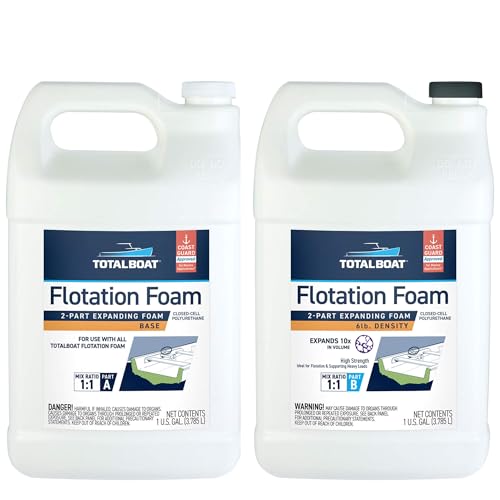
Features: Two-part marine-grade expanding foam; cures hard and rigid with high compressive strength; 6 pounds per cubic foot high-density formula suitable for flotation, casting, and structural reinforcement; fast-setting with 94% closed-cell foam to trap air and resist water, gas, and oil intrusion; cured foam compatible with epoxy, polyester, or vinyl ester resins and paintable.
- Best for: Boat flotation upgrades that require robust buoyancy and potential structural reinforcement in smaller aluminum craft.
- Why selected: Highest density among the listed options, delivering strong closed-cell performance for maximum buoyancy per volume.
- Caution: Higher density can make shaping and trimming more labor-intensive; plan multiple pours if filling large voids.
TotalBoat 2 Lb Density Expanding Foam Kit

Features: Lightweight two-part polyurethane foam; ideal for buoyancy, insulation, and gap filling; 94% closed-cell structure; simple 1:1 mix; cures in about 5 minutes at 70-80°F; suitable for applying in layers under decks or cavities.
- Best for: Larger aluminum boats needing substantial buoyancy with easier handling and multi-layer builds.
- Why selected: Best balance of buoyancy and ease-of-use for multi-stage fills in boats with complex interior voids.
- Caution: For nonstructural applications only; avoid using where structural reinforcement is required.
TotalBoat Flotation Foam – 2 Lb Density (2 Quart Kit)

Features: Lightweight two-part polyurethane foam; nonstructural flotation and void filling; 94% closed-cell foam; quick 5-minute cure window at moderate temperatures; can be coated with polyester, epoxy, or vinyl ester resins.
- Best for: Quick, small-to-medium volume buoyancy projects in aluminum boats and decks.
- Why selected: Ready-to-use pour kit with straightforward curing and coating options.
- Caution: Not intended for structural reinforcement or heavy-duty loads.
Fiberglass Supply Depot 4 Lb Density Expanding Pour Foam

Features: 4 lb density polyurethane two-part foam; pours in place for buoyancy, insulation, and soundproofing; produces about 2 cubic feet per gallon kit; can be laminated over with polyester, epoxy, or vinyl ester resins once cured.
- Best for: Moderate buoyancy needs with a stronger density profile and easier cutting or shaping after curing.
- Why selected: Higher density than 2 lb options, offering more buoyant mass per fill without becoming overly rigid.
- Caution: Higher density can be stiffer to trim; plan for shaping after cure if needed.
Fiberglass Supply Depot 2 Lb Density Expanding Pour Foam

Features: Two-part polyurethane foam with 2 lb density; ideal for nonstructural void filling and buoyancy; yields about 5 cubic feet per gallon kit; cures in place and can be carved or cut after curing.
- Best for: Lightweight buoyancy fills in aluminum boats and dock applications where extra voids must be filled cleanly.
- Why selected: Exceptional for easier pours into tight cavities and decks with less mass per fill.
- Caution: Not for structural reinforcement; avoid using in load-bearing zones without expert guidance.
Buying Guide
What density do I need for aluminum boats?
Higher densities deliver more buoyancy per volume and can provide rigid plugs, while lower densities are easier to pour into awkward cavities and offer easier trimming. Choose higher density for structural reinforcement and heavy buoyancy; opt for 2 lb options for general flotation and insulation tasks.
Is a 94% closed-cell foam important for boats?
Yes. A high closed-cell percentage reduces water uptake, improves buoyancy, and resists gas, oil, or solvent intrusion. It also helps prevent seepage into cavities and reduces long-term maintenance needs.
Can I coat cured foam with resin?
Most marine pour foams are compatible with polyester, epoxy, or vinyl ester resins after curing. Coating enhances moisture resistance and adds mechanical protection in exposed spaces.
Are these foams suitable for nonstructural applications only?
Yes. The listed products are primarily for flotation, insulation, and void filling. Do not rely on them for structural repairs or load-bearing components in aluminum hulls unless specified by the manufacturer.
How should I plan multiple pours?
For large voids or decks, pour in batches with adequate curing time between pours. This approach improves control over expansion and minimizes heat buildup or overfilling.
What safety considerations matter?
Work in a well-ventilated area, wear gloves and eye protection, and follow all mixing and curing instructions. Store components per manufacturer guidelines to avoid premature curing or skin contact.
FAQ
- Q: Which foam is best for aluminum boats with complex interior voids? A: The TotalBoat 6 Lb Density or Fiberglass Depot 4 Lb Density options provide stronger buoyancy and shape retention for irregular spaces.
- Q: Can I use these foams for exterior decks exposed to sun and water? A: They can be coated with compatible resins or finishes; check resin compatibility and UV resistance for long-term outdoor use.
- Q: Do these foams cure underwater or in damp environments? A: Most require a dry environment and moderate temperature for best cure; avoid prolonged wet conditions during curing.
- Q: Are there non-floating uses for these foams in boats? A: Yes, they can insulate, soundproof, and fill voids, but their primary purpose is buoyancy and flotation.
- Q: How should I store the foam kits between uses? A: Keep components sealed, cool, and away from moisture to prevent premature curing.
- Q: Can I mix more than the recommended ratio for higher volume? A: Do not alter the 1:1 ratio; deviations can affect curing and foam properties.