Answering the common question, these fiberglass mats are ideal for boat repair, structural reinforcement, and surface restoration. They work best for DIY boat owners, hull and deck repairs, and professionals tackling moderate-to-large projects. This guide highlights five reliable options and explains who each is best for, plus practical buying tips to help you choose the right mat for your vessel.
Summary of chosen products
| Product | Mat Type | Size / Coverage | Best For |
|---|---|---|---|
| Fiberglass Mat 50 in x 30 ft (125 Sq. Ft) – VIKEYTIM | Chopped Strand Mat | 50″ x 30 ft; ~125 sq ft | Large surface repairs, hull decks |
| Acuteye Fiberglass Chopped Strand Mat – 10 Yards x 4″ (1.5 oz) | Chopped Strand Mat | 10 yards long, 4″ wide | Medium-area patches, edges, patches |
| SIMPLYHARDWARE Fiberglass Woven Mat Cloth – 50″ x 4 yd | Woven Mat Cloth | 50″ x 4 yd | Surfboards, sailboats, even surface wrapping |
| CRMCC Fiberglass Mat Roll – 35″ x 30 ft (1.5 oz) | Chopped Strand Mat | 35″ wide x 30 ft | Boat decks, auto panels, large DIY projects |
| Nordstrand Fiberglass Mat Roll – 50″ x 30 ft (1.5 oz) | Chopped Strand Mat | 50″ x 30 ft | Marine-grade repairs, large coverage |
Fiberglass Mat 50 in x 30 ft – VIKEYTIM
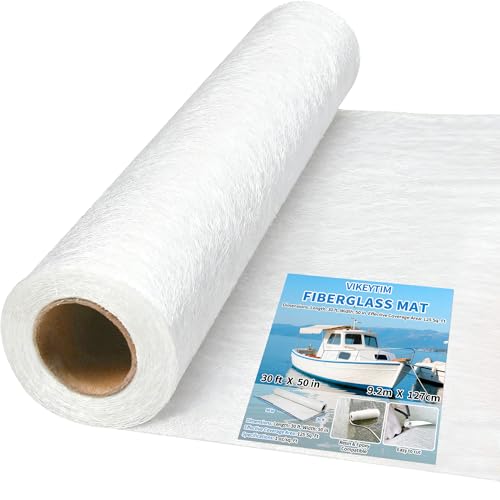
Best for large marine surface repairs. This chopped strand mat covers 125 sq ft when fully unfolded, designed to lay flat and resist folding marks. The mat’s random distribution provides uniform strength in all directions, making it suitable for hull or deck repairs where wide coverage is needed. Resin wets out quickly to create a sturdy laminate. Caution: large sheets can be unwieldy for one person to manage on tight spaces.
Acuteye Fiberglass Chopped Strand Mat – 10 Yards x 4″ (1.5 oz)

Best for targeted repairs and edge work. The mat is 10 yards long and 4 inches wide, with uniform thickness at 1.5 oz/ft². It rolls easily and lays flat, facilitating quick wet-out with resin. Suitable for small-to-medium patches and reinforcing channels or seams. Limitation: the narrow width may require multiple strips for larger areas.
SIMPLYHARDWARE Fiberglass Woven Mat Cloth – 50″ x 4 Yard, 8 oz

Best for consistent strength in both horizontal and vertical directions. This plain weave woven mat is often used on surfboards and sailboats, delivering uniform strength and reliable wet-out. It’s well-suited for projects that require durable, even reinforcement across wide surfaces. Caution: woven mats may be more challenging to trim precisely on tight seams.
CRMCC Fiberglass Mat Roll – 35″ x 30 ft (1.5 oz)

Best for large DIY projects and fast coverage. The 35-inch wide mat provides efficient application for boat decks and panels, with high-strength 1.5 oz/ft² construction. It absorbs resin well to form a strong laminate. Limitation: wide rolls can be harder to maneuver in confined spaces—consider helper or studio workspace for best results.
Nordstrand Fiberglass Mat Roll – 50in x 30ft

Best for marine-grade reliability and large surface repairs. This 50-inch wide mat unfolds to cover broad areas, offering 125 sq ft of coverage when rolled out. The 1.5 oz rating provides sufficient stiffness and resin uptake for durable laminates. Caution: ensure complete wet-out to avoid dry spots on larger sheets.
Buying Guide
What mat type should I choose?
- Chopped strand mats (CSMs) are versatile for general repairs, combining good wet-out with strong laminate results. They’re ideal for hull patches and deck repairs where you need a balance of coverage and ease of handling.
- Woven mats offer directionally consistent strength, which can be advantageous for surfaces that face repetitive stress in specific orientations, such as curved hull sections or boat decks with defined load paths.
How thick should the mat be?
- Common thicknesses range from 1.5 oz/ft² to 8 oz/ft². Heavier mats build up thicker laminates and are better for structural patches, while lighter mats are easier to wet out and work into tight spaces.
What width and roll length are practical?
- Wider rolls cover more area quickly but can be harder to manage in confined spaces. Narrower mats are easier to maneuver but may require more steps to complete large areas.
What resin compatibility matters?
- Most mats work with polyester, vinyl ester, and epoxy resins. Verify resin compatibility on the product page to ensure strong adhesion and proper cure.
How to apply for best results?
- Prepare a clean, dry surface. Cut the mat to fit the irregularities, apply resin evenly, and avoid excessive resin buildup to prevent solvent hotspots. Work in manageable sections to ensure uniform saturation and bonding.
FAQ
- What is chopped strand mat used for in boats?
It reinforces fiberglass laminates, providing strength and thickness where repair or reinforcement is needed.
- Can I use woven mat for hull repairs?
Yes, woven mats offer directional strength and can be used on surfaces that require consistent horizontal and vertical reinforcement.
- Is a wider mat better for large projects?
Wider mats speed up coverage but may be harder to handle in small or tight spaces; balancing width with workspace is important.
- Which resin works best with these mats?
Polyester, vinyl ester, and epoxy resins are common; verify the product’s recommended resin type for best results.
- Do mats require special storage?
Keep in a dry, cool place away from direct sunlight to prevent moisture absorption and fiber degradation.
- Can I apply mats without professional tools?
Basic hand tools and proper PPE are usually sufficient for hobby-level repairs; follow kit instructions for best results.