Answer: The top options are marine primers designed to bond to fiberglass and wood above the waterline, with epoxy barrier coats offering underwater protection. This guide highlights primers that seal, protect, and prepare surfaces for topside or antifouling paints. Best for boaters seeking durable adhesion, easy application, and reliable finish in various water conditions.
The following products are especially suitable for boat owners aiming to prime bottoms, gunwales, or topsides before paint. Choose based on whether you need a simple topside primer, a barrier coat for underwater protection, or a ready-to-spray option for faster projects. The buyer intent ranges from DIY refinishing to marina-ready maintenance.
Choosing At-a-Glance
| Product | Best For | Notes |
|---|---|---|
| TotalBoat Marine Topside Primer (White) | Fiberglass/Wood above waterline | One-part, easy application, great for topsides |
| TotalBoat Marine Topside Primer (Gray) | Fiberglass/Wood above waterline | Same as white with gray finish option |
| TotalBoat TotalProtect Epoxy Barrier Coat (White) | Above and below waterline protection | Two-part epoxy for barrier coat |
| Rust-Oleum Marine Coatings Wood and Fiberglass Primer (White) | Wood or fiberglass above waterline | Base coat for better adhesion |
| Quicksilver Primer Paint (Light Gray Enamel Spray) | Pre-coat for engine gear, cowl, drive | Spray-on primer for small components |
TotalBoat Marine Topside Primer for Fiberglass and Wood (White)
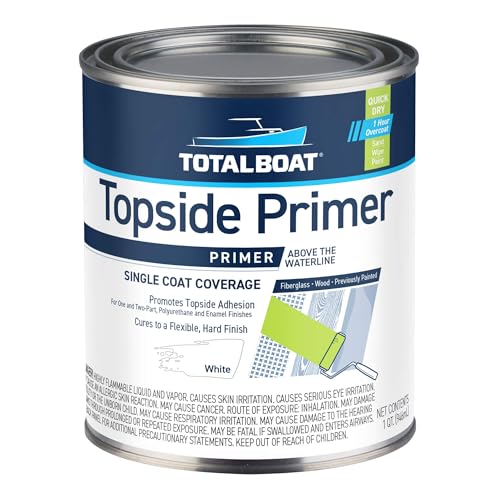
Product highlights: One-part marine primer that creates a durable, flexible undercoat for 1-part and 2-part polyurethane and enamel topside paints. Designed for use above the waterline on fiberglass, wood, gelcoat, and previously painted surfaces in good condition. It covers in a single coat, with a second coat only if higher build is needed. Best for DIY refinishing of boats where ease of application is a priority.
Who it’s best for: Boat owners needing a straightforward topside primer on fiberglass or wood. This is ideal for projects that require quick sealing with minimal layers. Limitations: For larger surface imperfections, a fairing compound may be needed before application.
TotalBoat TotalProtect Epoxy Barrier Coat System (White)

Product highlights: High-build two-part epoxy primer and barrier coat for use above and below the waterline. It’s especially effective for gelcoat blister prevention and repairs on fiberglass boats and provides strong protection on all underwater metals. This is a robust option for vessels requiring underwater durability and long-term protection.
Who it’s best for: Boats needing a durable underwater barrier with strong adhesion and corrosion resistance. Choose this when you want a barrier coat that contributes to long-term blister protection. Limitation: Requires proper mixing and handling as a two-part epoxy system.
Rust-Oleum Marine Coatings Wood and Fiberglass Primer (White)

Product highlights: Designed as an above-waterline base coat for wood or fiberglass surfaces to optimize adhesion of subsequent topcoats. Dries to the touch quickly and covers about 100 sq ft per gallon, offering a practical option for mid-sized boat projects.
Who it’s best for: Boat owners needing a reliable base coat to improve topcoat adhesion on above-waterline surfaces. Better for larger areas where a fast-drying primer is helpful. Caution: May require a compatible topcoat formulated for marine use to achieve best results over the primer.
TotalBoat Marine Topside Primer for Fiberglass and Wood (Gray)

Product highlights: One-part marine primer with the same bonding and application characteristics as the white variant, but in a gray finish. It provides a durable undercoat for topside paints on fiberglass, wood, and gelcoat. A single-coat seal is common, with a second coat if you want more build.
Who it’s best for: Builders and boaters who prefer a gray primer for ease of inspection or to visually assess coverage. Limitation: Like other topside primers, it’s best used above the waterline unless paired with an underwater barrier coat.
TotalBoat TotalProtect Epoxy Barrier Coat System (Gray)

Product highlights: Two-part epoxy barrier coat for versatile protection above and below the waterline. This system performs well for preventing blistering on gelcoat and provides superior protection on underwater metals. The gray variant offers the same performance with color preference in mind.
Who it’s best for: Boats needing comprehensive underwater protection and barrier coating for long-term durability. Limitation: Mixing and curing require careful adherence to instructions and ventilation when in use.
TotalBoat JD Select Ablative Antifouling Bottom Paint (Black)

Product highlights: Antifouling bottom paint with ablative film that wears away as the boat moves, reducing bottom buildup. Suitable for fiberglass, wood, and steel boats in both salt and freshwater. It helps maintain hull speed and cleanliness over a full season.
Who it’s best for: Boats needing antifouling protection with easier maintenance and less sanding next season. Limitation: Requires careful compatibility checks with your existing topcoats and marina regulations regarding bottom coatings.
Buying Guide
What primer should you choose for your boat? Start with the surface you’re treating. For topsides above the waterline, a one-part marine primer like TotalBoat Topside Primer offers easy application and quick curing. If you’re concerned about underwater protection or blistering, TotalProtect epoxy barrier coats provide robust barrier properties when applied correctly. For a simple base coat that improves adhesion of subsequent paints, Rust-Oleum’s primer is a practical option. If you plan to apply antifouling, consider an ablative bottom paint to minimize buildup over seasons. Always verify compatibility with your chosen topcoat and waterline conditions.
Application tips: Prepare surfaces by cleaning, sanding lightly, and removing loose material. For epoxy systems, follow mixing and ventilation guidelines strictly. When using spray formats like Quicksilver primers, ensure an even, thin coat and allow proper curing between steps. Work in a well-ventilated area and wear protective gear as recommended by the manufacturer.
Buying Considerations
- Waterline location: Use above-waterline primers for topsides; barrier coats for below-waterline areas.
- Surface type: Fiberglass vs. wood may influence adhesion and finish quality.
- Ventilation and safety: Epoxy systems require proper handling and curing conditions.
- Topcoat compatibility: Ensure your primer is compatible with your chosen polyurethane, enamel, or antifouling finish.
- Drying times and recoat windows: Adhere to manufacturer guidance to avoid problem finishes.
FAQ
- Q: Do I need a barrier coat if my boat is above the waterline?
- A: Not always. A dedicated barrier coat is primarily for below-waterline protection or for gelcoat blister prevention; topside primers can suffice above the waterline if adhesion is good.
- Q: Can I use these primers over old paint?
- A: Yes, if the old paint is in good condition, properly prepped, and compatible with the primer.
- Q: How many coats should I apply?
- A: Most topside primers seal with a single coat; apply a second coat only if you need higher build. Barrier coats may require proper layering per instructions.
- Q: Is a spray application better than brushing?
- A: It depends on the product and project scale. Sprays can speed coverage, while brushes and rollers ensure thorough bonding in crevices.
- Q: Are these products safe for marina environments?
- A: Barrier coats and antifouling paints often have environmental considerations. Choose low-VOC options and follow marina regulations.