Find the right weather station for your boat with options that fit on deck, in cabin, or below. This guide compares top models by sensor coverage, connectivity, and ease of use for marine environments. Ideal buyers include skippers needing local wind and rain data, weekend sailors seeking simple readings, and boaters who want smart alerts for safe passages.
Summary table of selected products:
| Product | Best For | Connectivity | Key Benefits |
|---|---|---|---|
| AIRAIN TECH 10-in-1 Wireless Weather Station (NO WiFi) | Boat owners who prefer standalone, offline readings | Radio, wireless; no WiFi | Wind, rain, moon phase, barometer, temperature, humidity, forecast |
| Ambient Weather WS-2902 WiFi Smart Weather Station | Home-on-the-water setups with remote access | WiFi | Hyper-local data, smart home integration, alerts |
| Tempest Weather Station | High-accuracy, app-enabled marine deployments | App-based wireless | Very fast updates, long-range sensor, robust outdoor use |
| Sainlogic WiFi Smart Weather Station | Users needing AI forecasts and detailed history | WiFi | AI weather forecast, 2-year data export, large display |
| Newentor Weather Station | Budget-friendly multi-location monitoring | WiFi (2.4G) | Multi-sensor support, 8-24h forecast, backlit display |
AIRAIN TECH 10-in-1 Wireless Weather Station (NO WiFi)

This standalone weather station provides essential outdoor readings without internet connectivity. Best for boaters who prefer offline operation and direct instrument readouts. It measures indoor/outdoor temperature and humidity, wind speed and direction, rainfall, barometric pressure, moon phase, and a 7.3-inch color display. It includes a high-precision Swiss sensor and alerts for wind chill and dew point to aid safety planning.
Who it’s best for: skippers on boats without reliable WiFi or who want a simple, self-contained system. Limitation: no remote cloud access or app-based alerts.
Ambient Weather WS-2902 WiFi Smart Weather Station
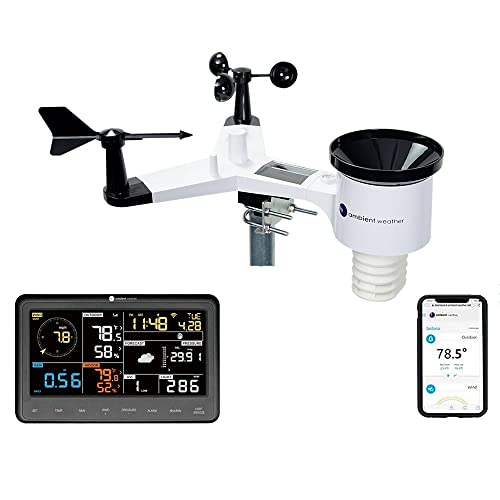
Ideal for boaters who want hyper-local data and remote access. This station supports wind speed/direction, temperature, humidity, rainfall, UV, and solar radiation with a color display and WiFi connectivity for alerts and cloud access. It is well-suited for marinas or dockside setups where you want to monitor weather from a cabin or living space.
Who it’s best for: sailors who want smart home integration and remote monitoring. Caution: requires reliable WiFi for full functionality.
Tempest Weather Station
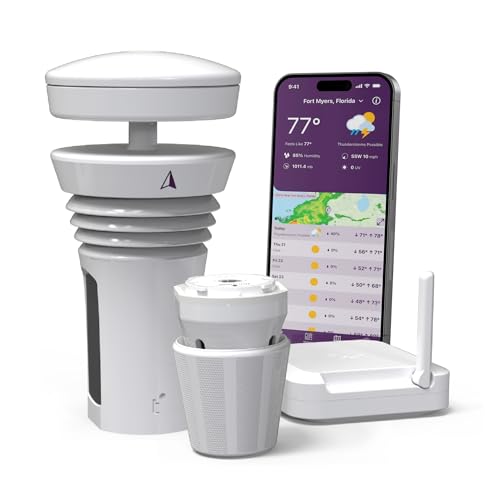
Tempest is a trusted option with strong marine usage due to its built-in wind meter, rain gauge, and robust app. It tracks temperature, humidity, barometric pressure, wind metrics, dew point, solar radiation, UV index, lightning, and rainfall. The outdoor sensor is solar-powered and communicates wirelessly up to 1,000+ feet, delivering updates every few seconds.
Who it’s best for: boaters who want rapid, precise updates and strong wireless range. Limitation: higher upfront cost and reliance on the Tempest ecosystem.
TecScan FUNcaster Barometer Ambient Weather Clock

This compact barometer clock emphasizes time, temperature, humidity, and forecast data. It attaches to a variety of surfaces and offers large numerals for easy readability. It is a simple, dependable option for boats needing a basic, dedicated barometer and clock on deck.
Who it’s best for: users who want a compact, permanent clock-and-barometer solution. Caution: limited sensors beyond pressure and time.
Sainlogic WiFi Smart Weather Station

Offerings include a large 8.5-inch display and 24/7 AI-assisted forecasts via Weatherseed®. It connects to WiFi for remote monitoring and data export, with local data monitoring and multi-parameter sensors. Excellent for boaters who want deep historical data and forecast accuracy.
Who it’s best for: mariners seeking AI-powered forecasts and long-term data insight. Limitation: supports only 2.4 GHz WiFi.
Newentor Weather Station

This wireless indoor-outdoor monitor features a color display, atomic clock, barometric pressure, and forecast. It supports up to three remote sensors for monitoring multiple spaces. The adjustable backlight aids visibility in bright or dark conditions aboard.
Who it’s best for: boaters who need multi-location monitoring at a budget. Caution: calibration can vary with sensor placement.
Buying Guide
What should you consider when choosing a boat weather station?
- Environment: Consider salt exposure and mounting space. Choose weather stations with weatherproof housings or marine-rated sensors.
- Connectivity: Battery-free, offline units work well on boats with limited WiFi. WiFi-enabled models offer remote access and alerts but require stable connectivity.
- Sensor Suite: For seagoing use, prioritize wind speed/direction, rain gauge, barometer, and moon phase. For inland boats, indoor/outdoor temperature and humidity may suffice.
- Display and Alerts: Large, legible displays help from the helm. Look for adjustable backlighting and audible/visual alerts for rapid weather changes.
- Data Access: If you need historical data, choose models with data export or app-based dashboards. For simple on-site readings, offline models are often best.
- Power: Solar-powered sensors support longer off-grid use. Check battery life and maintenance needs for marine conditions.
Choosing between offline and online systems
- Offline (NO WiFi): Best for smaller boats or shallow-water use where internet is unreliable. Easy setup and direct readings.
- Online (WiFi/App): Best for marinas or longer trips where remote monitoring matters. Look for cloud storage, alerts, and cross-device syncing.
Deployment tips for boats
- Mount sensors away from spray and direct sun to improve longevity and data accuracy.
- Position wind sensors in clear airflow away from rigging and masts to reduce turbulence.
- Regularly calibrate barometers and check sensor alignment to maintain accuracy in changing conditions.
FAQ
- Do I need internet to use a boat weather station?
- What is the most important sensor for boating?
- Can these stations integrate with marine charts or navigation apps?
- How do I protect devices from salt and spray?
- How often should I calibrate sensors?
- Are there weather stations that work well both on land and at sea?
Direct answers to common questions: Many stations operate indoors on battery or with limited WiFi; wind, rain, and barometer sensors are critical for boating safety; some models support app integrations with smart home ecosystems; protect devices with marine-rated enclosures and regular cleaning; calibration frequency depends on usage but quarterly checks help maintain accuracy; hybrid systems with both offline sensors and optional online dashboards work well for mixed environments.