Direct answer: these VHF radios are designed for boaters seeking reliable, marine-certified communication with NOAA weather alerts, DSC distress features, and international channel support. This guide highlights five strong picks and explains who each is best for, from offshore cruisers to coastal anglers. Use the buying guide to compare features like weather alerts, GPS, Bluetooth, IP ratings, and power options to match your vessel and sailing plans.
Overview table of selected products:
- Uniden UM385: All-in-one fixed-mount with DSC, weather alerts, and international channels.
- Uniden UM385BK: Budget-friendly black variant with same core features.
- COBRA BlueBound 350 (Black): Floating, 6W, NOAA alerts, IPX7, USB-C; best for rough waters.
- Retevis RM01P: IP67 floating handheld; ideal for port operations and quick one-handed use.
- COBRA BlueBound 350 (White): White version with identical specs for visibility and versatility.
Uniden UM385 25 Watt Fixed Mount Marine VHF Radio
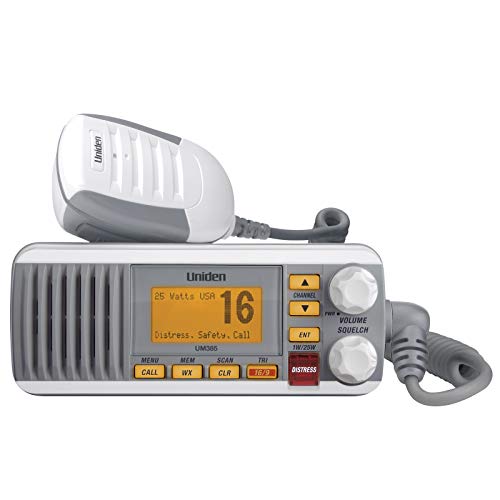
The UM385 is a fixed-mount marine VHF radio with 25 watts of transmit power and IPX4 waterproofing. It includes Triple Watch, DSC capabilities, and S.A.M.E. weather alerts, plus access to international channels. This unit is designed for boaters who want a centralized, shore-to-ship communication hub that also keeps weather updates front and center. Best for: coastal cruisers who need reliable weather information and emergency signaling without adding complexity to the helm.
Best for sailors who want DSC and weather alerts in one compact, mountable unit. Choose this if you prioritize a fixed-mount installation with international channel coverage and NOAA-style weather warnings.
Limitations: IPX4 rating means it handles light splashes but not full immersion; for boats with heavy spray or fully submersible needs, consider higher IP-rated models.
Uniden UM385BK 25 Watt Fixed Mount Marine VHF Radio

The UM385BK mirrors the UM385 in capability, offering 25W, triple watch, DSC, international channels, and S.A.M.E. Weather Alert in a black finish. It’s a compact, all-in-one marine radio suitable for small to mid-size vessels where a dashboard-friendly device is preferred. Best for: boaters who want identical feature sets in a darker, low-glare housing to reduce helm distractions.
Best for: users who value weather alerts and DSC with a compact, rugged design. Limitation: like the UM385, it’s not fully submersible; for splash-heavy environments, check higher IP-rated options.
COBRA BlueBound 350 VHF Handheld Marine Radio (Black)

This handheld radio offers 6-watt output with an IPX7 waterproof rating and a floating design in a black finish. It features NOAA weather alerts, international functionality, USB-C charging, and an LCD display. Best for: boaters who need a floating, rugged handheld with reliable long-range capability and quick access to weather updates. Better for: quick deployment and portability on smaller vessels or tenders.
Limitation: the higher power options aren’t available in all scenarios; if you need extended range on larger vessels, a fixed-mount model with 25W might be preferable.
Retevis RM01P Marine Radio (IP67 Floating)

The RM01P is a lightweight, IP67-rated floating handheld with 1750mAh battery, USB-C, and 88 global channels. It’s designed for port operation and coastal activity where one-handed operation and quick retrieval are priorities. Best for: port workers, coast guards, and anglers who need a rugged, buoyant radio that remains usable after drops or rain. Limitation: 88 channels may not cover every region with the same depth as higher-end fixed-mount models; channel density varies by region.
COBRA BlueBound 350 VHF Handheld Marine Radio (White)

The White variant offers the same features as the Black version: 6-watt power, floating core for buoyancy, NOAA weather alerts, IPX7 waterproof, USB-C, and a day/night LCD display. Best for: users who want high visibility in storage or on deck and a reliable backup radio with similar performance to the black model. Better for: vessels seeking a bright option that remains visible in low-light conditions. Limitation: color choice is cosmetic; performance remains the same as the black model.
Uniden UM725 Marine VHF Radio

The UM725 covers all US, Canada, and international channels with 1W/25W transmit power and features the largest LCD in its class. NOAA weather channels with alerts, a speaker microphone, and IPX8 waterproofing make it a strong all-around choice. It also includes DSC distress capabilities and text messaging options via VHF. Best for: boats needing robust weather monitoring, GPS-ready connectivity, and enhanced readability on deck. Limitation: more advanced features may require setup and familiarity with DSC and GPS integration.
Cobra MR F77W GPS Fixed Mount VHF Marine Radio
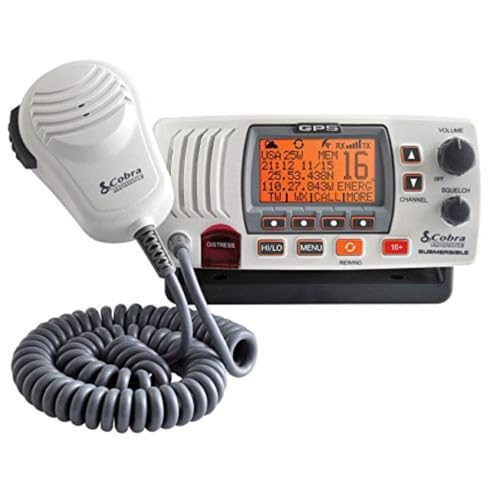
The MR F77W includes a built-in GPS receiver, submersible design, NOAA weather, and a signal strength meter. It supports US, Canada, and international channels with 25-watt performance and a backlit LCD. Best for: vessels requiring precise location data during distress calls and reliable long-range communication. Limitation: GPS-enabled models rely on satellite reception; in obstructed areas, GPS performance may vary.
Uniden UM725GBT Marine VHF Radio With Bluetooth

The UM725GBT adds built-in Bluetooth for smartphone connectivity alongside GPS, IPX8 waterproofing, and NOAA weather channels with alerts, plus DSC and a speaker microphone. Best for: boaters who want seamless pairing with mobile devices for messaging or alerts while keeping radios at the helm. Limitation: Bluetooth pairing requires compatible devices and may introduce additional setup steps at sea.
Buying Guide: Key Purchase Considerations
- Waterproofing and durability: Prioritize IP ratings (IPX7/IPX8) for handhelds, or IPX4 for fixed-mounts in calm conditions.
- Power output: 6W vs. 25W transmit power affects range and battery use. Choose 25W for larger vessels or open-water ranges; 6W is often sufficient for coastal use.
- Weather alerts and NOAA compatibility: Essential for planning storms, hurricanes, and maritime conditions. Ensure support for local regions and SAMe/NOAA channels.
- DSC distress and GPS: DSC provides automated distress signaling; GPS helps with location data during emergencies. Look for NMEA compatibility for GPS integration with other devices.
- Floating and portability: Floating handhelds improve recoverability if dropped overboard; fixed-mounts save helm space but require installation.
- Bluetooth and smartphone integration: Useful for messaging, notifications, and device management on deck; ensure compatibility with your devices.
- Channel availability: Ensure international coverage if you travel beyond U.S. waters; verify channel availability for your typical voyage area.
Frequently Asked Questions
- What is the difference between fixed-mount and handheld VHF radios? Fixed-mounts stay wired at the helm and generally offer higher stability and larger displays; handhelds are portable, floating, and rescue-friendly for on-deck use.
- Do VHF radios require monthly fees? No. VHF radios operate on licensed radio channels; some features like GPS or Bluetooth pairings are software-driven but do not require a subscription.
- Are all VHF radios waterproof? Many handhelds feature IPX7 or IPX8 waterproof ratings; fixed-mount models vary and may have better weather resistance but not full submersion protection.
- Is GPS essential in a marine radio? GPS enables rapid distress signaling with precise location data and can integrate with other navigation electronics for improved safety.
- What should I consider when choosing NOAA weather alerts? Look for models with local weather alert channels and SAMe Weather Alert, ensuring timely warnings for your voyage region.
- Can a VHF radio text or message other boats? Some Uniden models offer texting via marine VHF, but most communications remain voice-based; check your model’s capabilities before purchase.