Answering the call for clear, dependable marine VHF radios with DSC, these models offer essential safety features, distress signaling, and AIS/GPS integration where applicable. This guide highlights five top options, explaining who each is best for and why. Ideal buyers include casual boaters needing NOAA weather alerts, coastal crew requiring rugged handhelds, and anglers or sailors seeking robust DSC capabilities and GPS positioning. Below is a quick at-a-glance comparison to help you decide.
| Product | Best For | |
|---|---|---|
| Uniden UM385 | All-around boaters needing international channels | DSC, NOAA Weather Alert, triple watch |
| Retevis RM40 | Boaters who want built-in GPS and MOB alerts | GPS, DSC distress, real-time location |
| ICOM M94D | Vessel operators seeking AIS integration | Integrated AIS receiver, 6W output, clear audio |
| Uniden UM725GBT | Users needing GPS, Bluetooth, and wide-channel access | GPS, Bluetooth, NOAA weather, DSC |
| Uniden UM725 | Budget-conscious buyers needing robust features | NOAA weather alerts, IPX8 waterproof, DSC |
Uniden UM385 25 Watt Fixed Mount Marine VHF Radio
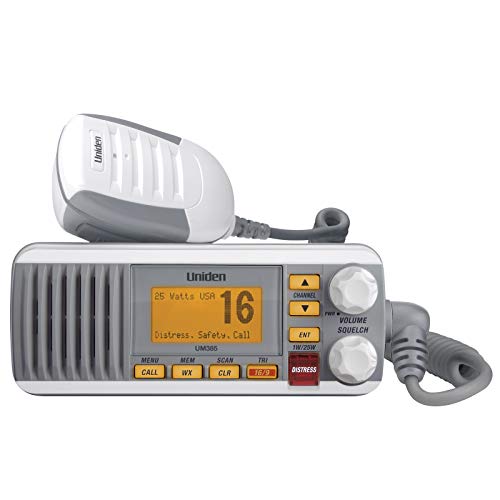
The UM385 provides DSC capability, triple watch, and S. A. M. E Weather Alert in a compact fixed-mount design. It supports a broad range of international marine channels and includes a rugged mic for on-wheel operation. This model is best for boaters who want comprehensive safety features in a single, durable unit without extra frills.
Best for: Recreational boaters who need reliable DSC, weather alerts, and international channel access in a single, dependable radio. Caution: Although feature-rich, some users may prefer a handheld option for portable needs or for quick access as you move about the deck.
Retevis RM40 Marine Radio With GPS

The RM40 adds built-in GPS, DSC distress calling, MOB alarms, and IP67 waterproofing with floating design. It automatically transmits GPS data for rapid location sharing to coast guard and nearby vessels. It’s well-suited for offshore anglers, kayakers, and coastal sailors who need real-time position updates during emergencies.
Best for: Users who require an integrated GPS workflow and quick-response distress signaling. Caution: As a handheld unit, battery life and reach may vary with weather and antenna setups; consider a robust charging plan for long trips.
Icom M94D 21 USA VHF Marine Transceiver with DSC & AIS Receiver

The M94D pairs a DSC-enabled transceiver with an integrated AIS receiver, helping you monitor nearby traffic while preparing distress calls. It offers 6W transmit power and a long-lasting 2400 mAh battery for extended use, along with a high-output speaker for clear audio in loud environments. This model suits active mariners who require situational awareness and reliable communications.
Best for: Sailors and coastal operators who benefit from AIS integration alongside DSC. Caution: AIS visibility is only as accurate as data broadcast by other vessels and can require additional charting or radar for full situational awareness.
Uniden UM725GBT Marine VHF Radio

The UM725GBT combines GPS, Bluetooth, and NOAA Weather channels with DSC, all in a submersible IPX8 design. The built-in GPS helps pinpoint location during distress, while Bluetooth enables easy phone integration and hands-free operation. It is ideal for boaters who want advanced connectivity plus reliable weather alerts.
Best for: Tech-savvy boaters who want GPS, Bluetooth, and weather alerts in one unit with strong water resistance. Caution: Bluetooth pairing for some devices may require software updates or compatibility checks with non-Uniden devices.
Uniden UM725 Marine VHF Radio

The UM725 offers IPX8 waterproofing, NOAA weather alerts, and DSC with a large LCD display for easy readability. It supports all US, Canada, and international channels at 1 or 25 watts, enabling flexible range for different boating environments. This option is a solid pick for budget-conscious buyers who still demand essential DSC and weather features.
Best for: Budget-focused buyers needing comprehensive DSC and weather alerts with broad channel coverage. Caution: While feature-rich, some users may miss enhanced AIS or GPS mapping found on higher-end models.
Buying Guide: Key Purchase Considerations
- Channel Coverage and DSC: Ensure the radio supports international channels if you travel beyond domestic waters and has a reliable DSC distress feature for instant location transmission.
- GPS and AIS Integration: If you navigate busy waterways, GPS helps with quick position sharing. AIS adds vessel traffic awareness in some models, improving situational awareness.
- Weather Alerts: NOAA weather alerts are essential for safety; confirm the radio can push real-time storm warnings and weather broadcasts.
- Water Resistance and Durability: IPX7/IPX8 ratings indicate submersion protection; fixed-mount radios often suit stable installations, while handheld models require robust battery life and floating design.
- Power and Range: Transmit power (1W vs. 25W) affects range. Consider your typical boating environment (coastal vs. open sea) and the need for longer reach.
- Connectivity Features: Bluetooth or smartphone compatibility can streamline setup and alerts, but verify compatibility with your devices and apps.
- Battery and Portability: Handheld units with long-lasting batteries and quick-charge options suit kayaks, tenders, or raft operations; fixed-mount units prioritize stability and ease of access.
FAQ
- What does DSC do on a VHF radio?
– DSC (Digital Selective Calling) enables distress signaling and direct, one-to-one calls to other radios or shore stations without broadcasting to all nearby vessels. - Is AIS integration important for a VHF radio?
– AIS provides real-time vessel traffic information, helping you maintain situational awareness, especially in busy waters or near shipping lanes. - Do I need NOAA weather alerts on my VHF radio?
– If you sail in areas with frequent storms or changing weather, NOAA alerts offer timely warnings and forecasts to improve safety planning. - Can I use a handheld VHF in rain or rough conditions?
– Many handhelds are IP67/IP68 rated and float, but battery life and antenna performance can be affected by water, so plan accordingly. - Is Bluetooth on a marine VHF radio worth it?
– Bluetooth can simplify device pairing and messaging, but verify compatibility with your devices and whether it fits your boat’s safety workflow. - Which radio is best for a budget setup?
– For tight budgets, models with DSC, NOAA alerts, and IPX8 or IPX7 ratings still offer essential safety features without extra bells and whistles.