Direct answer: Choose a durable, weather-resistant terminal block designed for marine use, with enough amperage and proper insulation to handle trolling motor power and accessories. The top picks below are best for boaters needing clean wiring, corrosion resistance, and easy expansion. The table summarizes the five selected products to help you compare at a glance.
| Product | Key Feature | Best For |
|---|---|---|
| RECOIL S1P-38 Busbar | 3/8″ stainless studs, reinforced cover, 48VDC | High-current trolling setups requiring robust insulation |
| RED WOLF 12V 100A Busbar (2PC) | 1/4″ dual studs, 316 stainless, insulated base | Compact, straightforward 12V systems with easy wiring |
| Joinfworld 12V 3/8″ Single Stud Block | Single 3/8″ M10 stud, 250A rating | Simple positive/negative pairing for marine setups |
| Joinfworld 12V 250A Dual 5/16″ Studs | Dual M8 (5/16″) studs, removable junction, 250A | Flexible, higher-current distribution for 12V systems |
| RECOIL S2PG Busbar with Divider | Dual 5/16″ studs with divider, 48VDC/300V AC | Separate positive/negative paths with added protection |
Note: This guide focuses on user-friendly, durable options suitable for marine trolling motor wiring. The five selections balance high current handling, corrosion resistance, and simple installation.
RECOIL S1P-38 Busbar Single 3/8” Studs

The RECOIL S1P-38 uses 3/8″ 304 stainless steel studs for each connection and includes 8AWG 3/8” ring terminals with stainless screws. A reinforced polycarbonate cover protects against accidental short circuits, with a maximum of 48V DC and 250A DC continuous current. Best for heavy-duty trolling setups where corrosion resistance and reliable insulation are critical. Choose this if you need a robust single-stud power distribution block with strong protective housing. Limitation: only one stud per block means parallel circuits require multiple units.
RED WOLF 12V 100A Power Distribution Block

This block features 1/4″ dual studs (M6) and a pure copper stud configuration on a flame-retardant nylon base, delivering corrosion resistance and conductivity for 12V–48V systems. It’s best for mid-range trolling setups where space is limited but a solid connection is needed. It’s also suitable for custom battery junctions to tidy the wiring. Caution: continuous current may drop with high temperature and humidity, so avoid maximum load in hot environments.
Joinfworld 12V 3/8″ Single Stud Block

Designed as a positive/negative pair in a single 12V block, it uses a 3/8″ M10 stud and is rated up to 250A when operating in 12V. Best for simpler, clean layouts where you want a dedicated pair for power and return paths. Better for boats needing straightforward wiring with minimal parts. Limitation: may require additional supports for larger gauge wires beyond the 3/8″ stud capacity.
Joinfworld Dual 5/16″ Studs 250A Block

This dual-stud marine block uses 5/16″ (M8) studs and supports up to 250A, working with 12V–48V systems. It provides separate red and black terminals for positive and negative connections, offering a tidy, high-current distribution solution. Good for boats with multiple circuits needing robust, space-efficient distribution. Caution: ensure your wire gauge matches the terminal size to avoid over-tightening or loose connections.
RED WOLF 12V 150A Block with Dual Studs
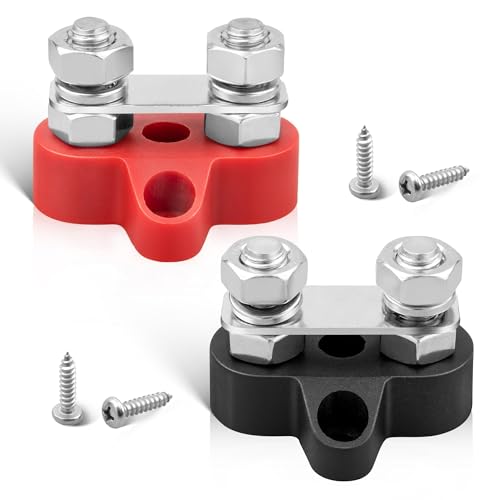
Featuring dual 5/16″ studs (M8) and 150A capacity, this block is designed for 12V–48V systems in marine environments. It simplifies multiple connections and helps maintain a tidy circuit with corrosion-resistant materials. Best for mid-to-high current trolling setups where space and organization matter. Limitation: maximum current can decrease under higher temperature and humidity, so plan for ventilation and heat management.
Buying Guide: Key Factors to Consider
- Current rating: Match block amperage to your trolling motor and accessories. Higher amperage handles more devices without overheating.
- Number of studs and terminals: Consider how many positive/negative connections you need and whether you require dual paths or a single main block.
- Material and corrosion resistance: Look for stainless steel studs and copper conductors with nylon or polycarbonate housings for marine use.
- Insulation and safety: Flame-retardant bases and reinforced covers protect against shorts and vibrations on a boat.
- Voltage compatibility: Ensure compatibility with your system voltage (commonly 12V, up to 48V DC) and check for any AC ratings if you plan mixed equipment.
- Mounting and size: Check footprint and mounting options to fit your boat’s electrical panel or engine compartment.
Frequently Asked Questions
- What is a trolling motor terminal block? A device that distributes power from the battery to the trolling motor and accessories, with insulated studs and terminals for safe connections.
- Why choose a dual-stud block? Dual-stud blocks simplify wiring for positive and negative paths and can handle higher current in tight spaces.
- What does “250A” mean in practice? It indicates the maximum continuous current the block is designed to carry safely, assuming proper wiring and cooling.
- Are marine terminal blocks waterproof? Many are designed with protective housings and nylon bases, but you should still position them away from direct spray and use proper seals where needed.
- Can I mix blocks in a single system? Yes, you can mix blocks, but ensure consistent voltage ratings and wire gauges, and keep positive and negative paths clearly separated to avoid shorts.
- Do I need a fuse with these blocks? A fuse or circuit breaker is recommended close to the battery to protect wiring and equipment, depending on system design.