Looking for a reliable trolling motor boat battery that lasts all day on the water? This guide presents five top options ideal for boaters who want strong, maintenance-free power. The selections cover AGM lead-acid, LiFePO4, and battery boxes that simplify setup. Best for anglers, small boats, and weekend mariners, these choices balance weight, longevity, and ease of use. Below is a quick summary table to compare key points at a glance.
| Product | Type | Best For | Approx. Weight | Notes |
|---|---|---|---|---|
| Newport 12V50Ah Deep Cycle AGM | AGM Lead-Acid | Lightweight trolling motor setups | ~32 lbs | Sealed, leak-proof; easy to transport |
| Newport Trolling Motor Smart Battery Box | Battery Box Power Center | Clean wiring, kayaks and small boats | N/A | USB and DC ports; external connections |
| SUPER EMPOWER 12V 100Ah LiFePO4 | LiFePO4 | Long life and high cycle durability | ~21.6 lbs | Drop-in replacement for lead-acid |
| DC HOUSE 12V 100Ah LiFePO4 | LiFePO4 | Marine and trolling motors with Bluetooth | ~ | Low-temp protection; Bluetooth monitoring |
| Litime 12V 100Ah LiFePO4 (2-pack) | LiFePO4 | Compact, scalable power for boats | ~ | Smart low-temp protection; IP65 rating |
Newport 12V50Ah Deep Cycle Heavy-Duty Marine Battery

The Newport 12V50Ah Deep Cycle Marine Battery is a lightweight, sealed AGM option designed for trolling motor use. Weighing about 32 pounds, it prioritizes easy transport and straightforward installation on a wide range of boats. It provides reliable power without adding unnecessary mass, making it a practical choice for anglers and day boats seeking a balance of weight and performance.
Best for: boaters who want a compact, maintenance-free AGM battery with predictable performance and easy handling. This unit is a strong fit for everyday trolling motors where weight savings matter.
Why selected: Its sealed AGM construction reduces maintenance concerns while offering strong deep-cycle capability suitable for trolling motors. It also minimizes the risk of leaks in rough water compared with some open-frame designs.
Caution: AGM batteries have lower energy density than LiFePO4, so longer runs may require a larger capacity if you fish all day at high throttle.
Newport Trolling Motor Smart Battery Box Power Center
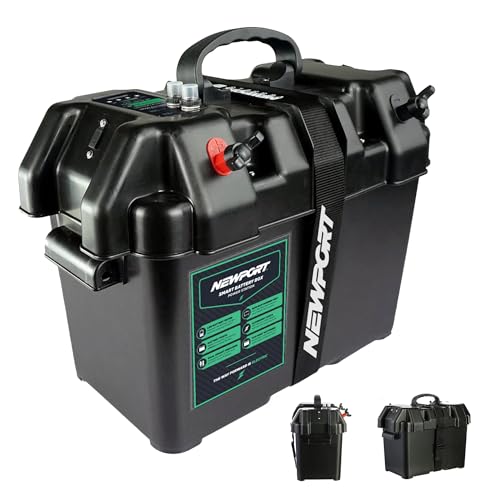
This portable marine power hub combines a 12V trolling motor battery box with built-in USB and 12V DC ports. It is designed to simplify wiring by providing external connections through a clean, organized unit. The system is ideal for kayaks, jon boats, and other small watercraft where clutter and exposed terminals are a concern.
Best for: boaters who want a neat, plug-and-play power center for trolling motors, electronics, and accessories without a heavy wiring chore. Great for beginners or boats with limited space.
Why selected: The all-in-one hub eliminates tangled wiring and exposed terminals, reducing on-water setup time and risk of shorts. The inclusion of USB and DC ports adds utility for devices beyond the trolling motor.
Caution: Not a standalone battery; requires a compatible battery to function, and the unit’s portability may be limited by the size of the matched battery.
SUPER EMPOWER 12V 100Ah LiFePO4 Battery

The SUPER EMPOWER 12V 100Ah LiFePO4 battery is designed for deep-cycle energy storage, including trolling motors, RVs, and marine power systems. It uses premium LiFePO4 cells with an integrated BMS that guards against overcharge, over-discharge, overcurrent, short circuits, and temperature extremes. This battery excels as a drop-in replacement for lead-acid systems, delivering substantial cycle life and safety features.
Best for: boaters seeking long life and high cycle durability with a reliable BMS for everyday marine power. It’s a solid upgrade from traditional lead-acid setups when planning longer seasons or frequent use.
Why selected: The included BMS and high cycle counts provide confidence for routine trolling motor use, with a true compatibility edge as a plug-in replacement for older lead-acid packs.
Caution: Although lighter than lead-acid equivalents, LiFePO4 batteries still require proper charging and maintenance to maximize their cycle life; ensure your charger is compatible with LiFePO4 chemistry.
DC HOUSE 12V 100Ah LiFePO4 Trolling Motor Battery

The DC HOUSE 12V 100Ah LiFePO4 battery features a built-in Bluetooth monitoring capability and an upgraded low-temperature protection system. It is designed for trolling motors, marine electronics, and off-grid use, offering a robust BMS that helps manage charge, discharge, and temperature. The battery aims to deliver reliable performance in varied marine environments.
Best for: users who want real-time battery monitoring on mobile devices and enhanced cold-weather protection for longer boating seasons.
Why selected: Bluetooth monitoring and low-temperature protection are practical for anglers and sailors who experience variable climates and want to track SOC and voltage remotely.
Caution: Bluetooth connectivity requires a compatible app and device within Bluetooth range for optimal monitoring; plan accordingly for remote boats.
12.8V 100Ah Trolling Motor LiFePO4 Battery (BUKNUWO)

The BUKNUWO 12.8V 100Ah LiFePO4 battery offers a 95% utilization rate and weighs around 22 pounds, making it a lighter choice with high energy density. It features a 100A BMS with comprehensive protections and supports expandable series/parallel connections for larger energy storage needs. It is positioned as a versatile option for marine power, solar systems, and other off-grid uses.
Best for: boaters who want a high-energy, lightweight LiFePO4 option with expansion potential for larger setups or future upgrades.
Why selected: High usable capacity and low weight make it suitable for small-to-mid-sized boats where weight savings translate directly to performance gains on the water.
Caution: The expandable configuration requires careful planning to avoid overloading other components when scaling up the system.
Buying Guide: Key Considerations for Trolling Motor Batteries
- Battery chemistry: LiFePO4 offers longer life and lighter weight but higher upfront cost compared to AGM or other lead-acid options. Choose based on desired cycle life and weight savings.
- Voltage and capacity needs: Match 12V systems for most trolling motors; assess amp-hour (Ah) rating for anticipated run time between charges.
- Weight and mounting: Lighter LiFePO4 batteries improve boat handling and efficiency; ensure proper mounting to withstand vessel motion.
- Temperature tolerance: Low-temp protection helps maintain performance in cold climates; consider environments where temperatures drop at night or in shaded boats.
- Maintenance and safety: Sealed designs reduce leakage risk; LiFePO4 batteries require compatible chargers and BMS protection.
- Portability and setup: Battery boxes and power hubs simplify wiring and organization, especially on smaller boats or kayaks.
- Monitoring and connectivity: Bluetooth apps or built-in monitors provide battery status and protective alerts for proactive maintenance.
- Expansion potential: If you plan to add accessories or larger electronics, consider batteries with scalable configurations or higher Ah ratings.
Frequently Asked Questions
- What is the difference between AGM and LiFePO4 trolling motor batteries?
– AGM is maintenance-free and affordable with solid performance, but heavier and with shorter cycle life. LiFePO4 is lighter, longer-lasting, and supports more cycles but higher upfront cost. - Do I need a special charger for LiFePO4 batteries?
– Yes. Use a charger designed for LiFePO4 chemistry to ensure proper charging voltage and battery safety. - Can I replace a lead-acid battery with LiFePO4 in my trolling motor setup?
– In most cases, yes, but verify your trolling motor and wiring are compatible with LiFePO4 voltage and BMS requirements. - Is Bluetooth monitoring essential for marine batteries?
– It’s convenient for real-time status and remote checks, but not strictly necessary if you’re comfortable with manual voltage checks. - What should I consider when expanding battery capacity for longer trips?
– Plan for weight, space, mounting strength, charging sources, and whether your current wiring and BMS will scale safely. - Are battery boxes necessary?
– They simplify installation and protect connections, especially on small boats or kayaks, reducing the risk of shorts or exposed terminals.