Answering the need for safe, reliable, and maintenance-friendly boat battery charging, these trickle chargers and maintainers keep marine systems ready. The top picks suit different boat owners: casual weekend sailors, full-time fishers, and owners with stored batteries. The featured units offer auto-maintain, temperature compensation, and desulfation to extend battery life. Below is a concise summary followed by detailed product sections and practical buying guidance.
Quick Reference: Top Picks
| Product | Best For | Key Benefit | Voltage Range | Maintenance Type |
|---|---|---|---|---|
| NOCO GENIUS1 | All-around boaters with mixed battery types | Smart charging with temperature compensation | 6V / 12V | Maintainer, Trickle, Desulfator |
| NEXPEAK NC201 | Belt-and-suspenders maintenance for varied fleets | 8-stage charging, desulfation, LCD feedback | 12V / 24V | Charger, Maintainer, Desulfator |
| NOCO GENIUS2 | Vehicles and boats with 12V lead-acid and LiFePO4 | Compact, efficient, temperature aware | 6V / 12V | Maintainer, Trickle, Desulfator |
| MOTOPOWER MP00205A | Budget-conscious boaters needing desulfation | Automatic desulfation + spark-free operation | 12V | Charger, Maintainer, Desulfator |
| NOCO GEN5X2 | Two batteries with independent control | Two banks, flexible charging modes | 12V | Onboard Charger, Desulfator |
Notes: All products are oriented toward 12V systems commonly used in boats, with several offering 6V compatibility. Each item supports maintenance charging and desulfation to improve long-term battery health. Always verify battery type compatibility with your boat’s batteries before use.
NOCO GENIUS1: 1A 6V/12V Smart Battery Charger

Best for mixed fleets needing a compact, automatic maintainer. The GENIUS1 is 35% smaller than comparable models yet delivers robust trickle charging and a desulfator function. It supports both lead-acid variants (AGM, Gel, SLA, VRLA) and LiFePO4 batteries. A built-in thermal sensor adjusts charging with ambient temperature, reducing risks of overcharging in heat or undercharging in cold.
- Best for: Small boats with a mix of battery chemistries seeking a single, versatile charger.
- Why chosen: All-in-one charger, maintainer, and desulfator with temperature compensation.
- Caution: Not designed for totally dead (0V) batteries without initial restoration steps.
NEXPEAK NC201: 10-Amp Battery Charger, Smart Trickle Charger

Best for boaters needing quicker charge cycles with robust protection. The NC201 offers 12V and 24V options with a 7-stage charging protocol, including desulfation and temperature compensation. It emphasizes safety with multiple protections, including reversal, overheating, fireproofing, and short-circuit safeguards. It’s suitable for marine, RV, and lawn equipment batteries.
- Best for: Boats with larger 12V or 24V battery banks requiring faster restoration.
- Why chosen: High-end protections and a comprehensive 7-stage program.
- Caution: It cannot safely revive completely dead (0V) batteries without prior repair steps.
NOCO GENIUS2: 2A 12V Smart Battery Charger
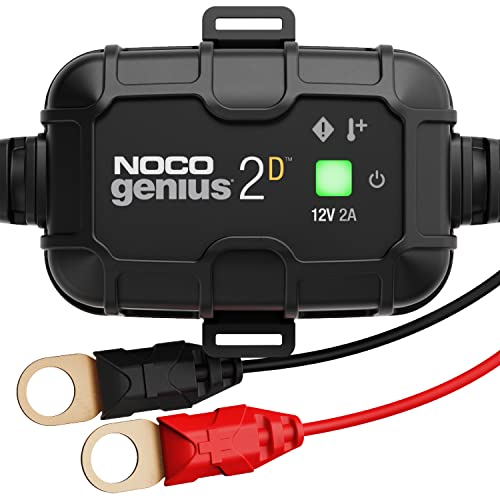
Best for space-limited installations on boats needing a compact, intelligent charger. The GENIUS2 covers both 6V and 12V batteries, with precision charging and a temperature-compensated algorithm. It introduces Force Mode to charge low-voltage batteries even when sensing fails, which can be useful in tight engine compartments where battery temperatures vary widely.
- Best for: Owners seeking a compact, efficient on-board charger for a single battery bank.
- Why chosen: Versatile 6V/12V support and an advanced Force Mode for stubborn batteries.
- Caution: Force Mode bypasses some sensing features; use as directed for best results.
MOTOPOWER MP00205A: 12V 800mA Automatic Battery Charger

Best for budget-minded boaters needing a reliable desulfator and maintainer. The MP00205A handles 12V lead-acid, including flooded, AGM, and gel cells, with automatic desulfation and a spark-free standby. It’s ETL listed for safety and provides automatic shutoff when the battery reaches full charge.
- Best for: Entry-level maintenance on boats with 12V lead-acid batteries.
- Why chosen: Combines charger, maintainer, and desulfator at a lower price point.
- Caution: Lower current may mean longer charging times for larger batteries.
NOCO GEN5X2: 2-Bank Onboard Charger

Best for boats with more than one battery needing independent charging. The GEN5X2 features two banks with a total of 10 amps (5A per bank). Each bank can be configured for 12V lead-acid or 12V lithium, with a dedicated repair mode. Temperature compensation ensures safe operation in varying marina climates.
- Best for: Multibank marine systems requiring separate health and charge status for each battery.
- Why chosen: Independent banks, flexible modes, and robust temperature control.
- Caution: Slightly larger than single-bank units; ensure mounting space is adequate.
Buying Guide: Trickle Chargers For Boat Batteries
What battery types do you need to support?
Many boaters use a mix of lead-acid variants (AGM, Gel, flooded) and LiFePO4. Choose a charger that explicitly lists compatibility with your battery chemistry and voltage. Temperature compensation is especially helpful in sun-drenched decks and shaded docks alike.
Do you need one bank or two?
Single-bank units are common for small boats and storage lockers. For boats with dual starting and house batteries, a two-bank charger (or two separate units) can simplify maintenance and prevent cross-influence between batteries.
How much charging current is needed?
For typical marine batteries, 0.1C to 0.2C charging current is common for trickle maintenance. For a 100Ah battery, 1A–2A maintenance is usually sufficient. Higher amperage is useful for faster top-ups but may require more space and robust installation considerations.
Is desulfation important?
Desulfation can help restore older lead-acid batteries by reducing sulfation. If your batteries sit unused for long periods, look for a unit with a desulfation function. Note that LiFePO4 batteries do not require desulfation in most cases.
Safety features to look for
- Overcharge protection and automatic shutoff when full
- Temperature compensation to adapt charging to ambient conditions
- Reverse polarity protection and short-circuit safeguards
- Fireproofing and spark-free connections
What about on-board vs. portable?
On-board (hardwired) chargers offer a clean, permanent setup suitable for boats with accessible mounting points. Portable units are flexible for seasonal boats or multiple vessels. Your choice depends on installation ease and space in the bilge or cabin.
Caveats and limitations to note
- Some devices cannot revive completely dead (0V) batteries without initial repair steps.
- Very high charging currents can cause overcharging if the battery is small or poorly ventilated.
- Always confirm compatibility with specific battery models before connecting to avoid compatibility issues.
What makes these options stand out for boat use?
These models emphasize marine-friendly design, temperature-aware charging, and desulfation to help extend battery life under boat storage and runtime conditions. They balance price, functionality, and ease of installation to suit a broad range of vessels and battery chemistries.
FAQ
- Q: Can I use a trickle charger on lithium batteries? A: Yes, if the charger explicitly supports lithium (LiFePO4) chemistry and provides appropriate charging profiles.
- Q: What’s the difference between a trickle charger and a maintainer? A: A trickle charger provides a small, constant charge; a maintainer actively manages the battery to keep it at peak voltage without overcharging.
- Q: Do these units require professional installation? A: Most portable models do not; onboard or direct-mount chargers may require basic electrical wiring and mounting hardware.
- Q: Can these chargers recharge a totally dead battery? A: Some can, but several models perform best after a partial restore; check the product’s recovery notes.
- Q: Are these chargers safe for marine environments? A: All listed units are designed for electrical safety and marine use, with features like spark-free and temperature-compensated charging.