Yes, thru-hull depth sounders provide reliable depth readings with solid hull compatibility. This guide highlights five top options, outlining who they’re best for, key features, and practical trade‑offs. Ideal buyers include anglers needing fast, accurate readouts, boaters with fiberglass hulls, and skippers seeking loud alarms and temperature data. The summary table below compares core specs at a glance to help with quick decisions.
| Product | Best For | Key Benefit | Notes |
|---|---|---|---|
| DepthTrax 2B Boat Mount in Dash Digital Depth Finder | Large boats needing vivid display | Up to 600 ft depth with 200 kHz transducer | Includes dual transducer options |
| Faria 13795 Chesapeake Thru-Hull | Easy readability in any condition | Oversized back-lit display | Thru-hull installation |
| Faria 13751 Chesapeake Black Depth Sounder | Classic in-hull compatibility | 199 ft depth, standard gauge hole | In-hull transducer option |
| HawkEye DT2BX-TM In-Dash | All-season temp data with depth | 2.5–600 ft depth range, audible/LED alarms | Includes transom mount transducer |
| HawkEye DT2BX-TH In-Dash | Thru-hull with temp sensing | Temp thru hull transducer included | Requires 2″ hull hole |
DepthTrax 2B Boat Mount in Dash Digital Depth Finder

The DepthTrax 2B delivers continuous depth readings from 2.5 to 600 feet on a large in-dash display and supports speeds up to 60 mph. It uses a 200 kHz transducer and offers dual mount options (transom or glue-in) suitable for fiberglass hulls and even up to 1/8-inch aluminum hulls. A 3‑stage Advanced Warning System provides audible alarms, a bright LED warning, and LCD indicators for quick alerts. Best for boats that require a clear, high-contrast display and flexible mounting.
Best for: anglers and skippers who need rapid, prominent depth data with strong alarms on larger vessels. Caution: ensure hull compatibility with the transducer mounting method chosen.
Faria Beede Chesapeake Depth Sounder Thru-Hull – Black SS, 2″

The Faria 13795 Chesapeake Thru-Hull features an oversized, back-lit display designed for easy readability in varied lighting. It includes audio and visual alarms for depth elevation, making it a strong option for boats where visibility is crucial. This model emphasizes straightforward operation and reliable alarms for depth changes, making it suitable for casual and recreational boaters who want clear, simple depth readings.
Best for: skippers who prioritize legible, large displays and reliable alarms in a classic thru-hull package. Caution: as a thru-hull unit, installation requires precise hull penetration and sealing.
Faria 13751 Chesapeake Black Depth Sounder with In-Hull Transducer

This model offers a 1-year depth range up to 199 feet and fits a standard 22-1/16″ gauge hole, making it a practical choice for existing gauges and installations requiring standard dimensions. In-hull transducer reduces drag and protects the transducer in hulls where thru-hull mounting is less desirable. Best for: boats needing a reliable depth read with a standard gauge hole fit and a compact footprint. Caution: limited depth range compared to deeper models.
HawkEye DT2BX-TM In-Dash Depth Sounder With Transom Transducer
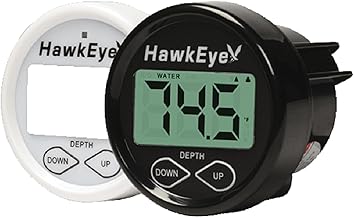
The DT2BX-TM provides uninterrupted depth readings from 2.5 to 600 feet on a large dash display, with a 3-stage Advanced Warning System including audible alarm and LED indicators. It includes a transom-mount temperature transducer with 30 feet of cable, delivering both depth and temperature data in one unit. Best for: buyers who want integrated depth and water temperature with a robust alarm system on mid-size to large boats. Caution: installation varies by boat type; ensure transom transducer mounting is compatible with hull design.
HawkEye DT2BX-TH In-Dash Depth Sounder with Thru Hull Transducer
This version includes a thru-hull transducer and temperature sensing, delivering instant depth updates plus air and water temperatures. The transducer requires drilling a 2″ hole in the hull, which should be planned with care. Best for: boats that prefer thru-hull installation combined with temperature data for environmental awareness. Limitation: requires hull penetration and proper sealing during installation.
Buying Guide
What to consider when choosing a thru-hull depth sounder:
- Depth range: Most readers benefit from 200–600 ft range; deeper readings support larger bodies of water.
- Transducer type: Thru-hull generally offers strong signal in fiberglass hulls; in-hull transducers can simplify installation but may affect hull integrity.
- Display readability: Oversized, back-lit displays improve visibility under sunlight and rough conditions.
- Alarms and alerts: Look for audible alarms, LED indicators, and muting options to respond quickly to depth changes.
- Temperature data: If you need water and/or air temperature, choose models with temp sensors and appropriate transducers.
- Installation implications: Thru-hull requires hull penetration; ensure you have needed tools, seals, and clearances.
- Power and mounting: Verify power requirements and whether dash or transom mounting better suits your vessel and cockpit layout.
FAQ
- What is a thru-hull depth sounder?
A depth sounder that uses a transducer mounted through the hull to measure water depth and transmit data to a display.
- How deep can these units read?
Most models cover from 2.5 feet up to 600 feet, depending on transducer frequency and hull conditions.
- Do these units include temperature sensing?
Several models offer air and water temperature data via transducers or integrated sensors.
- Is hull drilling required for all thru-hull models?
Yes, thru-hull installations typically require drilling; some models use transom mounts or in-hull transducers as alternatives.
- Which is best for a fiberglass boat?
Thru-hull and transom-mount options designed for fiberglass hulls provide reliable depth readings; choose based on mounting feasibility and maintenance preferences.
- What should I consider about alarms?
Look for multi‑stage alarms (audible, visual LED, LCD indicators) and muting options to manage readings without distraction.