Answering the need for reliable, easy-to-use marine radios, this guide highlights five practical Standard VHF choices and a few top alternatives. These models suit boaters needing handheld portability, fixed-mount reliability, or GPS-enabled safety features. The list focuses on waterproof ratings, ease of use, and essential features like weather bands, GPS, and AIS integration. Ideal buyers include recreational sailors, anglers, and coastal cruisers seeking dependable communication without unnecessary complexity.
| Product | Best For |
|---|---|
| Standard Horizon HX210 6W Floating Handheld | Portables, emergency use, small boats |
| Standard Horizon GX1800G Fixed Mount with GPS | Newer fixed-mount systems, integrated GPS |
| Fixed Mount VHF/GPS/AIS/NMEA2000 | Advanced data sharing, AIS needs |
| Standard Horizon HX210 Compact Floating | Compact handheld with WX/FM receive |
| Cobra MR F77W GPS Fixed Mount | GPS-ready, wider coverage |
Standard Horizon HX210 6W Floating Handheld VHF Transceiver

The HX210 is a 6W handheld VHF with a floating, submersible design (IPX7). It includes a water-activated emergency strobe, an oversized dot-matrix display, and an easy-to-operate E20 menu. This model suits boaters who need a reliable handheld for dinghy trips, night runs, or back‑up safety communications. Best for small craft and emergency readiness, it provides basic VHF channels plus a built‑in FM broadcast receiver for weather-band awareness. A potential limitation is the fixed 3-year waterproof warranty window and the lack of built-in GPS. Choose this if you value portability, quick access, and a visible display in rough conditions.
Standard Horizon GX1800G Fixed Mount VHF w/GPS – White
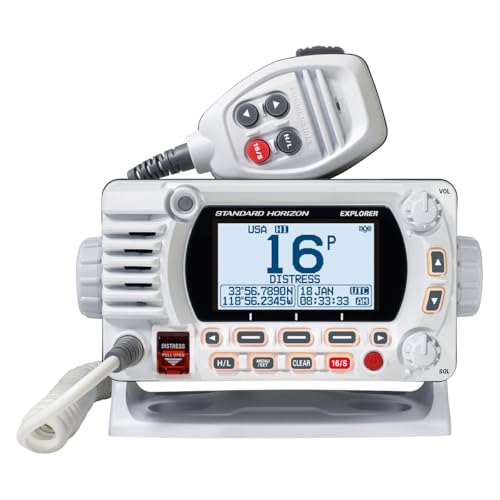
The GX1800G is a fixed-mount VHF radio with GPS capabilities, designed for larger boats needing reliable, constant access to VHF communications and location data. This model is best for owners who want an integrated navigation data stream and simple interface for daily use. Its fixed-install design improves antenna stability and reduces handling risk. A noted limitation is that setup and mounting will require basic installer know-how. Choose this if you want a steady fixed unit with built-in GPS and straightforward operation for regular coastal or offshore use.
Fixed Mount VHF/GPS/AIS/NMEA2000

This fixed-mount option emphasizes data sharing, with AIS and NMEA2000 integration for enhanced situational awareness and navigation. It suits boats that require current location data to be shared across devices and a robust fixed installation. The main limitation is the complexity of wiring and network configuration for AIS/NMEA2000 features. Choose this if you need reliable, network-ready communications with enhanced safety data exchange on larger vessels.
Standard Horizon HX210 6W Floating Handheld Marine VHF Transceiver
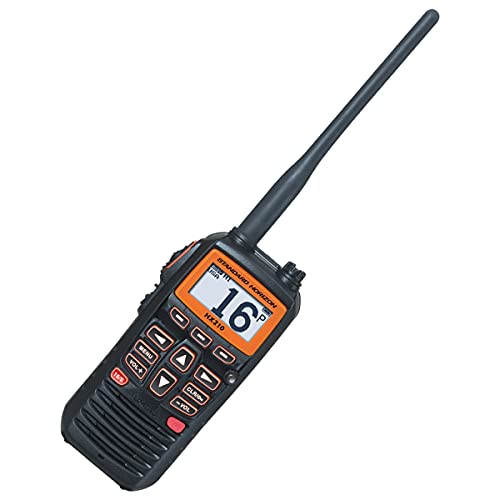
This HX210 variant emphasizes portability with a compact, floating form factor and an emergency strobe. It offers 6W/2.5W/1W selectable output power, an FM broadcast receiver, and a weather channel capability. Best for boaters who need a compact, rugged handheld for transient use on smaller craft. A possible drawback is that, with handheld operation, reach might be shorter than fixed-mount options in remote areas. Choose this for flexible, all‑around handheld performance on small-to-medium boats.
Standard Horizon HX210 HX210 6W Compact Floating Marine Handheld Vhf

This HX210 variant mirrors the compact floating design with a three-year waterproof warranty, water-activated emergency strobe, and an oversized display. It includes a wide reception range from 76 MHz to 108 MHz for WX and FM radio bands, plus selectable power for efficiency. It’s best for users who prioritize a robust, easy-to-see interface and reliable floating capability in a compact body. Avoid this if you need GPS or AIS data directly on the handheld, as those features are not listed here.
Buying Guide
Key considerations when selecting a standard VHF marine radio:
- Portability vs. fixed installation: Choose handhelds for versatility and emergency use; fixed mounts for stable, continuous access and data integration.
- Waterproofing and durability: Look for IPX7 or higher for confidence in rough seas and immersion scenarios.
- GPS, AIS, and NMEA2000: Built-in GPS improves distress signaling; AIS and NMEA2000 enable broader vessel data sharing and navigation integration.
- Power output and modes: Higher wattage provides longer range, but ensure the unit supports selectable power to save battery life on handhelds.
- Weather and weather-band access: WX channels and NOAA weather alerts are valuable safety features on marine radios.
- User interface: An oversized display and simple menus help reduce confusion in critical moments.
Frequently Asked Questions
- What is the difference between a handheld and fixed-mount VHF radio?
– Handhelds offer portability and backup capability; fixed mounts provide constant access and stable integration with other navigation equipment. - Do all marine radios include GPS?
– Not all do. Some fixed-mount models include GPS, while handhelds may rely on separate GPS devices or lack built-in GPS. - Is IPX7 waterproofing enough for ocean use?
– IPX7 covers immersion up to 1 meter for 30 minutes; it’s generally suitable for regular marine use, but always inspect seals after exposure to saltwater. - Should I choose AIS/NMEA2000 compatibility?
– AIS/NMEA2000 is beneficial for ships needing integrated data sharing across devices and better collision avoidance awareness. - What should I consider about power output?
– Higher watts extend range but consume more power; many handhelds offer 6W with lower alternatives for longer battery life. - Are there safety features I should look for?
– Water-activated emergency strobe lights, weather bands, and easy-to-use menus can enhance safety in emergencies.