The best solar system for boats combines reliability, ruggedness, and marine-grade protection. This guide highlights five top options suited for boats, yachts, and watercraft, helping you choose based on battery type, durability, and charging performance. Ideal buyers include weekend boaters needing a low-maintenance trickle charger, long-range sailors seeking dependable off-grid power, and anyone upgrading from lead-acid to lightweight LiFePO4 systems.
Summary table of chosen products
| Product | Best For | Key Benefit |
|---|---|---|
| SOLPERK Solar Panel Kit 20W 12V | Small boats, trailers, RVs | Smart MPPT controller with high efficiency |
| Voltset 12V Solar Battery Charger | Cars, RVs, boats, trailers | Smart MPPT, universal 12V compatibility |
| Renogy 200W Solar Panel Kit | Power-hungry boats, larger systems | Expandable, efficient PWM controller option |
| 12.8V 100Ah LiFePO4 Battery | Long off-grid runs, trolling motors | High cycle life, built-in BMS |
| ECO-WORTHY 260W Kit | Flexible mounting, uneven surfaces | High daily output with flexible panels |
SOLPERK Solar Panel Kit 20W 12V
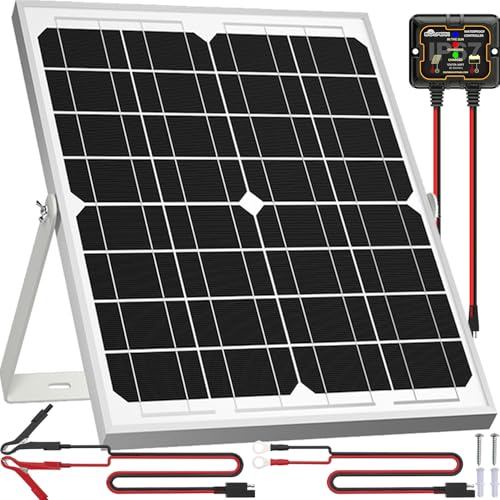
Best for compact vessels and light-duty charging, this kit includes a 20W monocrystalline panel with an 8A smart MPPT controller and an adjustable mounting bracket. It supports 12V batteries such as LiFePO4, Lithium-Ion, AGM, and more, making it suitable for small boats, trailers, and marine applications where space is limited.
Why it’s selected: The high conversion rate (21%-30% cell efficiency) and waterproof, rustproof build ensure reliable performance in marine environments. The three-stage smart charging minimizes overcharge risk and supports a range of battery chemistries, which is advantageous for owners upgrading to modern batteries.
Best for: Boat owners needing a compact, all-in-one charging solution with robust weather resistance. Choose this if you have limited space and want a straightforward install for maintaining a 12V lead-acid or LiFePO4 battery.
Caution: The kit’s 20W rating provides modest daily output; avoid relying on it for heavy daily power draw on larger vessels or high-amp appliances.
Voltset 12V Solar Battery Charger – 20W

This 20W panel with smart MPPT tracking is designed for universal 12V battery charging. It’s a versatile choice for cars, RVs, boats, and trailers, offering faster charging and better efficiency in varied sunlight. The built-in protection features help prevent overcharge, over-discharge, and short circuits, while preventing battery drain at night.
Best for: Boat owners seeking a dependable trickle charger that can adapt to multiple 12V battery chemistries, including LiFePO4 and AGM, without requiring frequent panel adjustments.
Limitations: While powerful for a small system, it may not fully recharge large battery banks on days with limited sun. Use as part of a larger charging strategy for bigger power needs.
Renogy 200 Watt Solar Panel Kit

The Renogy 200W kit targets larger off-grid needs on boats, campers, and trailers. It includes two 100W panels and a PWM charge controller, with expansion potential up to 400W by adding more panels. Its design supports secure mounting and easy integration with existing 12V systems, making it a solid choice for higher daily energy needs.
Best for: Boats requiring substantial off-grid power or future expansion. If planning to power refrigeration, lighting, and auxiliary systems, this kit scales with your energy demand.
Limitation: PWM controllers are less efficient than MPPT in extreme partial sunlight; pairing with a robust battery bank helps mitigate efficiency gaps in certain conditions.
12.8V 100Ah LiFePO4 Deep Cycle Battery

This LiFePO4 deep-cycle battery delivers long life and high cycle stability, ideal for marine use where space and weight matter. It features a built-in 100A BMS for protective monitoring and a robust 1280Wh capacity, suitable for extended off-grid periods on boats and trolling motors.
Best for: Vessel owners moving away from lead-acid to LiFePO4 for longer trips, better safety, and lighter weight. The integrated BMS simplifies management and protection on board.
Limitation: Ensure proper venting and installation space to maximize protection and leverage the BMS features effectively in marine environments.
ECO-WORTHY 260W Flexible Solar Kit

This kit combines two 130W flexible mono panels with a 30A charge controller, designed for uneven or curved surfaces common on boats and RVs. The flexible panels offer mounting versatility and reduced weight, improving installation options on decks, cabins, or curved hull surfaces.
Best for: Boats needing flexible, lightweight solar solution with strong daily output, and where conventional rigid panels do not fit the mounting area. Choose this for curved or irregular mounting spots.
Limitations: Flexible panels can be more susceptible to micro-cracks over time; ensure careful handling and protective mounting to maximize lifespan.
Buying Guide
What size system do you need for a boat?
Assess daily power usage, including lights, GPS, radios, refrigeration, and trolling motors. For small boats with minimal loads, a 20–60W panel plus a 12V battery may suffice. Larger boats with refrigeration or long periods at anchor benefit from 100–200W or more, with a battery bank sized to match daily energy draw.
Should you use MPPT or PWM controllers?
MPPT controllers maximize conversion efficiency, especially in irregular sunlight or partial shading, and are preferable for boats where roof space is limited or sun exposure varies. PWM controllers are simpler and cost-effective for basic setups with modest power needs.
Battery chemistry matters
LiFePO4 offers longer life, lighter weight, and better durability in marine environments, but costs more upfront. AGM and Flooded lead-acid are cheaper and forgiving but heavier and require more maintenance. Match battery chemistry to your power needs and budget, ensuring the charging system supports the chosen chemistry.
Weather and mounting considerations
Marine environments demand corrosion resistance, IP-rated hardware, and secure mounting. Consider panels with waterproof enclosures, corrosion-proof frames, and sturdy mounting brackets. Flexible panels are useful on curved surfaces, while rigid panels can offer easier cleaning and maintenance.
Expansion and future-proofing
Choose systems that allow easy expansion: add more panels or upgrade controllers without replacing major components. A modular approach helps adapt to evolving power needs from weekend trips to extended voyages.
FAQ
- Can I power a boat’s fridge with a 20W panel? A 20W panel generally cannot sustain a full boat fridge long-term; it’s best used for charging small batteries or maintaining charge during short trips. Consider larger arrays or battery storage for fridge usage.
- Is LiFePO4 worth the extra cost for boating? LiFePO4 offers longer life, lighter weight, and better high-discharge performance, which can justify the upfront cost for frequent or long-term use on water.
- Do I need a charge controller for every panel? A charge controller is recommended to protect batteries and optimize charging. For multi-panel setups, a single MPPT controller rated for total amperage can manage the array efficiently.
- Can I install solar panels on a boat without professional help? Simple, small setups can be DIY if you follow safety guidelines, use marine-rated components, and securely mount panels to withstand waves and wind.
- What maintenance do marine solar systems require? Regularly inspect connections for corrosion, clean panels to remove salt and grime, and check the BMS and wiring for wear in a marine environment.