If you need a compact, reliable battery for a trolling motor, these five options provide a range of chemistries, capacities, and weights to fit little boats, kayaks, or compact craft. The list highlights best uses, such as lightweight LiFePO4 for easy handling or higher-capacity packs for longer outings. Read on to compare which battery type is best for your trolling motor, and why each was selected for specific boating needs.
| Product | Brand | Capacity | Chemistry | Best For |
|---|---|---|---|---|
| Newport 12V50Ah Deep Cycle | Newport Vessels | 50Ah | AGM Lead-Acid | Mid-range power, durable and sealed |
| Lampword 12V 15Ah LiFePO4 | Lampword | 15Ah | LiFePO4 | Very lightweight, quick charging |
| ERYY LiFePO4 12V 25Ah | ERYY | 25Ah | LiFePO4 | Balanced weight and capacity |
| Renogy 12V 20Ah LiFePO4 | Renogy | 20Ah | LiFePO4 | Half-weight lead-acid replacement |
| SUPER EMPOWER 12V 100Ah LiFePO4 | SUPER EMPOWER | 100Ah | LiFePO4 | Long endurance, home energy and trolling motor |
Newport 12V50Ah Deep Cycle AGM Battery

The Newport 12V50Ah Deep Cycle Battery is a sealed AGM lead-acid option that combines durability with light weight for a battery of this class. It weighs about 32 lbs, making it easier to transport and install on a small boat. The sealed construction provides leak-proof operation, which is a key advantage for cramped bilge spaces. This battery is explicitly described as trolling motor compatible, offering steady, reliable power for casual to moderate boating sessions. A potential limitation is that it remains heavier than lithium options, which matters for ultra-light builds or solo paddlers.
Lampword LiFePO4 12V 15Ah Battery

This Lampword battery uses LiFePO4 chemistry, offering higher energy density with a third of the volume and weight of comparable lead-acid packs. It features fast charging and a broad operating temperature range, with 2000—4000+ cycles depending on DOD. The built-in safety note highlights care to parallel or series-connect multiple units for higher voltage or capacity. It’s ideal for lightweight setups or small trolling motors, but note that multiple units may be required to meet higher voltage needs.
ERYY LiFePO4 12V 25Ah Battery

The ERYY 12V 25Ah LiFePO4 pack pairs a smart BMS with high-grade cells to deliver 5,000+ cycles at 100% DOD and up to 10 years of life. It’s lighter and smaller than lead-acid alternatives, offering excellent portability for compact boats. The product notes emphasize expandability up to 4P4S configurations for higher voltage systems, which is useful for larger trolling motors or multi-device setups. Limitations include the need for appropriate charging equipment compatible with LiFePO4 chemistry.
Renogy 12V 20Ah LiFePO4 Battery
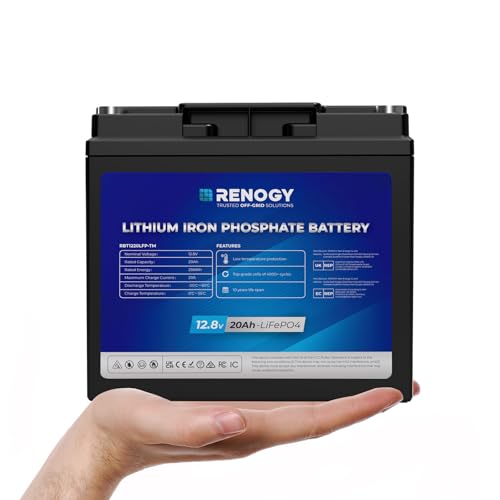
Renogy’s 12V 20Ah LiFePO4 battery is marketed as a half-weight, longer-running replacement for 20Ah lead-acid batteries, with 20+ built-in BMS protections including low-temperature cut-off. It’s well-suited for small trolling motors where weight savings and extended runtime matter. Best for paddlers or boats needing a compact, safe, and efficient lithium option. A caution is to verify compatibility with your trolling motor’s voltage and BMS requirements before purchase.
SUPER EMPOWER 12V 100Ah LiFePO4 Battery

The 100Ah option from SUPER EMPOWER provides substantial continuous power for longer trolling sessions, RV or off-grid use, and other power-hungry devices on board. It features LiFePO4 cells with an integrated BMS for overcharge, over-discharge, and temperature protection. It’s best for users who need a high-capacity, longer-lasting battery in a compact footprint. The trade-off is that it’s heavier and higher in initial cost than smaller capacity models, though it delivers extended runtime.
Buying Guide
- Determine your boat’s power needs: How long you want to run the trolling motor between charges guides capacity choice. For small craft, 15–50Ah is common; for longer trips, 60–100Ah or more is typical.
- Choose chemistry based on weight and maintenance: LiFePO4 offers higher energy density, longer life, and lighter weight than AGM lead-acid, but at a higher upfront cost. AGM is robust and maintenance-free but heavier.
- Assess charging equipment: LiFePO4 requires compatible chargers and BMS compatibility. Ensure your charger, solar setup, and boat electronics support the battery’s chemistry.
- Consider size and fit: Battery dimensions and the mounting space on your boat matter. LiFePO4 options can be more compact for the same capacity.
- Plan for expansion: If upgrading later, check whether the pack supports parallel/series configurations to reach higher voltage or capacity.
FAQ
- What is the lightest trolling motor battery option?
LiFePO4 packs are typically lighter than AGM for the same capacity, with good weight savings highlighted in multiple models listed above. - Do I need special chargers for LiFePO4 batteries?
Yes. Use a charger compatible with LiFePO4 chemistry and follow BMS guidance to prevent overcharge or overheating. - Can I connect multiple batteries for higher voltage?
Many LiFePO4 packs support series or parallel connections when using identical cells and a compatible BMS. - Is a higher Ah rating always better for trolling motors?
Higher Ah extends runtime but increases weight and cost. Match capacity to your typical outing duration and boat weight. - What safety features should I look for?
Built-in BMS protection, short-circuit protection, and temperature monitoring are important for reliable operation on water. - Are LiFePO4 batteries suitable for saltwater boats?
Yes, provided the case is corrosion-resistant and connections are well-protected; ensure proper storage and maintenance.