Finding the right small gas motor for a compact boat requires balancing power, weight, and reliability. This guide highlights five compact outboards suited for dinghies, inflatable boats, kayaks, and small fishing craft. Each option is explained for who it’s best for, plus quick trade-offs to help you decide. Whether you need lightweight portability, stronger thrust, or easy maintenance, you’ll see how these engines compare for common boating needs.
| Product | Best For | Key Benefit |
|---|---|---|
| YIYIBYUS 2.3HP 52CC | Lightweight inflatables and dinghies | High RPM range for quick acceleration |
| Gosangom 3.5HP 2-stroke | Small boats needing more punch | Efficient fuel use with compact build |
| HinLIaDa 2.3HP 52CC | Budget-friendly, easy steering | Low weight with strong efficiency |
| CUKUSIN 4HP 4-stroke | Inflatables and kayaks with smoother operation | Four-stroke reliability and quiet running |
| BJTDLLX 6HP 2-stroke | Faster boats needing more thrust | Robust cooling and 360° steering |
The following sections compare each product directly. Use the quick flags “best for,” “better for,” and “choose this if” to pick the right engine for your craft and conditions.
YIYIBYUS 2.3HP 52CC Outboard Motor

Best for: lightweight inflatable boats and small dinghies that require easy handling. This 52cc, 2-stroke engine delivers 1.7 kW (2.3 HP) with a wide operating speed range of 4500–8500 rpm, supporting quick starts and responsive acceleration. It uses a 25:1 fuel mix and an 850 ml fuel tank for short trips. The unit’s aluminum and PP construction offers corrosion resistance and durability in varied water conditions. It’s a good choice when you want a portable motor that’s simple to store after use.
Caution: As a 2-stroke, fuel efficiency might be lower than modern 4-stroke counterparts, and mixing fuel requires care to avoid engine damage.
Gosangom 3.5HP 2-Stroke Outboard

Best for: boats that need extra thrust without upgrading to a larger engine. This 3.5 HP model uses a lightweight aluminum alloy with corrosion resistance suitable for both freshwater and saltwater use. It reaches up to 5,000 rpm with a compact 21.6 lb weight and a 6.7″ three-blade propeller that reduces water resistance for better efficiency. A practical option for frequent short trips where portability matters.
Caution: Being a 2-stroke, you’ll still need to monitor fuel mix and maintenance to avoid performance dips over time.
HinLIaDa 2-Stroke 2.3HP Outboard
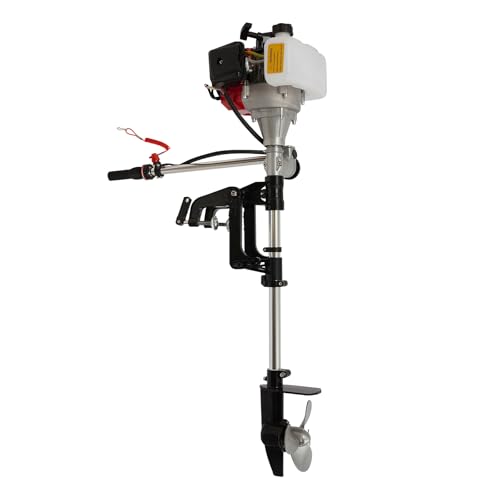
Best for: budget-conscious buyers seeking dependable, compact power for inflatable or small fishing boats. This 52cc, 2-stroke engine delivers 1.7 kW and operates at 4500–8500 rpm, providing solid performance for small craft. The design emphasizes easy steering with a steering angle greater than 120°, making maneuvering in tight spaces more convenient. Lightweight materials aid in handling and storage.
Limitation: As with other 2-stroke engines, fuel efficiency and oil mixing require attention to maintain peak performance.
CUKUSIN 4 Stroke 4HP Outboard

Best for: inflatable boats and kayaks that demand smoother operation and better reliability. This 4-stroke, 4 HP engine includes an air-cooling system, improved heat dissipation, and a user-friendly throttle with reverse capability. The 15 kg weight makes handling easier during installation and removal. The motor suits users who value quiet operation and reduced maintenance complexity compared to two-stroke models.
Limitation: Four-stroke engines can be bulkier and heavier than equivalent two-stroke options, and some users may notice slightly slower acceleration on very light craft.
BJTDLLX 6HP 2-Stroke Outboard

Best for: faster boats or those needing more reliable thrust in choppier water. The 6 HP, 2-stroke engine includes a water-cooling system and CDI ignition, with a short shaft suitable for compact setups. It offers 360° steering rotation for versatile maneuvering and a robust aluminum build for corrosion protection. This option is appropriate when more torque and speed are essential for getting through rough water or pulling heavier loads for your craft.
Limitation: Higher power 2-stroke models typically require attentive fuel mixing and more routine maintenance to sustain peak performance.
Buying Guide: Small Gas Outboard Motors For Your Tiny Vessel
- Power needs vs. boat size: Match horsepower and shaft length to your boat’s weight, hull type, and typical load. Lighter inflatables benefit from 2–3.5 HP, while heavier small boats may justify 4–6 HP for better planing and speed.
- Two-stroke vs. four-stroke: Two-stroke engines are lighter and often deliver quicker throttle response, but require fuel mixing and can be less fuel-efficient. Four-stroke engines tend to be quieter, cleaner, and easier to maintain, though they may be heavier.
- Fuel system and maintenance: Consider fuel tank size, ease of fueling, and whether the engine requires premixing oil. Look for simple carburetor access and readily available spare parts.
- Durability and materials: Aluminum and corrosion-resistant housings extend life in saltwater and brackish environments. A short shaft fits smaller dinghies, while longer shafts suit boats with higher transoms.
- Steering and control: Engines with broader steering angles or 360° capability improve maneuverability in tight spaces. Manual reverse helps in docking scenarios.
- Weight and portability: For packable options, lighter models around 20–25 lb are easiest to transport and mount on small vessels.
Frequently Asked Questions
- What size engine is best for a small inflatable boat? A 2.3–3.5 HP 52cc engine is typically suitable for most small inflatables, providing adequate thrust without overloading the hull.
- Are four-stroke motors worth the extra weight? Yes for quieter operation and easier maintenance, especially if you spend long hours on the water.
- How important is shaft length? Short shafts fit most dinghies and inflatable boats with low motors, while longer shafts are needed for higher transoms to avoid cavitation and prop strike.
- Do two-stroke engines require more maintenance? They require fuel-oil premixing and more frequent carburetor checks, but can offer lighter weight and quicker throttle response.
- Is corrosion resistance important for saltwater use? Yes; engines with aluminum housings and corrosion-resistant coatings last longer in saltwater environments.
- Can I use these on a kayak? Some compact outboards are suitable if designed with appropriate shaft length and weight balance for kayaks used with lightweight gear.