Answers to the most common buyer questions about converting a 30A shore power outlet to standard 110V household outlets. These adapters are best for RV owners, boaters, and outdoor enthusiasts who need simple, portable access to 110V power from a 30A generator or shore power source. This guide highlights five reliable options and clarifies who each is best for, along with practical considerations.
Quick comparison of chosen products
| Product | Best For | Notes |
|---|---|---|
| MECMO Shore Power NEMA L5-30P to 5-15/20R | RV and marine users needing three regular outlets | 3-prong household outlets from a locking power source |
| ADCAUDX 1FT 30-Amp to 15-Amp | Compact, light-duty charging and light tools | 10AWG wiring, built-in adaptability to 15A/30A |
| CORDMITPRO 30A to 110 Adapter | Emergency power, tools, lighting with built-in protection | 3x 5-15/20R outlets, built-in circuit breaker |
| MECMO 3X 5-15R/5-20R | Large 110V access for RVs or generators | Three 5-15/5-20R receptacles |
| LBSC 30 Amp to 110 Adapter | Versatile outdoor and job-site power | Stable twist-lock to household outlets |
MECMO Shore Power NEMA L5-30P to 5-15/20R

This adapter converts a NEMA L5-30P locking dock power connector to a set of three standard 120V household outlets (5-15R/5-20R). It is rated for 30A at 125V (about 2500W), making it suitable for RVs, marine shore power, and generators that use a twist-lock feed. Best for RVs that need multiple household outlets from a single locking power source. A potential limitation is that it does not convert to a single high-current 15A/20A outlet; it provides three standard receptacles instead.
Who it’s best for: RV travelers who want convenient, three 120V outlets from their L5-30P shore or generator connection. Better for those who value three outlets rather than one high-current outlet.
ADCAUDX 1FT 30-Amp to 15-Amp Marine & RV-Adapter Cord

This 1-foot adapter converts a 30A L5-30P male into a single 15A (5-15) or 20A (5-20) female, plus a 30A twist-lock RV receptacle. It uses 10 AWG conductors and STW jacket for durability. It’s ETL Listed and designed to support common 15A/20A devices when charging RVs or running tools during outdoor activities or outages. A limit is that the adapter’s maximum output matches the lowest linked receptacle (often 15A) when used with certain appliances.
Who it’s best for: RV owners who need a compact, lightweight pigtail that can feed a standard 15A/20A outlet from a 30A twist-lock source. Choose this if you want flexibility of 15A or 20A connections from one cord.
CORDMITPRO 30 Amp to 110 Adapter
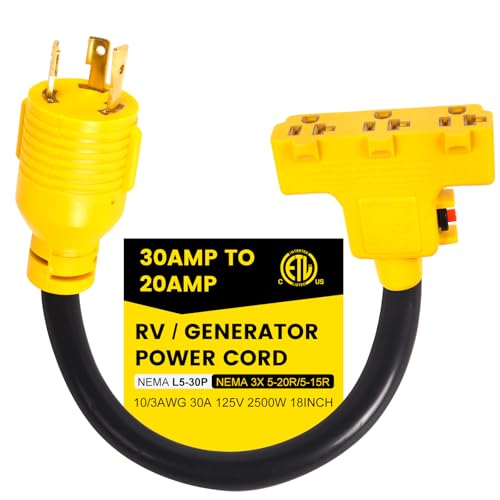
This versatile adapter converts a 30A L5-30P locking feed into three 5-15R/5-20R household outlets. It includes a built-in circuit breaker for overload protection, enhancing safety during power outages or outdoor work. It uses heavy-duty copper wiring and a robust jacket designed to resist abrasion, heat, oil, and moisture. A limitation is that continuous high-load use near the 30A/125V limit may warm the cord; avoid long-term maximum loads on all three outlets simultaneously.
Who it’s best for: Outdoor crews, campers, or homeowners who need a safer, three-outlet solution with added overload protection. Choose this if you expect to power multiple smaller devices at once and value built-in breaker protection.
MECMO Shore Power NEMA L5-30P to 3X 5-15R/5-20R
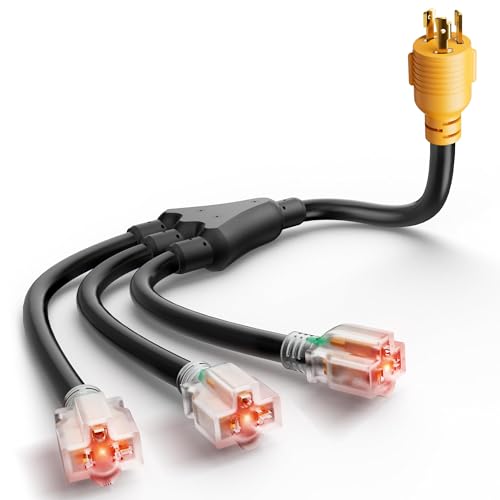
This model provides three household-style outlets from one L5-30P, effectively distributing power to multiple devices. Rated for 20A at 125V (approximately 2500W), it is well-suited to RVs, generators, and marine shore power where several 15A/20A loads are needed. It’s a practical pick for people who want more than one household outlet from a single lockable inlet. A potential drawback is the 20A rating of the three outlets combined, which may limit simultaneous high-load use.
Who it’s best for: RVs or marine setups requiring multiple 15A/20A outlets from a single locking connection. Choose this when you need several small devices powered at once and prefer straightforward three-outlet distribution.
LBSC 30 Amp to 110 Adapter
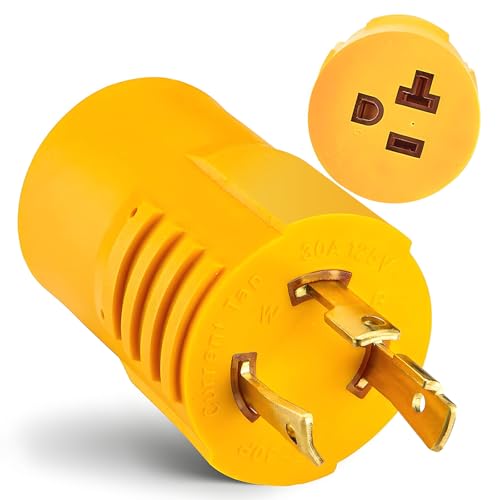
The LBSC adapter converts a 30A twist-lock L5-30P to a standard NEMA 5-15/5-20R outlet pair. It’s designed to maximize generator efficiency by translating 30A/125V input into household outlets, making it suitable for a wide range of devices. The three-prong twist-lock design ensures a stable connection to the generator or shore power. A consideration is that the device emphasizes versatility over high-current loads on a single outlet pair.
Who it’s best for: Outdoor hobbyists and job-site users who need reliable conversion from a generator outlet to standard household receptacles. Choose this if you prioritize a stable connection and broad compatibility with household devices.
Buying Guide
What to consider when choosing a shore power adapter
- Electrical rating: Ensure the adapter matches your source (commonly 30A, 125V) and your devices’ wattage. Do not exceed the rated capacity.
- Number and type of outlets: Decide whether you need one, two, or three 15/20A outlets, or a mix with a single 30A inlet. Consider future power needs.
- Cord construction: Look for heavy-gauge conductors (10 AWG or better), robust jackets, and weather-resistant materials for outdoor use.
- Safety features: Built-in circuit breakers or overload protection help prevent equipment damage and fire risk.
- Portability and length: Short pigtails are compact for travel, while longer cords can reach distant outlets or generators. Balance portability with reach.
- Compatibility: Confirm the adapter type (L5-30P, L5-30R, 5-15R, 5-20R) aligns with your generator, RV, or marine shore power inlet.
- Durability and environment: Outdoor use requires UV, moisture, and heat resistance; look for durable plastics and copper conductors.
How to use these adapters safely
- Inspect plugs and cords for damage before use. Do not use if the insulation is cracked or the connectors are overheating.
- Unplug by gripping the plug, not the cord, to reduce wear at the connection.
- Avoid daisy-chaining multiple adapters or connecting high-wattage appliances that exceed the adapter’s limits.
- Keep adapters dry and off the ground in wet environments. Use weatherproof enclosures where applicable.
Practical scenarios
- RV camping with a 30A shore power inlet needing several 120V outlets for lights, a microwave, and a small fridge.
- Marine use when a boat’s shore power must feed 120V devices while docked.
- Emergency power at a campsite or outdoor event where multiple 120V devices must run from a single source.
Summary tips
- For simple, always-on convenience with three outlets, consider models offering three 5-15/5-20R receptacles.
- If you frequently power higher-draw devices, prioritize adapters with higher overall robustness and built-in safety features.
- Keep spare fuses or breakers on hand if your setup relies on a built-in protective feature.
FAQ
- What does a 30A to 110V adapter do?
It converts a 30-amp, 125V supply to standard 110V outlets, enabling common household devices to run from RV, marine, or generator power. - Can I run high-wattage appliances from these adapters?
Only within the adapter’s rated capacity. Do not exceed 2500W total for many 30A-to-110 configurations. - Are built-in circuit breakers necessary?
They add protection against overload and can prevent damage to devices in the event of a surge or fault. - Are these adapters weatherproof?
Some models emphasize outdoor durability; check the product description for weather resistance and use appropriate enclosures. - Which adapter is best for RV use?
Adapters offering multiple 5-15R/5-20R outlets from a locking L5-30P are typically best for RV-related needs. - Do I need a longer cord?
Only if your power source is distant. Short pigtails are more portable; longer cords provide more reach but may add bulk.