Finding the right remote steering system for an outboard motor depends on your boat type, preferred control style, and installation constraints. This guide highlights five reliable options that suit different boats and use cases, from compact kickers to full helm upgrades. Each product section explains who it’s best for, why it was selected, and a practical consideration to help you choose confidently.
| Product | Best For | Key Benefit |
|---|---|---|
| TrollMaster TMPROANGLER | Tech-forward cruisers and saltwater anglers | Advanced wireless throttle and steering with Strike Mode |
| attwood 11663-7 | Traditional helm setups wanting kicker integration | Steers a kicker from the main wheel with adjustable rod |
| VEVOR 16′ Steering System | Medium to larger boats needing sturdy cable steering | Long steering cable and robust rotary helm |
| Misakomo 12 FT Rotary System | Cost-conscious users needing reliable replacement | 12 ft cable and complete kit for straightforward install |
| QYMOPAY 13ft Steering Kit | Yachts and larger fishing boats | Corrosion-resistant materials with complete hardware |
TrollMaster TMPROANGLER Wireless Throttle and Steering Control

The TrollMaster TMPROANGLER offers full wireless throttle and steering with a dedicated ergonomic remote. This setup is best for tech-savvy boaters who want precise control with programmable modes like Strike Mode for micro speed adjustments. Best used on boats where wireless control reduces cockpit clutter and enhances maneuverability, such as saltwater anglers or trolled applications. Caution: wireless systems may require battery management and regular signal checks in harsh weather.
attwood Outboard Kicker Motor Steering Kit 11663-7

The Attwood kit enables steering a kicker motor from your main outboard’s wheel. It’s ideal for boats that rely on a primary engine but want streamlined control of a smaller auxiliary motor. The 24″ zinc-plated rod is durable, and you can cut the connector rod to fit. Best for boats that need a simple, integrated steering solution without a full upgrade. Limitation: it relies on the main steering geometry; ensure compatibility with your helm layout.
VEVOR Boat Steering System Kit (16′)

The VEVOR kit targets boats that require a longer, more robust steering solution. It includes a 16 ft steering cable, a 13.5″ wheel, a 3/4″ tapered shaft, and a rugged rotary helm. Best for medium to larger vessels where firmer control and durability are priorities. Choose this if you want a complete rotary steering system with clear compatibility notes. Caution: confirm cable length matches your rudder/cylinder configuration before purchase.
Misakomo 12 FT Boat Control Cable System

The Misakomo kit provides a 12 ft rotary steering control with a 12.5″ wheel and standard 3/4″ tapered shaft. It’s designed to replace aging or worn systems with a robust, corrosion-resistant alloy build. Best for boat owners needing a straightforward, complete kit for mechanical/manual steering. Better for smaller to mid-sized craft; avoid if your rudder setup requires an unconventional cable routing.
QYMOPAY Marine Steering Control Cable Kit
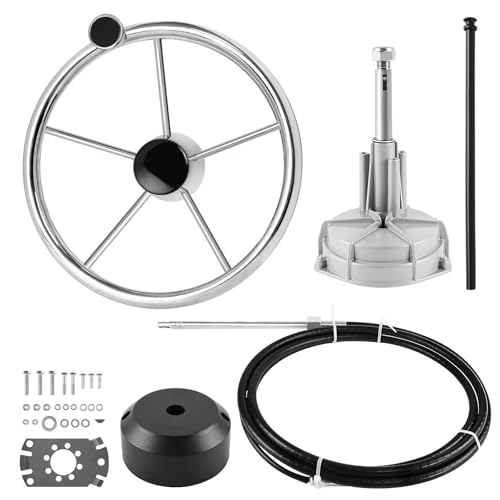
The QYMOPAY kit features cast steel and 304 stainless steel tubes for corrosion resistance, with a 13 ft cable and a 13.5″ wheel. It’s well-suited for yachts and other larger vessels seeking reliable, maintenance-friendly steering hardware. It offers a complete package that supports accurate steering with standard tapered shaft. Limitation: ensure your installation space accommodates the 13 ft cable length and the wheel size.
Buying Guide: Key Considerations For Remote Steering Systems
- Boat type and engine configuration: Determine whether you need wireless control, a direct cable connection, or a kickers-to-main linkage. Wireless options suit open cockpits and compact helms; cable systems fit traditional layouts with straightforward, reliable performance.
- Cable length and fit: Measure the distance from the helm to the outboard(es) and verify shaft sizes (3/4″ tapered shaft) and wheel diameter (commonly 12.5″ to 13.5″). Longer cables require additional routing space and may affect response.
- Materials and corrosion resistance: Stainless steel and premium alloys extend life in saltwater environments. Look for rust-proof components and sealed housings for moving parts.
- Integration with existing gear: If adding a kicker motor or replacing a helm, confirm mechanical compatibility with current steering linkage and throttle controls.
- Ease of installation: Some kits are plug-and-play with minimal tools, while others demand more substantial helm reconfiguration. Consider professional installation if uncertain.
- Maintenance and diagnostics: Seek systems with accessible adjustment screws, clear wear indicators, and documented maintenance steps to minimize downtime.
Frequently Asked Questions
- What is the best remote steering option for a small boat?
– A compact wireless throttle and steering kit can reduce cockpit clutter and improve maneuverability on small boats, especially if you frequently dock or troll in tight spaces. - Do I need a full rotary steering kit or can I use a kicker-motor steering kit?
– If you want to control a kicker motor from the main helm, a kicker-specific steering kit is often sufficient and simpler to install; full rotary kits suit larger vessels needing robust control across the entire helm. - How long should the steering cable be?
– Cable length should match the distance from helm to rudder or to the outboard, with extra length to route safely around obstacles. Common lengths are 10 to 16 feet, depending on boat size. - Is corrosion resistance essential for marine steering components?
– Yes. Marine environments are harsh; stainless steel and premium alloys reduce rust and wear, extending service life with less maintenance. - Can I install myself, or should I hire a pro?
– Simple plug-and-play systems can be DIY-friendly. More complex installations, especially on larger boats or dual-engine setups, benefit from professional installation to ensure correct alignment and safety.