Answering the question “which mooring whips are best for pontoon boats?” this guide highlights five top options that balance protection, ease of use, and durability. Each product is rated for boats in the typical pontoon range and helps reduce hull scrapes from wakes, wind, and tide. The recommended picks suit casual cruisers, seasonal boaters, and anyone seeking reliable dock protection without complex setup.
Summary table of selected products:
| Product | |||
|---|---|---|---|
| SIVEIS 8FT Fiberglass Mooring Whips Pair | Up to 18 ft / 2,500 lbs | 180° adjustability, cushions waves, quick install | Fiberglass length limits for larger pontoons |
| Dockmate Ultimate 12′ Mooring Whips | Mid-size to larger pontoon setups | Spring action protection, easy one-hand operation | Longer overall length may require more storage space |
| Taylor Made Standard Mooring Whips 16′ | Boats 20’–33’, up to 20,000 lbs | Fixed angle or rocker base for reliable dock distance | Heavier and longer; storage considerations |
| SFNSM 2 Pack Mooring Whips 30in | Smaller to mid-size craft including pontoons | Compact and easy to store, includes dock cleats | Shorter length; best for close docks or high-wake regions |
| TaylorMade Boatguard Mooring Whip 8′ | Boats up to 2,500 lbs | Rocked base design with strong protection | Limited length may suit smaller pontoons only |
SIVEIS 8FT Fiberglass Mooring Whips Pair

Best for small boats up to 18 feet or 2,500 pounds, these mooring whips use 8-foot high-strength fiberglass with a 180° adjustable stainless steel base. The kit includes two bases, ropes, pulleys, cleats, and hardware for quick installation. The design cushions wind and waves to protect the hull while keeping a consistent dock gap. Choose this if you have a compact pontoon and need a reliable, all-in-one setup that fits tight dock spaces.
Best for: boat owners seeking a compact, complete mooring kit with straightforward installation. Caution: the 8-foot length may limit protection in very rough wake conditions or larger pontoons.
CSUPPCREA 16″ Heavy Duty Stainless Hooks Dock Defender Rods (2 Pack)
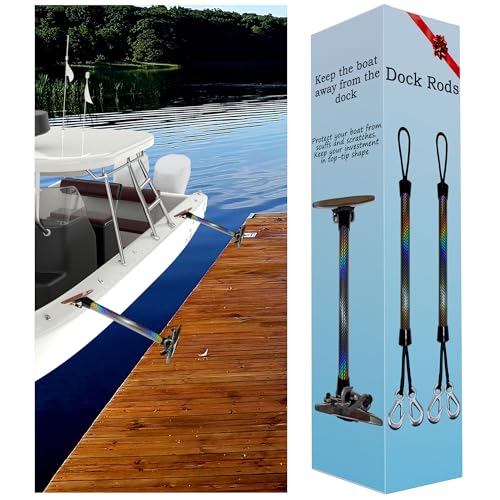
Best for quick docking assistance and simple tie-up processes, these 16-inch stainless steel dock defender rods pair with heavy-duty hardware to simplify mooring. Made to endure tough marine conditions, they offer robust performance for pontoons that demand fast, reliable docking without knot-heavy setups. Pick this if you want an easy-to-use alternative to traditional lines and knots.
Best for: boaters who value speed and simplicity in docking. Caution: shorter rod length may not provide as much distancing as longer mooring whips on windy days.
Dockmate Ultimate 12′ Mooring Whips

Best for mid-size pontoons and boats, the Dockmate pair uses large-diameter fiberglass with adjustable aluminum bases and rubber shock absorbers. Its spring action reduces damage from wakes and winds, and one-hand operation with a roller tip makes adjustments quick. Choose this if you want a balance of protection and ease of use with flexible docking angles.
Caution: longer 12-foot length requires proper storage and handling to avoid snagging on dock fixtures.
TaylorMade Standard Mooring Whips 16′

Best for boats in the 20’–33’ range and up to 20,000 lbs, these mooring whips use a fixed-angle or rocker arm base to position the vessel away from the dock. They provide reliable protection with a high-quality fiberglass rod and a low-friction tip. Choose this if your pontoon is mid-to-large and you want strong distance from the dock in varied conditions.
Limitation: longer length may require deeper mounting space and careful storage when not in use.
TaylorMade Boatsguard Mooring Whips for Boats Up To 25 Feet

Best for boats up to 25 feet and under 10,000 lbs, these premium mooring whips use a rocker arm base to keep the hull safely away from the dock during severe weather. The fiberglass rods feature a low-friction tip and whip cleat for easy boarding. Choose this if you have a mid-sized pontoon and expect heavier wake conditions.
Limitation: ensure the mounting area can accommodate the rocker base footprint for optimal performance.
Buying Guide
What size of mooring whip do I need?
Match length to your pontoon size and typical dock spacing. Larger pontoons often require longer whips or more robust bases to maintain a safe gap from the dock during wakes and tides.
What dock conditions should I consider?
Consider wake intensity, current, wind, and dock type (wood, concrete, or metal). Spring-action or shock-absorbing options help protect against heavier conditions, especially on exposed docks.
What installation considerations are important?
Look for complete kits with bases, ropes, pulleys, and cleats for quick setup. Ensure bases are corrosion-resistant (316 stainless steel is common) and that the mounting surface can handle the load distribution.
What features improve ease of use?
One-hand operation, adjustable bases, and low-friction tips simplify boarding and docking, especially on busy days or crowded marinas.
How do I choose between standard and premium options?
Standard options suffice for modest wake areas and smaller boats. Premium options with rocker bases and longer lengths offer greater protection in severe conditions and larger pontoons, but require more storage space and careful mounting.
FAQ
- Q: Are mooring whips suitable for all pontoon sizes? A: They come in various lengths and weight ratings. Choose a model that matches your boat length, weight, and typical wake exposure.
- Q: Can mooring whips be installed on wooden docks? A: Yes, many kits include bases compatible with wood and concrete docks; verify base mounting hardware fits your dock type.
- Q: Do mooring whips require regular maintenance? A: Inspect for corrosion, wear on ropes, and pulley integrity. Clean and lubricate moving parts as needed.
- Q: How do I position whips for optimal protection? A: Position to create a safe clearance between the hull and dock, accounting for tide and wind shifts. Adjust bases to maintain even load distribution.
- Q: What is the best practice for storage when not in use? A: Remove or retract whips if possible and store in a dry area to prevent corrosion and damage.
- Q: Is one whip enough for a pontoon? A: For best protection, use a pair or kit designed for the boat size to distribute load and maintain a stable gap from the dock.