Finding the right external gas tank for an outboard engine depends on capacity, compatibility, and portability. This guide highlights five top picks ideal for fishing boats, deck boats, and inflatables, with clarity on who each tank suits best. Use the table below to compare essentials at a glance.
| Product | Capacity | Best For | Key Benefit |
|---|---|---|---|
| VEVOR Boat Fuel Tank | 3.17 gal / 12 L | Compact boats, deck seating | Long hose, durable HDPE |
| AloneGoer 3 Gallon | 3 gal / ~12 L | Yamaha outboards, spares | Multi-layer barrier, corrosion-resistant |
| Scepter 9 Gallon Portable | 9 gal / 34 L | Extended trips | Built-in gauge, vented cap |
| PeakPursuit Portable Boat Tank | 3 gal | Under-seat storage, versatile | 9.8 ft hose, vent options |
| VEVOR 6.34 Gallon | 6.34 gal / 24 L | Medium-to-large boats | Separate inlet/outlet, gauge |
This article covers five products to help buyers choose based on capacity needs, hose length, fuel compatibility, and storage ease. Each option is described with who it is best for and any notable limitations.
VEVOR Boat Fuel Tank, 3.17-Gallon

Best for compact boats and small decks, this 3.17-gallon tank uses high-density polyethylene for durability and resistance to aging, impact, and corrosion. It includes a 9.8 ft/3 m hose with a 0.24″/6 mm inner diameter, and is compatible with Yamaha connectors. The molded top handle facilitates transport and storage under seats or in tight compartments.
- Best for Yamaha outboard connections and small boats
- Includes a long hose for flexible access from a dock or rails
- Caution: Prolonged direct sunlight can age the tank and cause expansion
Who it’s best for: Buyers with small to mid-sized boats who need a portable, space-saving fuel tank. Why selected: Combines portability with reliable HDPE construction and a compatible hose for common Yamaha fittings.
AloneGoer 3 Gallon Portable Boat Tank
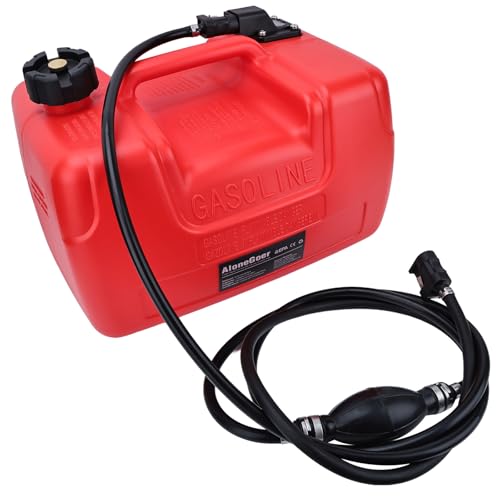
Best for Yamaha outboards or as a spare fuel tank on board, this 3-gallon tank uses multi-layer barrier technology (HDPE-EVOH-HDPE) to reduce evaporation up to 98% and resist UV aging and salt spray. It is designed for durability in marine environments and includes a compatible fuel line connector.
- Better for long days on the water where minimizing evaporation matters
- Multi-layer barrier technology improves fuel retention in salty air
- Caution: Verify exact connector compatibility with your Yamaha model before purchase
Who it’s best for: Boat owners seeking a corrosion-resistant spare fuel tank. Why selected: Strong barrier technology and UV stabilization offer longevity in humid, salt-pray environments.
Scepter 6 Gallon Portable Marine Gas Can

Best for longer trips on boats where under-seat storage is preferred, this 6-gallon tank adds ample capacity with a built-in gauge and a 2-way vented cap. It supports diesel and ethanol-blended fuels and accepts standard marine fittings when paired with the appropriate line.
- Best for extended boating sessions needing additional fuel capacity
- Vented cap helps manage vapor pressure during refueling
- Caution: Ensure fuel type compatibility with your engine before use
Who it’s best for: Boaters who value gauge visibility and a stable under-seat profile. Why selected: Combines gauge, venting, and compact rectangular design for better space management.
PeakPursuit Portable Boat Tank, 3 Gal

Best for versatility on deck boats and inflatables, this 3-gallon tank includes a 9.8 ft hose and a level gauge. It features a dual venting system to adjust flow or seal tightly, and HDPE construction for longevity in marine conditions.
- Choose this if you need a flexible hose length for hard-to-reach fill points
- Dual venting helps adapt to different refueling scenarios
- Caution: Fit and secure the venting system properly to avoid leaks
Who it’s best for: Buyers seeking ease of handling with flexible hose access. Why selected: The long hose and venting options address common on-water fueling challenges.
VEVOR Marine Tank, 6.34-Gallon

Best for medium-to-large boats, this 6.34-gallon tank includes a 9.8 ft hose and a gauge. It emphasizes separate inlet and outlet to prevent spillage and recommends filling up to 80% to minimize evaporation and risk.
- Better for boats needing a mid-range fuel capacity with clear monitoring
- Separate inlet/outlet reduces leakage risk during transfers
- Caution: Avoid overfilling to manage vapor pressures and leakage
Who it’s best for: Boat owners who want a balance of capacity and control. Why selected: Gauge visibility and dedicated inlet/outlet design support safer transfers on board.
Buying Guide
Key considerations when selecting an outboard external gas tank:
- Capacity needs: Choose 3–9 gallons based on boat size, engine fuel consumption, and planned trip length.
- Hose length and diameter: A longer hose (around 9.8 ft) improves reaching fill points; verify inner diameter compatibility with your fittings.
- Material and build: HDPE tanks resist aging and corrosion; multi-layer barriers reduce evaporation.
- Venting and safety features: Vented caps, dual venting, and secure seals help control vapor and prevent leaks.
- Gauge and level monitoring: Built-in gauges simplify fuel management during trips.
- Fit with your engine brand: Check connector compatibility (Yamaha, etc.) and ensure standard marine fittings.
- Storage and handling: Lightweight, compact designs fit under seats or in small storage bays.
Frequently Asked Questions
- What capacity should I choose for an average small boat?
– A 3–6 gallon tank is commonly sufficient for many small boats and short trips. - Are vented caps safer for marine use?
– Yes, vented caps reduce pressure buildup and improve safety during refueling. - Can I mix these tanks with my existing fuel system?
– Verify compatibility with your engine and fuel line fittings before matching components. - Does evaporation affect fuel quality?
– Multi-layer barrier tanks reduce evaporation significantly, preserving fuel quality. - Is a gauge necessary?
– A built-in gauge helps track fuel levels quickly, especially on longer outings.