Yes—finding the right onboard charger makes boat life safer and smoother. This guide highlights top options for 12V lead-acid and lithium batteries, suited to anglers, cruisers, and workboats. Each product section explains who benefits most, why it was chosen, and any practical limitation to consider on a modern vessel.
Summary of selected products
| Product | Bank Count | Total Amps | Best For |
|---|---|---|---|
| NOCO Genius GEN5X3 | 3 | 15 | Small to mid-size boats needing flexible multi-bank charging |
| NOCO Genius GEN5X2 | 2 | 10 | Two-battery systems with compact footprint |
| NOCO Genius GENPRO10X2 | 2 | 20 | Powerful dual-bank for larger battery banks |
| MINN KOTA MK 315D Digital | 3 | 15 | Three-bank, dependable for offshore or cabin boats |
| SOARFLY 3 Bank 30A | 3 | 30 | Flexible three-bank with deep-cycle and LiFePO4 support |
NOCO Genius GEN5X2: 2-Bank, 10A Onboard Charger

Best for small to mid-size boats with two battery banks. The GEN5X2 delivers 5A per bank and supports multiple charging modes for lead-acid and lithium batteries. It’s compact, waterproof, and engineered for harsh marine environments, making it a strong all-around choice for sailors and weekend boaters.
Who it’s best for: boaters with two primary 12V battery banks or spaces where a compact, reliable charger matters. Why selected: high efficiency with temperature compensation and overcharge protection, plus flexible modes for AGM, Li, and standard lead-acid cells. Caution: larger boats with more than two banks will need a higher-bank model.
NOCO Genius GEN5X1: 1-Bank, 5A Onboard Charger
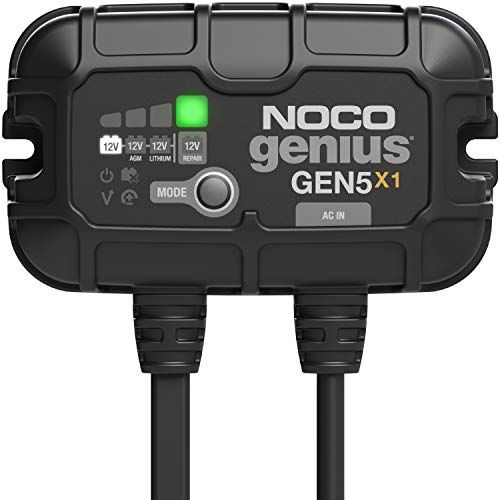
Best for single-battery setups or compact boats with limited space. The GEN5X1 provides 5A of charging for one bank and offers modes for AGM, Li, and standard lead-acid batteries. It’s a straightforward option when only one bank is required and space is at a premium.
Who it’s best for: boats with a single primary battery or limited mounting space. Why selected: simplicity, solid protection features, and a compact footprint. Caution: not suitable for boats needing multi-bank charging or larger battery banks.
NOCO Genius GEN5X3: 3-Bank, 15A Onboard Charger
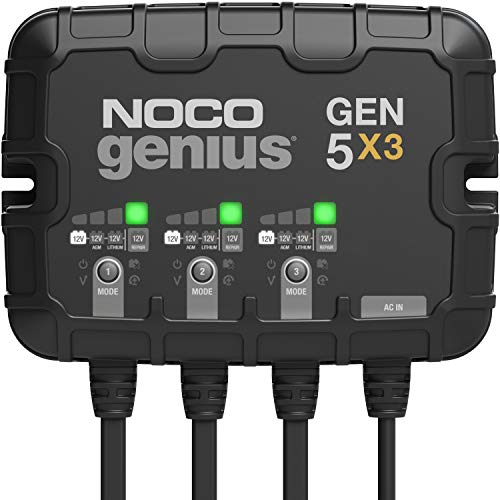
Best for boats with three battery banks that require precision maintenance. The GEN5X3 provides 5A per bank and supports separate charging modes, enabling independent balancing across three batteries. It’s compact for a 3-bank unit and suitable for cruisers and larger fishing boats.
Who it’s best for: crews with multiple battery needs (starter, deep-cycle, and house banks). Why selected: flexible per-bank modes, robust protection, and space-saving design. Caution: installation requires more space than 2-bank models.
NOCO GENPRO10X2: 2-Bank, 20A Onboard

Best for boats needing substantial charging power across two banks. The GENPRO10X2 delivers 10A per bank with a total of 20A, supporting quick top-offs for multiple battery types. It’s a strong choice for larger boats or those with frequent battery draws.
Who it’s best for: boats with higher daily energy needs or larger deep-cycle systems. Why selected: higher total amperage per bank improves charging speed, especially in cooler climates. Caution: may be overkill for simple two-battery setups with light usage.
SOARFLY 3 Bank Marine Battery Charger

Best for boats needing three independently controlled banks with 10A per bank. The SOARFLY charger supports SLA/AGM, Li-ion, and Calcium batteries, plus a Force Mode to recover deeply discharged cells. It’s well-suited for sport boats or workboats with varied battery types.
Who it’s best for: owners with diverse battery chemistries and three-battery setups. Why selected: flexible mode selection, independent bank control, and a robust three-bank format. Caution: ensure the mounting space accommodates a three-bank unit and its wiring needs.
Minn Kota 315D Digital On-Board Charger

Best for boats that prioritize automatic temperature compensation and a digital, microprocessor-based charging cycle. The Minn Kota 315D offers a three-bank setup with dedicated indicators for charge stages, maintenance mode, and faults. It’s suitable for cabin and saltwater boats that require reliable, ongoing maintenance.
Who it’s best for: boaters seeking precise, automated charging with clear status indicators. Why selected: automatic temperature compensation and a digital control system improve charge accuracy. Caution: more traditional users may prefer a plug-and-play, simpler unit for quick installs.
Buying Guide: Key Considerations For Your Boat Charger
- Bank count vs. battery layout: Match bank numbers to the number of 12V battery banks on your boat. More banks mean more independent charging for starters, trolling motors, and house batteries.
- Battery chemistry support: Ensure the charger supports lead-acid, AGM, Gel, and lithium (LiFePO4) if you use mixed chemistries on board.
- Charging modes and per-bank control: Look for selectable modes (12V, AGM, Lithium) and independent per-bank control for flexible maintenance.
- Temperature compensation: Temperature-aware charging improves accuracy in varying climates and helps extend battery life.
- Waterproof and rugged design: Marine environments demand IP-rated protection and solid construction for exposure to splashes, salt, and vibration.
- Installation footprint: Some models are compact, while others require more space. Measure mounting area and consider wiring paths.
- Repair and maintenance features: Some units include a Repair or Force mode to revive deeply discharged batteries. This can be useful in emergencies.
- Monitoring indicators: LEDs or digital readouts aid in quick status checks during operations or dockside maintenance.
Frequently Asked Questions
- What is the difference between a 2-bank and a 3-bank charger?
– A 2-bank charger charges two separate batteries or sets of batteries independently, while a 3-bank charger adds a third independent charging path for another battery bank or type. - Can I use a marine charger for LiFePO4 batteries?
– Yes, if the charger supports LiFePO4 chemistry with appropriate charging modes and safety protections. - Do onboard chargers require professional installation?
– Installation complexity varies. Simple mounting and wiring may be DIY-friendly, but high-current marine setups often benefit from professional wiring to ensure safety and compliance. - Should I pick a charger with a Force or Repair mode?
– Force/Repair mode can help revive dead or deeply discharged batteries, but use as directed to avoid battery damage. - How important is temperature compensation?
– Temperature compensation improves charging accuracy and extends battery life, especially in variable marine environments. - Is a higher total Amp rating always better?
– Not necessarily. Choose based on your total battery bank size and how quickly you need to recharge after use.