Whether you need reliable top-off power at sea or shore-side maintenance for RVs, these onboard battery chargers deliver safe, automatic charging across multiple battery types. This guide highlights options suited for different needs: multi-bank marine chargers for larger systems, compact single-bank units for tight spaces, and rugged models with deep-cycle compatibility. The top picks below are chosen for ease of use, reliability, and compatibility with lead-acid and lithium batteries.
| Product | Banks / Total Amps | ||
|---|---|---|---|
| NOCO Genius GEN5X2 | 2 banks / 10A total | Marine Onboard | Two-battery setups, demanding environments |
| NOCO Genius GEN5X1 | 1 bank / 5A | Marine Onboard | Compact installs, single-battery systems |
| Guest 2707A | 2 banks / 8A total | Marine Onboard | IP67-rated, dual-bank reliability |
| NOCO GEN5X3 | 3 banks / 15A total | Marine Onboard | Three-battery setups, varied chemistries |
| FirstPower Pro 5X2 | 2 banks / 10A total | Marine Onboard | Waterproof, flexible chemistry modes |
Notes: Banks indicate independent charging channels. Amps per bank help estimate how quickly each battery can reach full charge. All models support lead-acid family chemistries and many support lithium iron phosphate (LiFePO4) with appropriate modes.
NOCO Genius GEN5X2: 2-Bank Onboard Charger

The GEN5X2 offers two independent 5A banks for a total of 10A. It is advertised as 37% smaller and 43% more powerful than its predecessor, designed for marine environments where space and resilience matter. Each bank supports 12V, AGM, and Lithium modes, plus a Repair Mode for stubborn batteries. This makes it well suited for boats with dual battery banks or a small mixed-chemistry setup.
Best for: boat owners with two 12V batteries requiring balanced charging and flexible battery modes. It is a strong choice for users who value compact size and multi-bank independence.
Caution: If you have a single, large deep-cycle battery, a single-bank charger with higher total amperage might offer faster top-off than a two-bank 5A-per-bank setup.
NOCO Genius GEN5X1: 1-Bank 5A Onboard Charger
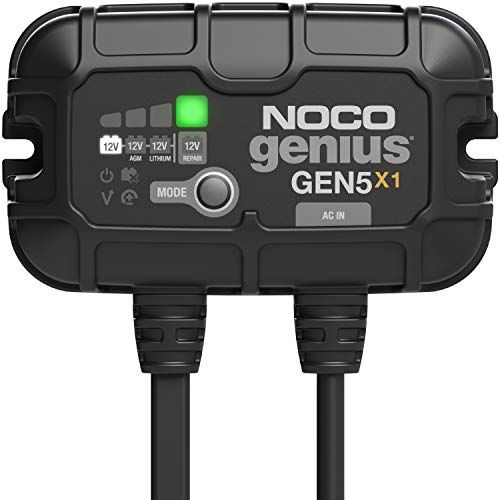
The GEN5X1 provides a single 5A bank in a compact, rugged package. It supports multiple charging modes for different 12V chemistries and includes Overcharge Protection and Temperature Compensation. Suitable for smaller boats or RVs with a single 12V battery, it maintains batteries efficiently while freeing up space for other equipment.
Best for: owners with one 12V battery seeking a compact, reliable onboard maintainer. Choose this if space is at a premium and a single battery is all you need.
Limitation: Not ideal for larger systems with more than one battery needing simultaneous charging.
Guest 2707A On-Board Battery Charger

The Guest 2707A features a dual-bank system with IP67 waterproof sealing for marine use. It includes safety features such as reverse polarity, over-current, over-voltage, over-temperature, and ignition protection. This makes it a practical choice for boats operating in harsher condition environments where moisture and vibration are concerns.
Best for: boaters needing a rugged, two-bank charger with strong protective features to withstand marine conditions. It offers solid reliability in wet environments.
Limitation: While robust, it may be outpaced by higher-amperage options when charging multiple heavy-draft batteries quickly.
Smart 2 Bank Marine Charger by Zrfmib

This two-bank charger delivers 10A total with 5A per bank and supports independent mode selection for each battery (12V SLA/AGM, 12V Lithium, 12V Calcium). It also emphasizes ability to recover dead batteries by enabling a forced charge. The unit’s 2-bank design is flexible for boats with two separate battery banks or for a single large system requiring maintenance across chemistries.
Best for: users needing selectable modes per bank and the ability to recover deeply discharged batteries. It’s a solid all-around choice for mixed chemistries in a marine context.
Limitation: The interface relies on a manual MODE button, which may be less convenient for users who prefer automatic fully-automatic operation without mode switching.
NOCO Genius GEN5X3: 3-Bank 15A Charger
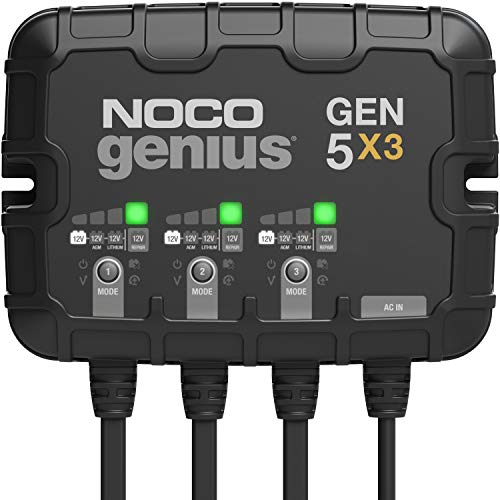
The GEN5X3 offers three banks with a combined 15A capacity, providing independent charging for three 12V batteries. Like the other GEN5X models, each bank supports 12V, AGM, Lithium, and Repair modes. This makes it a versatile option for larger boats or RVs with multiple batteries that require regular, separate maintenance.
Best for: boaters or RV users with three 12V batteries needing simultaneous, controlled charging. It is ideal for expanding a multi-bank system without sacrificing charging precision.
Caution: A three-bank setup consumes more space and may be more complex to install than two-bank models.
FirstPower Pro 5X2: 2-Bank 10A Marine Charger

The FirstPower Pro 5X2 provides two banks at 5A each, totaling 10A, and emphasizes IP68 waterproof sealing for all-weather operation. It supports 12V SLA/AGM, Lithium, and Calcium modes, with independent battery charging per bank. The two-bank layout makes it suitable for dual-battery setups in boats or RVs where 24/7 charging is desired without sunken space requirements.
Best for: users needing a rugged, waterproof two-bank charger with flexible chemistry support for 12V systems in marine or rugged outdoor applications.
Limitation: Like similar two-bank units, charging speed per battery may be slower than higher-amperage multi-bank options when both banks charge simultaneously on larger batteries.
Buying Guide: Key Considerations And Comparisons
- Number of banks: More banks enable independent charging for multiple batteries. Choose two or three banks if you run dual or triple battery setups.
- Total amperage per bank: Higher amperage accelerates charging for larger deep-cycle batteries. Match bank amperage to your battery sizes and charging needs.
- Battery chemistries supported: Ensure the unit provides modes for Lead-Acid, AGM, Gel, and Lithium (LiFePO4) if you use mixed chemistries.
- Waterproof rating: For marine environments, IP67 or IP68 ratings provide protection against water ingress and harsh conditions.
- Mounting and installation: Direct-mount or surface-mount designs, plus mounting brackets, affect ease of installation in tight spaces.
- Repair and maintenance modes: Some models offer a Repair or Desulfation mode, useful for recovering aging batteries.
- Safety features: Look for overcharge protection, temperature compensation, reverse polarity protection, and ignition protection where applicable.
- Size and weight: Compact models save space but verify clearance around battery compartments and ventilation.
FAQ
- What is an onboard battery charger?
It is a device that charges and maintains 12V batteries in boats, RVs, or other vehicles, often with multiple independent banks and modes for different chemistries.
- Do I need a lithium-capable onboard charger if I have LiFePO4 batteries?
Yes. If you use LiFePO4, choose a charger with dedicated LiFePO4 or Lithium charging modes to ensure proper voltage and balance.
- Can an onboard charger charge batteries while the engine is running?
Most onboard chargers are independent of the engine; they draw power from the alternator or shore power and charge batteries safely when connected.
- What maintenance mode helps prolong battery life?
Trickle or float maintenance modes help maintain full charge without overcharging, extending battery life during storage or long periods of inactivity.
- Is a higher total amperage better for all setups?
Not always. Higher amperage can speed up charging for large batteries, but for smaller systems or limited space, a lower-amperage, well-fit charger may be more appropriate and cost-effective.
- Should I buy a three-bank charger for two-battery boats?
Only if you plan to add a third battery or require independent charging for two separate banks with more flexible modes.