Answering the question “which marine paint below the waterline is right for me?” this guide highlights five top options. The best choices vary by hull material, above/below waterline use, and maintenance needs. This overview helps buyers compare surfaces, drying times, and coatings to prevent fouling. It is especially useful for fiberglass, wood, or metal hulls. The following table summarizes the chosen products to help you decide quickly.
- Product: Rust-Oleum 396967 Marine Flat Boat Bottom Antifouling Paint (Quart, Black)
- Product: Rust-Oleum 396959 Marine Coatings Topside Paint (Quart, White)
- Product: TotalBoat TotalProtect Epoxy Barrier Coat System (White, Quart)
- Product: Battleship Grey Marine Coatings Topside Paint (Grey, 32 Oz) + Diluent
- Product: TotalBoat Underdog Marine Antifouling Bottom Paint (Black, Gallon)
Product 1: Rust-Oleum Marine Flat Bottom Antifouling Paint

Best for fiberglass, wood, or steel hulls below the waterline. This antifouling paint slowly releases copper to deter barnacles and marine growth. It can be recoated in about 4 hours and launch-ready in roughly 16 hours, covering up to 110 sq ft. Choose this for boats needing a quick-drying bottom barrier and effective fouling resistance on multiple substrate types. Limitation: copper-release rate may vary with water temperature and densiity, affecting long-term performance.
Product 2: Rust-Oleum Marine Coatings Topside Paint

Best for above-waterline surfaces on fiberglass, wood, or metal. An oil-based formula provides flexibility with easy leveling and good durability. Dries to the touch in 1–2 hours and covers up to 100 sq ft. Choose this option for a smooth, reliable finish on topsides where exposure is greater but submersion is not involved. Caution: oil-based paints can require proper ventilation and longer cleanup times than waterborne variants.
Product 3: TotalBoat TotalProtect Epoxy Barrier Coat System
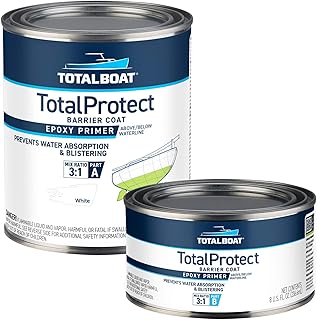
Best for a high-build epoxy primer and barrier coat, suitable above and below the waterline. Excellent for gelcoat blister prevention and repair on fiberglass boats, with strong protection for underwater metals. Use when a durable, long-lasting barrier is needed across diverse hull materials. Caution: epoxy systems require precise mixing and longer cure times than single-component paints.
Product 4: Battleship Grey Marine Coatings Topside Paint

Best for metal, wood, or fiberglass surfaces above the waterline. This product features high-concentration coatings with included thinner, designed for larger coverage, greater thickness, and hardness. It’s suitable for harsh sea environments and provides good adhesion and long duration. Choose this if you need a heavy-duty topside paint and want an all-in-one package to reduce separate thinner purchases. Limitation: data emphasizes application ratios; follow site-specific mixing guidelines carefully.
Product 5: TotalBoat Underdog Marine Antifouling Bottom Paint

Best for frequent boaters needing economical antifouling protection. This copper-based paint releases biocide to deter barnacles and mussels, suited for fiberglass, wood, or steel hulls. It is designed for single-season use with a durable finish that withstands trailering and beaching better than traditional ablatives. Choose this for cost-effective, season-long bottom protection on boats used regularly. Limitation: may require reapplication each season in high-traffic waters.
Buying Guide: Key Purchase Considerations
What hull material are you painting? Substrates like fiberglass, wood, and metal may require different formulas (antifouling vs. topside). For below-waterline returns, antifouling paints with biocide help prevent growth; for above-waterline, topside paints focus on UV resistance and durability. Drying and curing times influence launch readiness and scheduling. Consider environmental regulations and any copper content requirements for copolymerized formulations in your sailing area.
Substrate and Application
- Fiberglass: Commonly compatible with antifouling and epoxy barrier coatings.
- Wood: Select flexible, moisture-tolerant formulas to reduce cracking.
- Metal: Prefer corrosion-resistant, adherent coatings with proper surface prep.
Durability and Maintenance
- Antifouling coatings: Look for seasonal performance and ease of re-application.
- Topside paints: Prioritize abrasion resistance and UV stability for visible areas.
Environmental and Safety Considerations
- Follow local regulations for biocide use and copper-based products.
- Ventilation and proper cleanup are essential for oil-based systems.
- Surface prep and curing conditions impact long-term performance.
Application Tips
- Proper surface preparation yields better adhesion and durability.
- Follow manufacturer mixing and thinning guidelines for best results.
- Plan for reapplication cycles based on water exposure and boat usage.
Comparison Snapshot
| Product | Best For | Key Benefit | Typical Coverage |
|---|---|---|---|
| Rust-Oleum Marine Flat Bottom | Below waterline, multiple substrates | Copper-release antifouling | Up to 110 sq ft |
| Rust-Oleum Topside Paint | Above waterline, fiberglass/wood/metal | Flexible oil-based finish | Up to 100 sq ft |
| TotalProtect Epoxy Barrier Coat | Above and below waterline, gelcoat repair | High-build epoxy barrier | Varies by coat system |
| Battleship Grey Topside Paint | Above waterline, heavy-duty use | High-concentration formula with thinner | Depends on surface area |
| TotalBoat Underdog Bottom Paint | Below waterline, frequent use | Copper biocide, economical | Varies by hull size |
Frequently Asked Questions
- What is the main difference between antifouling and topside paints?
Antifouling paints are designed to prevent marine growth below the waterline, while topside paints protect above-water surfaces from UV, moisture, and abrasion. - How soon can I launch after applying antifouling paint?
Ranges vary by product, but some allow launch in as little as 16 hours with proper curing conditions. - Is oil-based paint suitable for all hulls?
Oil-based topside paints provide durability but require ventilation and longer cleanup; suitability depends on substrate and local regulations. - Do copper-based antifouling paints pose environmental concerns?
Copper-based biocides can impact marine environments; check local regulations and consider alternatives for sensitive waters. - How often should bottom paint be reapplied?
It depends on usage, water conditions, and coating type; frequent users may recoat annually, while occasional boats may extend to multiple seasons. - Can I mix different brands on the same boat?
Mixing brands is not recommended due to potential adhesion and curing incompatibilities; apply products only as directed by each manufacturer.