Answering the common buyer question: which onboard charger delivers dependable 12V charging for lead-acid and lithium batteries in marine environments? This guide highlights five reliable options, from compact single-bank units to robust multi-bank models. Ideal buyers include small- to mid-size boat owners needing space-saving power management, and larger vessels requiring multiple battery banks with precise charging modes. Below is a quick summary table of the chosen products to compare key traits at a glance.
| Product | Bank Count | Total Amp Rating | |
|---|---|---|---|
| NOCO Genius GEN5X2 | 2 | 10A | Two battery systems; small to mid-size boats |
| NOCO Genius GEN5X3 | 3 | 15A | Three batteries; larger boats with ample space |
| NOCO Genius GENPRO10X2 | 2 | 20A | Power-hungry systems; deep-cycle and starting batteries |
| FirstPower Pro 2 Bank 5X2 | 2 | 10A | Waterproof, 24/7 onboard maintenance |
| NOCO Genius GENPRO10X1 | 1 | 10A | Direct-mount, under-hood charging |
NOCO Genius GEN5X2: 2-Bank 10A Onboard Charger

The GEN5X2 provides two independent banks at 5A each, totaling 10A. It’s designed to be compact while delivering reliable performance in harsh marine settings. Features include selectable modes for 12V, 12V AGM, 12V Lithium, and a Repair Mode for maintenance. Best for boaters with two battery banks that require separate charging and maintenance cycles. A potential limitation is that the total output is shared across both banks, so simultaneous high-demand charging across both banks may be less aggressive than higher-output, multi-bank options.
NOCO Genius GEN5X1: 1-Bank 5A Onboard Charger
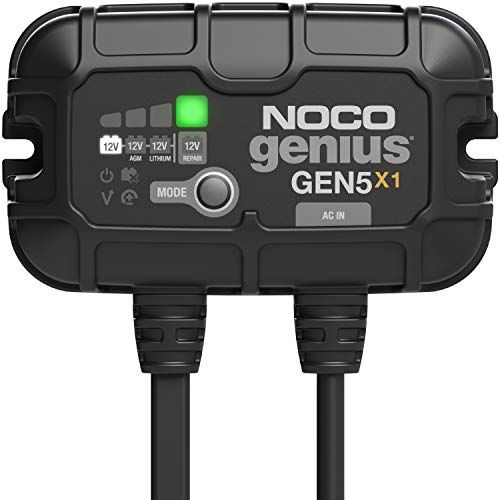
The GEN5X1 delivers a single 5A bank with 12V charging across lead-acid and lithium chemistries. It suits compact boats or engines where only one battery bank needs active, automatic maintenance. Choose this if space is ultra-tight or you only need to supervise a primary starting battery. Limitation: no second bank means you’ll need a separate maintainer for additional batteries.
NOCO GEN5X3: 3-Bank 15A Onboard Charger
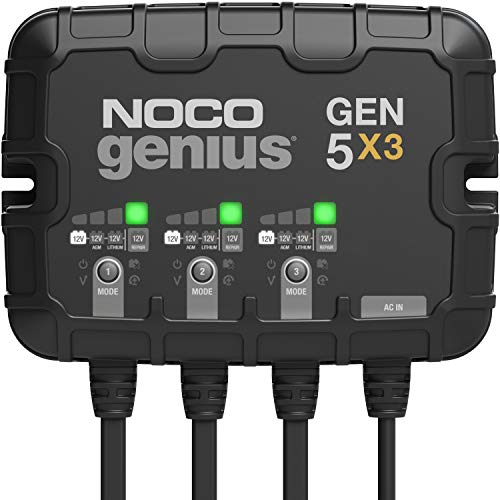
The GEN5X3 provides three independent banks at 5A each, totaling 15A. This model is well-suited for boats with multiple batteries across different systems or high-power demands. It offers flexible charging modes per bank (12V, 12V AGM, 12V Lithium, and Repair Mode). A potential limitation is its size and installation footprint on smaller vessels; ensure mounting space is adequate.
NOCO GENPRO10X2: 2-Bank 20A Onboard Charger

The GENPRO10X2 offers two banks at 10A each (total 20A), delivering robust charging for deeper-cycle and starting batteries. It’s designed for harsh marine environments and supports multiple chemistries. Best for power-intensive boats with several battery setups and a need for faster recovery after discharge. Caution: higher amperage may generate more heat; ensure proper mounting and ventilation.
FirstPower Pro 2 Bank Marine Charger 5X2

The 2-bank, 5X2 model from FirstPower Pro provides two 5A channels for 12V systems, with IP68 waterproofing and dead-battery recovery features. It’s a strong option for boats that endure wet conditions and need 24/7 onboard charging maintenance. Best for users needing reliable maintenance in challenging environments. A limitation to note is that it’s a two-bank system with moderate amperage per bank, which may be slower for multiple high-demand loads compared to higher-output models.
NOCO Genius GENPRO10X1: 1-Bank 10A Onboard Charger

The GENPRO10X1 focuses on a single 10A bank with 12V charging, suitable for boats where only one bank needs active onboard management. Best for compact vessels or spaces where a single, high-quality onboard charger is required. Limitation: no provision for an additional bank if your system grows in complexity.
Buying Guide: How To Choose The Right Marine Onboard Battery Charger
- Bank count and total amperage: Match the number of battery banks and the required charging power to your boat’s battery configuration and usage patterns. More banks help manage separate systems (starting, deep-cycle, lithium), but require space and wiring considerations.
- Battery chemistries supported: Ensure the charger supports your battery types (lead-acid, AGM, Gel, VRLA, LiFePO4). Independent bank modes for each chemistry simplify management on mixed systems.
- Waterproofing and mounting: For open or damp installations, choose IP68-rated units or models designed for marine environments. Direct-mount options save space on engine bays or under-seat compartments.
- Charging modes and recovery: Look for modes like 12V, AGM, Lithium, and a Repair/Desulfation option. A Dead-Battery Recovery feature can revive batteries that fall below 1V.
- Size and installation: Consider the space available on your vessel. Multi-bank units are physically larger but reduce wiring complexity; single-bank units are smaller but may necessitate multiple devices.
- Temperature compensation: Temperature sensors help prevent overcharge in hot conditions and undercharge in cold conditions, improving battery longevity.
- Maintenance and ease of use: Look for clear indicators, easy mode switching, and secure mounting hardware. Some units offer automatic maintenance cycling to preserve battery health.
- Safety features: Overcharge protection and short-circuit protection protect both the charger and battery bank in rough seas.
Frequently Asked Questions
- What is the difference between a two-bank and a three-bank charger? A two-bank charger can manage two separate battery circuits, while a three-bank charger can handle three. More banks allow greater separation of starting, house, and lifepo4 cells but require more space and wiring.
- Can a marine charger charge lithium batteries? Yes, many marine chargers support lithium (LiFePO4) in specific modes per bank. Ensure the model lists LiFePO4 or Lithium compatibility in its modes.
- Do onboard chargers work while the engine is off? Most onboard chargers maintain a float or trickle charge when connected to shore power, independent of engine operation.
- Is it important to match charger amperage with battery capacity? Yes. Higher-capacity batteries benefit from higher-current charging but require appropriate bank logic and thermal management to avoid thermal stress.
- What installation considerations matter? Plan for ventilation, water exposure, and secure mounting. Check user manuals for wiring diagrams and fuse requirements to ensure safe operation.
- Should I buy a charger with temperature compensation? Temperature compensation helps prevent overcharge in heat and undercharge in cold, improving longevity and performance for marine batteries.