The top picks below are designed to efficiently charge house or auxiliary batteries from a running alternator. They are best for boaters, RV owners, and adventurers who need reliable, auto-detecting charging while on the water or the road. The selections emphasize safety, multi-battery compatibility, and easy installation for marine and mobile applications. This guide highlights five models that balance performance, protection, and ease of use for different battery chemistries and system setups.
| Product | Max Current | Best For | Key Benefit |
|---|---|---|---|
| Renogy DC to DC Charger 12V 20A | 20 A | Small boats, light RV setups | Alternator detection and LiFePO4 activation |
| Renogy DC to DC Charger 12V 40A | 40 A | Medium boats, larger RVs | Smart multi-stage charging with LiFePO4 control |
| Renogy DC to DC Charger 12V 60A Lifepo4 | 60 A | Electric-start boats and larger systems | 3-stage charging and advanced protections |
| Victron Orion-Tr Smart DC to DC Charger 12/12V 30A | 30 A | Dual-battery systems in boats or campers | Bluetooth monitoring and isolation |
| Victron Orion-XS Smart DC to DC Charger 12/12V 50A | 50 A | High-demand systems, mixed-voltage setups | High efficiency with IP65 protection and configurability |
Renogy DC to DC Charger 12V 20A

Best for compact installations where space is limited. This charger features built-in alternator detection, charging only when the engine runs, and smart modes that adapt during startup to protect the main vehicle or marine battery. It is ideal for small boats, light RVs, and daily-use vehicles needing reliable LiFePO4, AGM, Gel, or Flooded battery charging. A simple on/off LiFePO4 activation option gives control over auxiliary battery status. Caution: With lower amperage, plan longer to recharge larger banked systems.
Renogy DC to DC Charger 12V 40A

Best for mid-size boats and larger RVs where more charging capacity is needed. It includes alternator detection and intelligent charging strategies, plus a compact wall-mount design to simplify installation. It supports LiFePO4 activation for peak performance with a simple on/off control. Limitation: The unit’s output is fixed, so consider your total battery capacity to avoid underutilization on frequent shallow discharges.
Renogy DC to DC Charger 12V 60A Lifepo4
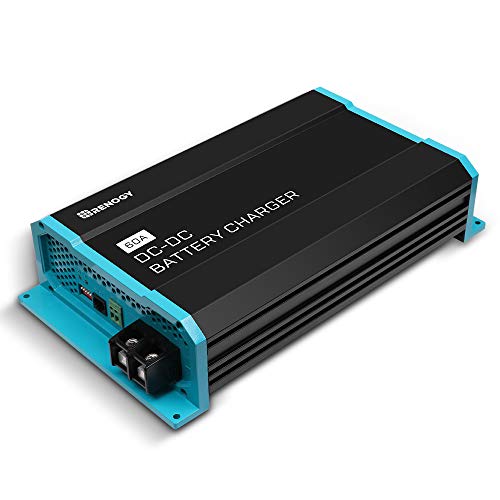
Best for larger, power-hungry systems where multiple battery chemistries must be supported. This 60A model uses multi-stage charging and offers comprehensive protections including over-voltage and reverse polarity. It isolates input and output to minimize interference with the vehicle’s electrical system. Choose this if you have a sizable auxiliary battery bank and want robust LiFePO4 activation for full, safe charging. Caution: Higher current requires careful wiring and proper heat management in compact spaces.
Victron Orion-Tr Smart DC to DC Charger 12/12V 30A

Best for dual-battery setups requiring professional-grade monitoring. It employs three-stage charging to safely deliver power from the alternator to the service battery while protecting both battery banks. Built-in Bluetooth enables remote monitoring and adjustments via the VictronConnect app. Limitation: 30 A may be insufficient for very large auxiliary banks or high-draw systems in extended off-grid use.
Victron Orion-Tr Smart DC to DC Charger 18A
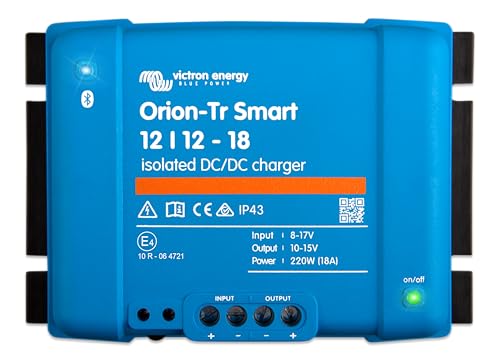
Best for compact dual-battery systems where space and weight are critical. This 18 A model still delivers three-stage charging with isolation and Bluetooth control, making it suitable for smaller boats or campers with modest auxiliary needs. Caution: Lower amperage may extend recharge times for larger battery banks or demanding devices.
VEVOR 12V 60A DC to DC Charger

Best for versatility across battery chemistries, including lead-acid and lithium, with a multi-stage charging profile. It provides several protections and an isolated input/output to minimize electrical interference, making it suitable for RVs, boats, and commercial vehicles. Limitation: The 60 A model requires careful thermal management in enclosed spaces to prevent overheating during long charging cycles.
Victron Orion-XS Smart DC to DC Charger 50A

Best for demanding dual-battery configurations with high efficiency and IP65 protection. The Orion-XS 50A provides configurable input/output currents and robust monitoring. It excels in environments with heat or water exposure and supports a wide range of battery types. Caution: Higher price and complexity may be overkill for very small systems.
Buying Guide
What should you consider when choosing a marine DC to DC charger?
- System size and battery type: Match amperage to your auxiliary battery bank and chemistry (LiFePO4, AGM, Gel, Flooded).
- Alternator compatibility and startup behavior: Look for alternator-detection features that prevent draining the starting battery at key moments.
- Protection features: Prioritize over-voltage, over-temperature, reverse polarity, and input/output isolation to protect both the vehicle and house batteries.
- Installation and space: Wall-mountable or compact designs simplify installation in boats, RVs, or tight engine compartments.
- Monitoring and control: Bluetooth or app-based monitoring helps you track charging status and adjust settings remotely.
- Operating environment: For marine or offshore use, choose IP-rated units (IP65 or higher) to withstand moisture and dust.
FAQ
- What is a DC-to-DC charger used for in boats and RVs?
It charges a house or auxiliary battery from the vehicle’s alternator, often with three- or multi-stage charging to optimize battery health and lifespan.
- Do these chargers work with LiFePO4 batteries?
Yes, most models support LiFePO4 along with other common chemistries like AGM, Gel, and Flooded.
- Is Bluetooth monitoring important?
Bluetooth offers convenient remote status checks and adjustments, especially for complex or multi-battery systems.
- Can I install a DC-to-DC charger myself?
Many models are designed for simple, at-home installation, but consult wiring diagrams and ensure proper gauge wiring and heat management.
- What happens if the engine isn’t running?
Alternator-detection features delay charging to protect the starting battery when the engine is off.
- How do I choose between 20A, 40A, and 60A?
Choose based on your auxiliary battery capacity, expected daily draw, and available space. Larger banks benefit from higher amperage but require adequate wiring and cooling.