Direct answer: For reliable VHF marine communication, choose antennas designed specifically for the 156–163 MHz band with solid coax, durable mounting, and appropriate gain. The following five models are selected to cover a range of boat sizes and mounting preferences, from compact, low-profile options to longer fiberglass designs. Each choice is best for different needs—smaller craft benefit from compact, easy-install antennas, while larger vessels may gain from higher gain and longer elements. The list below also highlights suitable buyers for each product and potential limitations to consider before purchase.
| Product | Best For | Key Benefit |
|---|---|---|
| HYS VHF Marine Antenna Waterproof 3DBI | Smaller craft, portable setups | 3 dBi gain with 43.3″ fiberglass element and built-in mount |
| UAYESOK VHF Marine Base Antenna 48 Inch | Stable, medium-length installations | 44″ fiberglass body with 7m RG-58U cable |
| eifagur Long Range VHF Marine Antenna | Longer-range communication | 16.5 ft cable, 2.5 dBi gain, robust construction |
| Tram 1600-HC Pretuned 35-Inch VHF Antenna | Budget-friendly, quick install | 1/2 wave design and 6 dB gain |
| HYS VHF Marine Antenna Low-Profile 16.4ft | Low-profile setups on modest masts | 5 m coax with 2 dBi gain |
HYS VHF Marine Antenna Waterproof 3DBI

Reference features: Frequency 156-163MHz; 5MHz bandwidth; VSWR ~1.5:1 at 159.5 MHz; 50Ω impedance; 3.0 dBi gain; vertical polarization with 360° horizontal beam width and 58° vertical beam width. No DC ground.
Best for: Smaller boats needing a compact, built-in-mount VHF antenna with reliable performance. Selection justification: The 3 dBi gain and fiberglass construction offer a balance of durability and coverage for coastal or inland waterway use. Caution: The DC ground is not provided, which may affect some mounting configurations; ensure your mounting solution accommodates ground requirements.
UAYESOK VHF Marine Base Antenna 48 Inch
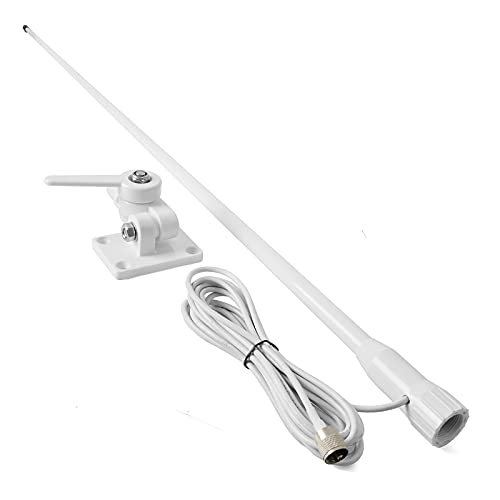
Reference features: Frequency 156-163MHz; 50 Ω impedance; 1.5:1 nominal VSWR at 159.5MHz; 3 dBi gain; 7 m RG-58U cable; fiberglass construction; anti-corrosion coating.
Best for: Medium-length installations on boats that need stable performance with a robust coax run. Why chosen: Longer than compact models but not overly tall, this antenna provides solid range while remaining manageable on mid-sized vessels. Caution: Cable length may require careful routing to avoid interference or damage in tight spaces.
eifagur Long Range VHF Marine Antenna

Reference features: Marine frequency 156-163 MHz; 50 Ω impedance; 2.5 dBi gain; 50 W max input; VSWR < 1.8; 5 m low-loss RG-58 coax with PL259; stainless steel bracket for mast top mounting; designed for any 156-163 MHz device.
Best for: Boats requiring a balance of range and straightforward installation with a robust, corrosion-resistant design. Choose this if you want a dedicated 156–163 MHz performance with a longer cable for flexible mounting. Caution: Gain is moderate; if you need higher gain, consider a longer or higher-gain model.
Tram 1600-HC Pretuned 35-Inch VHF Antenna

Reference features: Covers all marine band frequencies; DC ground shunt fed 1/2 wave; 6 dB gain. Includes RG58 cable and PL-259 connectors.
Best for: Budget-conscious buyers who want a straightforward, pre-tuned option with broad marine-band coverage. Why selected: The 35-inch length provides a reasonable compromise between performance and space for many small-to-mid-size vessels. Limitation: 6 dB gain is solid but not the highest among longer antennas; consider space constraints on smaller rigs.
HYS VHF Marine Antenna Low-Profile 156-163MHz

Reference features: 156-163 MHz operation; 2 dBi gain; 50 W max; 16.4 ft (5 m) RG58 low-loss coax with PL259; rubber antenna design for improved signal quality in receive and transmit.
Best for: Vessels needing a low-profile mast or rail mount with reliable reception. Why chosen: The low-profile design reduces clearance issues while preserving marine-band coverage. Caution: Lower gain means not ideal for long-range transmissions in open water; better suited for closer-range coastal communications.
Buying Guide
What size and mounting type should I pick?
- Small boats: Look for compact, low-profile antennas with 2–3 dBi gain to fit in tight spaces.
- Medium to large boats: A 3–5 dBi gain antenna with fiberglass construction balances range and durability; longer cables may be used for flexible mounting.
- Mounting: Consider whether you need a fixed, ratchet, or base-molt system; ensure your mast or rail supports the weight and wind exposure.
How important is coax quality and length?
- Longer runs with low-loss coax help preserve signal strength, especially on longer setups. Look for RG-58 or similar with PL259 connectors when provided.
- Quality shielding and corrosion resistance improve reliability in saltwater environments.
What frequency range and gain matter?
- All selected models operate in the marine VHF band 156–163 MHz; gains range from about 2 dBi to 6 dBi. Higher gain extends range but may require longer, stiffer deployments.
- Higher gain antennas are more sensitive to mounting alignment and surroundings; ensure clear line-of-sight on the intended waterway.
What are common limitations to watch for?
- Higher-gain antennas can be physically larger and heavier, impacting mounting options and vessel clearance.
- Some models omit DC grounding, requiring careful integration into vessel electrical systems.
Frequently Asked Questions
- What frequency range do marine VHF antennas cover?
- Is higher gain always better for boats?
- Do I need a ground connection for these antennas?
- Can I install these antennas on a mast or rail?
- Do these antennas come with cables?
- What maintenance is recommended for fiberglass marine antennas?
Most marine VHF antennas cover 156–163 MHz, which is the standard band for marine communications.
Higher gain can improve range but often requires larger antennas and better mounting; balance gain with vessel size and mounting space.
Some models require a dedicated ground or grounding method; check the product data. If your installation lacks DC ground, plan an appropriate mounting approach.
Yes, many are designed for mast-top or fixed-mount installations with included brackets; ensure compatibility with your boat’s layout.
Several models include RG-58 coaxial cables of varying lengths; verify length and connector type (PL259) before installation.
Inspect for cracks, corrosion, and loose fittings after heavy seas or storms. Clean surfaces and check cable integrity periodically.