When choosing a marine battery isolator switch, the goal is reliable power management for starting, charging, and running onboard electronics. This guide highlights five top options, tailored for boaters who need quick shutdowns, space-efficient installs, and durable construction. The best pick depends on your system voltage, space, and whether you prefer emergency combine features or digital monitoring. Below is a quick summary to help you compare key options and decide which switch fits your boat best.
Summary of selected products:
- Seachoice Battery Select Switch, Disconnect Isolator Cutoff, Dual, 12-50V — Best for two-battery boats needing simple selection.
- Blue Sea Systems e-Series 4-Position Battery Switch — Best for compact installs with multiple mounting options.
- Blue Sea Systems 4-Position Mini Selector, 6007 m-Series — Best for emergency combine and tight spaces.
- Blue Sea Systems m-Series On/Off Switch — Best for rugged uses with flexible mounting and removable knob.
- Nilight 90015A Battery Switch — Best budget heavy-duty isolator with high current capability.
Overview table (quick reference):
| Product | Best For | Key Benefit |
|---|---|---|
| Seachoice Dual Switch | Two-battery boats | Simple battery selection for starting or charging |
| Blue Sea e-Series 4-Position | Compact installs | Multiple mounting options |
| Blue Sea Mini 4-Position | Emergency combine | Combine power from both batteries |
| Blue Sea m-Series | Tight spaces | Removable knob and flexible mounting |
| Nilight 90015A | Budget, heavy duty | High continuous current |
Seachoice Battery Select Switch, Disconnect Isolator Cutoff, Dual, 12 -50V

Best for boats with two or more batteries that must be alternately used for starting or charging. The switch permits selection between batteries and supports operation in parallel, all within a 50V limit. UL listed, ignition protected, and CE approved for marine use.
Who it’s best for: boaters managing two battery banks who value straightforward switching without complex wiring. Why selected: robust dual-battery capability and industry approvals. Caution: installation should follow marine electrical codes to ensure isolation is effective during maintenance.
Blue Sea Systems e-Series Battery Switch Selector 4 Position, 32V DC, 325A Red, 9001e
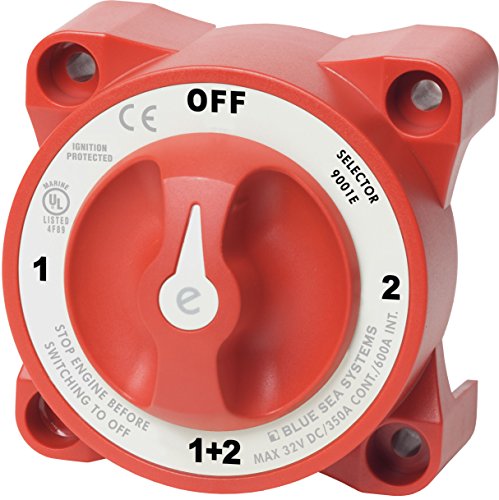
Compact design with multiple mounting options for tight spaces. Suitable for surface or rear installation and ignition-protected for engine rooms in gasoline-powered boats. Provides reliable performance in a space-conscious package.
Best for: boats needing versatile mounting and a compact form factor. Choose this if you want a four-position switch that fits tight panels. Limitation: may require careful planning for cable routing to avoid shorting terminals.
Blue Sea Systems 4‑Position Mini Selector Battery Switch, Red, 6007 m‑Series

Compact design fits in limited mounting areas while offering an emergency combine feature to draw power from both batteries during engine starting or essential radio use. Three mounting methods enhance installation flexibility on panels, surfaces, or in the rear.
Best for: users needing emergency dual-battery support in a small footprint. Choose this if you value a combine option and flexible mounting. Limitation: four-position capability may be more than needed for very simple two-bank systems.
Blue Sea Systems m-Series Battery Switch ON/OFF with Knob, 6006, Red

This switch emphasizes compact design with flexible mounting options and a removable knob to prevent accidental current flow during service. It is well-suited for panels where space is at a premium and where safer handling is preferred during electrical work.
Best for: boats needing a rugged, space-conscious on/off switch with added safety. Choose this for safer maintenance; avoid if you require a multi-battery management feature beyond on/off.
Nilight 90015A Battery Switch 12-48V Waterproof Heavy Duty

Heavy-duty ABS housing and rear cover insulation help prevent short circuits. It supports 12-48V systems with 275A continuous current, 455A intermittent, and 1250A momentary for cranking. Can be used standalone or linked with other switches for higher flexibility.
Best for: budget-conscious setups needing strong load handling. Choose this if you want a standalone isolator with high current bursts; caution: ensure compatibility with your cabling and mounting space.
Buying Guide
What should you consider when selecting a marine battery isolator switch?
- Voltage range and current capacity: Match to your boat’s battery bank voltage (12V, 24V, 32V) and peak load demands. Higher current ratings support cranking and high-demand electronics.
- Mounting space and installation flexibility: Look for compact designs and multiple mounting options (surface, flush, rear) to fit your panel layout.
- Safety features: Features like ignition protection, removable knobs, or emergency combine capabilities help reduce electrical hazards and power drain.
- Single vs. multi-battery management: Decide if you only need an on/off switch or a switch with four positions and a combine function for simultaneous charging and starting.
- Durability and environment: Waterproof housings and corrosion-resistant materials extend life in a marine environment.
- Maintainability: Easy access to terminals and the ability to lock switches or remove components during service adds to long-term reliability.
Frequently Asked Questions
- What is an isolator switch on a boat used for?
It disconnects the battery from the electrical system to prevent battery drain when the boat is not in use and to isolate circuits during maintenance.
- Should I choose a four-position switch or a simple on/off switch?
Choose a four-position switch if you need separate battery selection, parallel operation, and emergency combine features. A simple on/off switch is enough for basic power control.
- Is ignition protection important for marine switches?
Yes. Ignition-protected switches reduce the risk of sparks and are designed for use in engine rooms or near fuel systems.
- Can I install any battery switch myself?
Installation can be straightforward, but electrical work on boats should follow marine electrical standards. If unsure, consult a marine electrician.
- What maintenance is needed for battery switches?
Regularly inspect for corrosion, clean terminals, and ensure connections are tight and free of moisture. Replace worn components if needed.
- Can I link multiple switches to handle higher current?
Some models support linking with other switches for higher current handling. Check the product specifications to confirm compatibility.