Answering the needs of boaters seeking reliable cooling and climate control, these marine air conditioners are designed for boats and yachts. This guide highlights five top options, showing who they’re best for, why they stand out, and practical considerations. Ideal buyers include liveaboard skippers, weekend cruisers, and saltwater vessels requiring corrosion resistance, quiet operation, and energy efficiency. Below, a quick comparison table helps you scan key specs at a glance.
| Product | BTU | Voltage | Best For |
|---|---|---|---|
| MarinAire 16,000 BTU/h Self Contained | 16,000 | 110-120V/60Hz | Medium-to-large boats, quiet operation |
| MarinAire 6,000 BTU/h Self Contained | 6,000 | 110-120V/60Hz | Small cabins, budget-friendly cooling |
| MarinAire 11,000 BTU/h Self Contained | 11,000 | 110-120V/60Hz | Mid-size cabins, balanced performance |
| Dometic ECD Self-Contained 16,000 BTU | 16,000 | 230V | Large boats, energy efficiency |
| OutEquip 12V 10,000 BTU Rooftop A/C | 10,000 | 12V DC | Off-grid or trailerable boats, quick install |
MarinAire 16,000 BTU/h Self Contained Marine A/C And Heat Pump

This 16,000 BTU model is designed for larger boats needing robust cooling and heating with quiet operation. It features a noise-reducing cover, a corrosion-resistant titanium coil, and an energy-efficient R410A refrigerant. Best for boats with moderate to large living zones where comfort and low noise are priorities. Choose this if you want strong cooling paired with quiet performance and reliable durability in harsh marine conditions. A potential limitation is the need for proper bonding to a sacrificial anode for corrosion protection.
MarinAire 6,000 BTU/h Self Contained Marine A/C & Heat Pump

Designed for smaller cabins or limited spaces, this 6,000 BTU unit offers a compact footprint with rotatable blower and sound shield for quieter operation. Best for small boats, daysailers, or as a supplemental cooling option. It’s a practical pick when space constraints or a tighter budget matter. A caveat is that high heat loads may require smaller rooms or additional cooling capacity elsewhere on the vessel.
MarinAire 11,000 BTU/h Self Contained Marine A/C & Heat Pump

The 11,000 BTU model balances cooling capacity with energy efficiency, leveraging a quiet sound cover and a titanium coil for corrosion resistance. It’s well-suited for mid-sized boats and yachts where a strong, steady cooling load is needed without excessive energy draw. Best for users who want solid performance with lower noise and long-term durability. If space or power supply is constrained, consider smaller variants or staggered cooling zones.
Dometic ECD Self-Contained Air Conditioner (16,000 BTU)
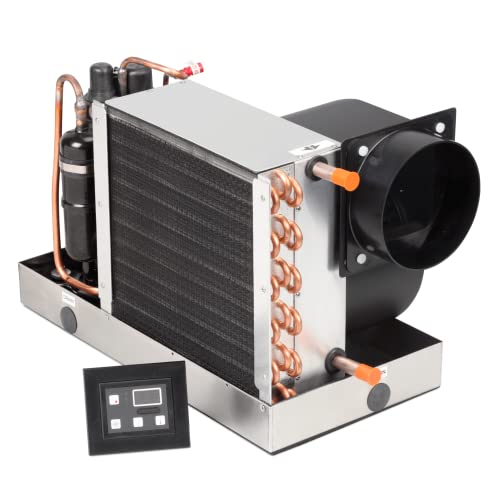
With a 16,000 BTU capacity, this Dometic unit is designed for larger boats and RVs, featuring energy-efficient R410A refrigerant and a compact design that eases installation. It emphasizes environmental friendliness and ease of use, including a digital control and display for straightforward operation. Best for boaters prioritizing powerful cooling in bigger cabins and hobbyists seeking a space-saving installation. A limitation is the 230V requirement, which may necessitate appropriate shore power or on-board electrical planning.
MarinAire 16,000 BTU/h Self Contained Marine A/C & Heat Pump (208–230V)

This variant mirrors the 110-120V model with a higher voltage option for installations requiring 208–230V. It maintains the quiet operation, titanium coil corrosion resistance, and energy-efficient R410A refrigerant. Best for vessels docked at marinas or shore power situations where higher voltage is available. Avoid this if your boat’s electrical system cannot safely support 208–230V or if you need a plug-and-play 110V option.
Dometic Retrofit Kit ECD10/2-1171-410A

This retrofit kit suits users updating existing systems with new R410A refrigerant-compatible components. It includes a versatile blower and a digital display. Best for boat owners upgrading or replacing older equipment to improve efficiency and control. A limitation is that it’s a kit rather than a complete system, requiring compatible existing hardware and installation know-how.
FO-KOKO Dual Hose 6800 BTU Portable Camping A/C

This portable, dual-hose unit offers 6800 BTU cooling plus 7500 BTU heating in a compact package. Best for temporary cooling on smaller boats or as a supplementary climate control solution when permanent installations aren’t feasible. It’s windowless, which helps in tight spaces, but portability means it isn’t a fixed on-board solution for long-term use.
OutEquip 12V Rooftop A/C With Heater

This 12V rooftop model provides a 10,000 BTU cooling capacity, designed for RVs, campers, and boats with off-grid power. Best for battery-powered or vehicle-connected cooling on smaller vessels, where quick installation and DC operation are priorities. A limitation is that 12V systems may have runtime constraints based on battery capacity and alternator supply.
Buying Guide
- Larger cabins demand higher BTU ratings. Match BTU to target space by measuring square footage and ceiling height.
- Consider shore power, generator, or DC/12V options. 110–120V units require standard AC supply; 230V units need compatible electrical systems.
- Titanium coils and sacrificial-anode bonding improve longevity in saltwater environments.
- Look for R410A refrigerant and efficient blower design to reduce run-time and fuel or power use.
- Quiet operation matters for comfort below deck and during overnight stays.
- Compact, modular units and digital controls simplify mounting and setup on various boat layouts.
- Retrofit kits can update older systems, but verify compatibility with existing ductwork and electricals.
FAQ
- What size marine AC do I need for my boat? Determine the area to cool (square footage) and choose BTU accordingly. Larger boats often require 11,000–16,000 BTU units for primary cooling.
- Is a 12V marine AC sufficient for larger boats? Typically not for large living spaces; 12V units are best for small cabins or off-grid, supplemental cooling.
- Why is corrosion resistance important? Saltwater exposure can corrode components; titanium coils and bonding help protect the system.
- Can I use an 230V unit on a boat? Only if your vessel has suitable 230V shore power or on-board electrical support; otherwise, choose a 110–120V model.
- Are retrofit kits worth it? Retrofit kits are useful for updating existing systems to newer refrigerants and controls, but require compatible hardware.
- What maintenance is needed for marine A/C? Regular condensate drain checks, filter cleaning, and periodic inspection of hoses and seals help maintain performance and longevity.