When choosing lines for docking, the goal is simple: secure your boat quickly, absorb shock, and protect your boat finish in all weather. This guide highlights five top dock lines that balance strength, flexibility, and ease of use. These products are best for: casual day boats and pontoons needing quick connect lines; boats that dock in variable conditions; and boaters who want reliable, pre-spliced lines for fast, knot-free docking. The table below compares core attributes to help you decide at a glance.
| Product | Best For |
|---|---|
| PACTHSD Boat Dock Lines 1/2″ x 15′ (4 Pack) | All-around mooring in lakes, rivers, and marinas; rugged, durable use |
| Botepon Bungee Dock Lines | Quick docking and temporary berthing with built-in shock absorption |
| Jranter Bungee Dock Line Mooring Rope 4 ft (4 Pack) | Shorter, tension-absorbing lines for jet skis, small boats, and docks |
| JaunniQir Bungee Dock Lines 4.3 ft (2 Pack) | Shock absorption for wave action; fast, knot-free docking |
| PropelTech 4 Pack 1/2″ x 15′ Dock Lines | Pre-spliced, heavy-load lines for boats under ~30 feet |
PACTHSD 1/2″ x 15′ Boat Dock Lines

Best for everyday mooring in varied water conditions. These 1/2″ diameter lines are 15 feet long with a 12″ loop, built from high-strength, double-braided nylon for low stretch and abrasion resistance. The construction is designed to endure outdoor exposure, UV light, and salt spray, helping to protect your boat’s finish while keeping it securely attached to cleats, moorings, or posts.
- Diameter and length: 1/2″ x 15′ per line
- Material: Marine-grade double braided nylon
- Loop: 12″ fixed loop for easy cleat attachment
Best for: boaters who want robust lines that are easy to handle, with reliable stretch control to minimize shock loading. This pack is ideal for vessels docked in marinas or lakefronts where frequent tying and untying occur. Caution: verify your cleat size and dock design to ensure the 12″ loop fits your setup.
Botepon Bungee Dock Lines
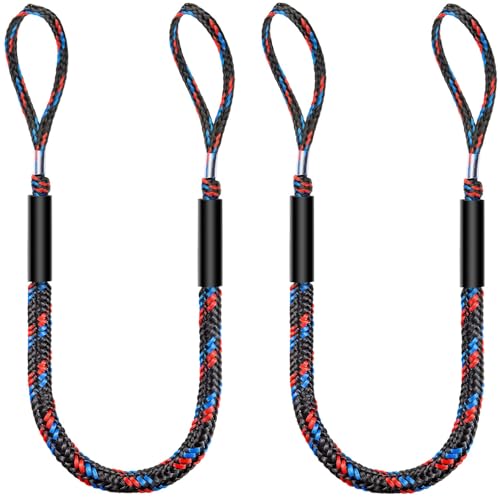
Designed for quick, knot-free docking, these lines use a bungee core to absorb shock and reduce movement during mooring. The system makes docking up to a line easy and is especially helpful when anchoring near piers or in choppier water.
- Key benefit: quick connect, no knots required
- Best for: temporary docking scenarios, boat owners who want a fast tie-up
- Limitation: may be less suitable for long-term mooring under heavy load unless paired with additional traditional lines
Best for: boat owners who frequently dock for short periods or who entertain and need a reliable quick-dock solution. Choose this if you prioritize speed and ease of use. Caution: ensure the quick connect method aligns with your cleat or post hardware.
Jranter Bungee Dock Line Mooring Rope (4 ft, 4 Pack)

Shorter bungee lines with a built-in shock absorber help reduce jerking and tugging when a boat shifts with waves or wind. Each end features a loop and slider for simple attachment to cleats or dock posts, with a hidden inner cord for snubbing shock. This design supports gentle docking and reduces wear on hardware.
- Best for: mooring smaller watercraft or temporary berthing needs
- Strength: provides elasticity to dampen movement
- Limitation: shorter length may require additional lines for larger boats
Best for: boaters seeking easier docking with less manual tying. Choose this if you want quick, repeatable connections. Avoid if you need long-range mooring or if your boat sits far from the dock after pulling in.
JaunniQir Bungee Dock Lines (4.3 ft, 2 Pack)

This two-pack offers a 10 mm latex core with elastic stretch to absorb wave action, keeping the boat firmly connected at the dock. The design supports quick docking with three simple installation methods and includes 316 stainless clips for secure attachment. It aims to prevent rotation and reduce wear on mooring hardware.
- Best for: jet skis, PWCs, kayaks, and smaller boats needing shock absorption
- Advantage: frictionless docking without knot tying
- Limitation: shorter length relative to some full-season mooring lines
Best for: boaters who want a compact, elastic line that’s easy to handle and quick to deploy. Choose this if you dock small watercraft frequently in variable conditions. Avoid if you require longer lines for larger vessels or deeper-water mooring.
PropelTech 4 Pack 1/2″ x 15’ Dock Lines (Black)

These are a four-pack of 1/2″ diameter, 15-foot dock lines, pre-spliced with a 12″ eyelet. Made from marine-grade double braided nylon, they balance flexibility with strength to minimize kinking and protect your boat’s finish. They resist UV, oil, salt, and corrosion, and offer a strong break force for boats under 30 feet in length.
- Best for: boats under 30 feet needing reliable, ready-to-use lines
- Strength: high breaking force up to 7500 lbs
- Limitation: not the lightest option; bulkier than thinner lines
Best for: boaters who want a ready-to-use, pre-spliced option with strong performance. Choose this if you prefer uniform lines and want to avoid knot-tying on the water. Avoid if your boat is significantly longer than 30 feet or if you favor lighter gear.
PropelTech 4 Pack 3/8″ x 15’ Dock Lines (Black)

A lighter alternative, these 3/8″ lines provide solid strength with enough flexibility to reduce stress on your boat and hardware. Pre-spliced with a 12″ eyelet, they’re designed for boats under roughly 21 feet. They resist UV, salt, and oil exposure for reliable long-term use.
- Best for: smaller boats and pontoons needing a balance of weight and strength
- Strength: designed with a 5000–plus breaking force equivalent
- Limitation: thinner diameter means not suitable for heavier mooring loads
Best for: budget-conscious owners with smaller vessels who want durable, pre-spliced lines. Choose this if you don’t need the maximum possible load and prefer lighter gear. Avoid if you regularly moor larger boats or in heavy seas.
Buying Guide: Key Considerations For Dock Lines
- What boat size and weight is common in your docking location? Choose lines with a breaking strength that comfortably exceeds your boat’s weight to avoid overstress during wind or waves.
- What is the typical docking environment? If you frequently dock in windy or choppy water, consider lines with shock-absorbing bungee cores or nylon that minimizes stretch and protects hardware.
- Do you need pre-spliced lines? Pre-spliced lines save time and reduce knot-tying on the water, which is beneficial for beginners and quick berthing scenarios.
- How important is ease of use? Quick-connect designs and larger eyelets enable faster docking, especially for single-handed operation or when you’re multitasking on the dock.
- What kind of maintenance do you expect? Nylon lines resist salt and UV exposure but check for wear on the eyelets and loops to ensure continued safety and performance.
- What length and diameter suit your boat and dock hardware? Longer lines provide flexibility, but heavier lines can be harder to handle; match diameter to expected load and cleat sizes.
FAQ
- Q: Are bungee dock lines safer for rough waters? A: Yes, their elastic cores absorb shock, reducing sudden pulls on the boat and dock hardware.
- Q: Should I use different lines for bow and stern docking? A: Depending on boat length and docking setup, using lines of similar length and material can simplify docking, but match to the strongest cleats available.
- Q: How do I know if a line is pre-spliced? A: Pre-spliced lines have a finished loop at one end, ready to attach to a cleat or post without knot-tying.
- Q: Can I mix nylon lines with other materials? A: It’s generally best to stay with nylon for uniform stretch and wear characteristics unless you have a specific need for another material.
- Q: What is the typical safe working load? A: It depends on the line diameter and construction; always reference the manufacturer’s break strength and your boat’s weight when choosing lines.
- Q: Do lines require maintenance? A: Rinse with fresh water after saltwater use, inspect for fraying, and replace lines that show significant wear.