Looking for the right jet ski tow sled to boost rescue capability or fun on the water? This guide highlights five top options built for lifeguards, responders, and outdoor enthusiasts. Each entry notes who it’s best for, its standout features, and practical limits. Use this quick reference to compare buoyancy, portability, and setup time to pick the sled that fits your needs.
| Product | Best For | Key Benefit | Limitations |
|---|---|---|---|
| FYTEINFLA Floating Water Mat Rescue Sled | Pro rescuers, lifeguards | Sturdy 0.9mm PVC with EVA grip | Bulkier size |
| COOLWAVE Inflatable Water Rescue Sled | Fire and rescue teams | Puncture-resistant and quick to inflate | Requires pump setup |
| SAYOK Large Inflatable Rescue Sled | Teams and Big loads | High buoyancy and 14 handles | Heavier to carry |
| MSEUOI Inflatable Water Towable Tube | Family fun and small groups | Versatile 1-3 riders | Not a traditional rescue sled design |
| Vinfgoes Inflatable Bodyboard Rescue Sled | Rescue professionals | Double-layer PVC with EVA grip | Inflation time varies by pump |
FYTEINFLA Floating Water Mat Rescue Sled

The FYTEINFLA sled is a large, flat rescue mat designed for professional responders and big-wave scenarios. Best for teams needing a stable platform with strong connection points. It measures 180 cm by 100 cm with a 10 cm thickness and includes three heavy-duty straps and carabiners for securing injured persons or equipment. A hand pump allows inflation to 11-15 psi, and a repair kit is included for on-site maintenance.
- Best for trained rescue teams needing a stable, low-profile platform.
- Better for organized rescues than impromptu recreational use.
- Caution: Bulkier to transport and store compared with smaller sleds.
COOLWAVE Inflatable Water Rescue Sled

COOLWAVE focuses on a lightweight, portable rescue board with high puncture resistance from premium PVC knitted drop-stitch fabric. It inflates up to 15 psi and folds compactly for transport, making it suitable for lifeguards, divers, and outdoor enthusiasts who need rapid deployment and long-term durability.
- Best for crews who value easy transport and quick setup.
- Better for environments where puncture resistance is critical.
- Limitation: Requires air pump and time to inflate to peak pressure.
SAYOK Large Inflatable Rescue Sled

This SAYOK sled emphasizes buoyancy and versatility. It weighs about 33 pounds (15 kg) and offers 185 cm by 105 cm by 15 cm dimensions with up to 200 kg (440 lb) load capacity. It uses double-layer brushed PVC and EVA for grip, inflates to 15 psi, and includes 14 nylon handles and safety points for dragging and securing patients or equipment. It can be rolled for storage after use.
- Best for rescue operations requiring multiple grip points and ease of handling.
- Better for scenarios with need to secure an injured person quickly.
- Limitation: Heavier and larger to transport than smaller models.
MSEUOI Inflatable Water Towable Tube
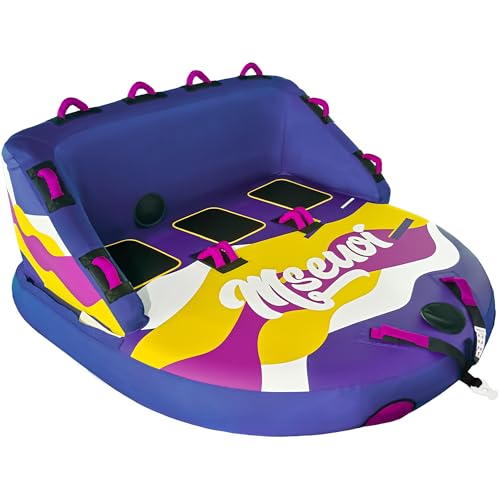
The MSEUOI tow tube is designed for up to three riders, with a large 71-inch diameter and padded handles for comfort during long sessions. It features quick-setup via rapid air valve and includes repair patches for punctures. This model prioritizes group fun but remains suitable for light rescue training and recreational towing behind jet skis.
- Best for family or friend outings where multiple riders are present.
- Better for recreational use with moderate safety features.
- Limitation: Not a dedicated rescue sled for injured-patient transport.
SportsStuff Booster Towable Tube

The SportsStuff Booster Ball is a towable accessory designed to improve visibility and ease of recovery. It includes a 60-foot tow rope with a 4,100 lb break strength and serves as a visual marker that helps locate the tube in wakes and spray. It acts as a shock-absorber to minimize drag and protect riders from snapping back into the tow line.
- Best for adding visibility and ease of handling on busy water.
- Better for experienced tubers and safe towing setups.
- Limitation: Not a primary rescue sled; functionally a support aid.
Vinfgoes Inflatable Bodyboard Rescue Sled

The Vinfgoes sled uses a rigid design with dropped stitched PVC, an extra front rub layer, and double-layer top walls. It features a big EVA pad for grip and inflates to 11-15 psi. Its dimensions mirror other professional sleds at 180 cm by 100 cm by 10 cm, with robust grip through multiple handles for dragging and control during rescues or big-wave situations.
- Best for professional rescue teams needing reliable grip and buoyancy.
- Better for steady, controlled rescues rather than fast, tight maneuvers.
- Limitation: May require more inflating time for peak rigidity.
Buying Guide: Key Considerations For Jet Ski Tow Sleds
What should you look for when choosing a tow sled? Start with purpose and environment, then examine construction, capacity, handles, storage, and inflation needs. For professional rescues, prioritize durable materials, high PSI tolerance, and multiple attachment options. For recreational use, consider weight, portability, and ease of setup.
- Buoyancy and load capacity: Ensure the sled can support the rider(s) and equipment you plan to move.
- Material and durability: Look for puncture-resistant PVC, reinforced seams, and EVA grip areas.
- Inflation system: Quick-inflate valves save time; verify the maximum safe PSI recommended by the manufacturer.
- Handles and attachment points: Count the number of drag handles and safety points for secure control during towing.
- Portability and storage: Consider whether the sled folds or rolls and how easily it fits in your vehicle or rescue boat.
Frequently Asked Questions
- What makes a rescue sled different from a standard inflatable tube?
A rescue sled prioritizes stability, grip, and secure handling for carrying injured persons or rescuers, with multiple handles and reinforced areas. Tubes emphasize thrill and recreational towing rather than patient transport. - How many PSI should I inflate a sled to?
Most professional sleds inflate to 11-15 psi, but always follow the manufacturer’s guidelines to avoid over- or under-inflation. - Are these sleds suitable for saltwater?
Yes, but look for corrosion-resistant hardware and materials designed for extended exposure to saltwater. Rinse after use. - How many riders can a standard rescue sled carry?
Capacity varies by model; high-capacity sleds can support 200 kg (440 lb) or more, while smaller models are designed for individuals or light loads. - Is a built-in deflation mechanism important?
Quick deflation speeds up setup for repeated deployments and helps in rapid transport after use. - Do I need extra accessories?
Consider repair kits, extra straps, and spare carabiners for field maintenance and quicker rescues.