Answering the needs of boat owners who rely on reliable off-grid power, these inverter chargers blend clean sine-wave power with automatic transfer switching for seamless, battery-powered operation. This guide helps buyers choose the right model for different setups—marina outages, weekend trips, or long-range cruising. The top picks below target common boat scenarios: small cabin electronics, refrigeration, and entertainment systems, all while protecting sensitive devices.
| Product | Best For | Key Advantage |
|---|---|---|
| Femotic 3000W Pure Sine Wave Inverter Charger | Mid-sized boats needing strong continuous power | High continuous and surge capacity with LCD display |
| ECO-WORTHY 600W Inverter Charger | Budget-minded RVs or boats with basic loads | 2-in-1 inverter and charger with UPS function |
| VEVOR 2000W Pure Sine Wave Inverter Charger | Off-grid boats with varied loads | Multiple operating modes and broad battery compatibility |
| Renogy 2000W Pure Sine Wave Inverter Charger | Off-grid RVs and boats needing strong safety features | Electronic safeguards and lithium compatibility |
| VEVOR 4000W Pure Sine Wave Inverter Charger | Larger boats with higher power demands | Higher power with versatile battery compatibility |
Note: This overview highlights models commonly used in boat and RV settings. Always verify battery compatibility and installation requirements with a marine electrician before use.
Femotic 3000W Inverter Charger

Overview: 3000W continuous output with 6000W surge, pure sine wave, and LCD display. The unit supports DC 12V input to AC 120V output and includes an auto transfer switch. It is compatible with multiple battery types and is designed for off-grid and emergency use on boats. Best for mid-size boats with essential appliances like refrigerators, freezers, and sensitive electronics that require clean power.
- Best for: Boats needing reliable, clean power for critical electronics.
- Why selected: High continuous power with substantial surge capacity supports hairline power-hungry devices.
- Caution: Some lithium chemistries may not be fully compatible; confirm battery type before pairing.
ECO-WORTHY 600W Inverter Charger
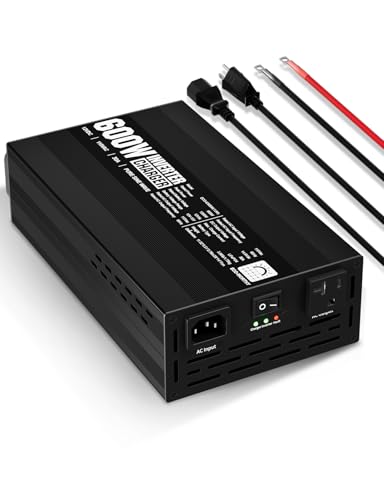
Overview: A 600W pure sine wave inverter with a 30A charger, delivering up to 1200W peak. Includes UPS-style 20ms battery fallback and multiple protections. Best for smaller boats or sailboats with modest loads and a LiFePO4 battery setup for camping or short trips.
- Best for: Boats with light to moderate loads and a need for quick transition to battery power.
- Why selected: 2-in-1 design reduces components and wiring; UPS function helps protect devices during outages.
- Caution: Limit continuous load to stay within safe operation and ensure adequate battery capacity.
VEVOR 2000W Pure Sine Wave Inverter Charger

Overview: 2000W continuous output with 6000W surge and LCD remote control. Designed for off-grid solar setups, RVs, boats, and home use. Features multiple operation modes and broad battery compatibility, including LiFePO4 and AGM types. Best for boats with medium power demands and solar charging integration.
- Best for: Boats needing versatile modes and battery-type compatibility.
- Why selected: LCD display and remote control simplify tuning and monitoring on a moving vessel.
- Caution: Keep each outlet load under about 1.2kW to prevent overheating and ensure stability.
Renogy 2000W Pure Sine Wave Inverter Charger

Overview: 2000W continuous output with 6000W surge and LCD display. Renogy emphasizes electronic safeguards and broad battery compatibility, including GEL, AGM, SLA, and LI types. Best for boats needing robust protection features and reliable performance with lithium-ready systems.
- Best for: Boats prioritizing electrical safeguarding and diverse battery options.
- Why selected: Strong safety features help protect expensive marine electronics during transient conditions.
- Caution: Ensure lithium compatibility and appropriate wiring for 24V or 12V systems as applicable.
VEVOR 4000W Pure Sine Wave Inverter Charger

Overview: 4000W continuous power with high surge capacity for larger boats. 24V or higher battery configurations may be supported, with multiple protection features and LCD display for status checks. Best for boats with higher daily power needs, such as larger refrigerators or multiple appliances running simultaneously.
- Best for: Larger vessels requiring substantial continuous power and a robust protection suite.
- Why selected: Higher wattage expands the range of devices that can run simultaneously.
- Caution: Higher power units demand appropriately sized wiring and battery bank to avoid strain.
Buying Guide
Key questions to guide your purchase:
- What load will you run aboard? List essential devices and peak requirements to match inverter wattage and surge capacity.
- What battery chemistry do you plan to use? Confirm compatibility with LiFePO4, AGM, GEL, SLA, or flooded lead-acid and ensure charging current matches battery specs.
- Do you need UPS or automatic transfer features? If yes, prioritize units with 20ms or faster transfer to avoid power gaps for sensitive electronics.
- Which boat length and power needs justify higher wattage? Larger boats benefit from 2000–4000W systems with generous surge margins.
- What voltage system is standard on your boat? Most marine systems use 12V or 24V; verify the inverter’s input voltage and the output voltage compatibility.
- Is space and wiring capacity a constraint? Choose a model with a compact footprint and straightforward wiring, and plan for proper ventilation.
FAQ
- Q: What is pure sine wave and why does it matter on a boat?
- A: Pure sine wave delivers smooth, consistent power suitable for sensitive electronics, reducing flicker and malfunctions compared to modified sine wave units.
- Q: How do I choose the right wattage?
- A: Sum the running watts of the devices you intend to use and add a safety margin for surge power; ensure the inverter can handle the peak load.
- Q: Can I mix battery types with these inverters?
- A: Many models are compatible with multiple battery chemistries, but always confirm the manufacturer’s battery compatibility list for your unit.
- Q: Is a remote control or LCD display important?
- A: An LCD display helps monitor voltage, current, and system status; remote controls improve convenience on a moving boat.
- Q: What about protection features?
- A: Look for overload, short-circuit, overtemperature protection, and automatic shutdown to protect both the inverter and the boat’s electrical system.