Answering the question: these battery switches help you safely select, isolate, or combine boat battery banks to ensure reliable starting and essential power. They’re best for boat owners who want quick, switch-based control of two or more batteries, with clear isolation options and optional alternator field disconnect features. The top picks below are grouped by capabilities, from universal mounts to dedicated 6-32V selectors, and include compact, high-amp models for cramped compartments and heavy-duty rigs.
| Product | Best For | Voltage Range | Key Feature |
|---|---|---|---|
| Guest 2110A Universal Mount Marine Battery Selector Switch | Ships in universal mounting spaces | 6-32V | AFD option, high amp capacity |
| Guest 2111A Battery Selector Switch | Heavy-duty, easy cable routing | 6-32V | Without AFD, longer stud lengths |
| Seachoice Battery Select Switch | Two-battery systems or more | Up to 50V | Dual bank selection, ignition protected |
| Blue Sea Systems 4-Position Mini Selector | Compact installations with emergency combine | 12-32V | Emergency combine, multiple mounting methods |
| Attwood 14230-3 Single Pole 4-Way Selector | Versatile 6-32V DC systems | 6-32V | Automatic alternator field circuit disconnect |
Guest 2111A Battery Selector Switch, Universal Mount without AFD
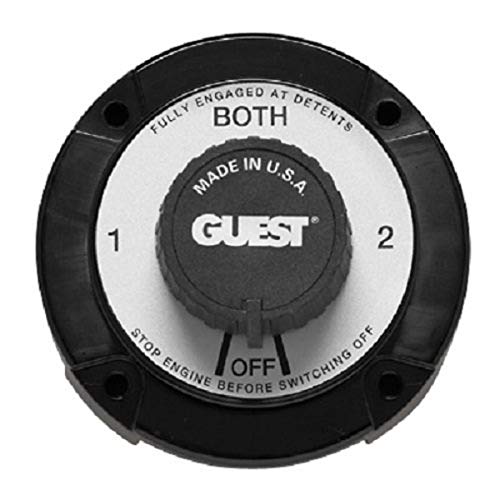
The Guest 2111A is designed for universal mounting without an Alternator Field Disconnect (AFD). Continuous amperage is 230A and 345A momentary, suitable for typical dual-battery setups on many vessels. Longer stud lengths help with cable routing and assembly in tight compartments. This model is best for boaters who need a robust, AFD-free option with straightforward installation and strong positive circuit control via copper sweep contacts.
Who it’s best for: boaters seeking a reliable, non-AFD universal mount switch with easy wiring and ample continuous current. Why selected: balances high continuous amperage with simple installation in cramped panels. Caution: no AFD means you must manage alternator and field connections separately if required.
Guest 2110A Universal Mount Marine Battery Selector Switch with Alternator Field Disconnect

The 2110A includes an Alternator Field Disconnect (AFD) feature, designed for boats where you want to prevent ignition surges from the alternator feeding back into the system. With 230A continuous and 345A momentary amps, it supports larger setups. Longer stud lengths improve assembly and cable routing. Built with copper sweep contacts for positive circuit control. This is best for cruiser or sport-boat owners who need AFD-capable switching in a compact form.
Who it’s best for: users needing AFD control and solid high-current performance. Why selected: AFD adds protection against field surges. Caution: AFD requires proper wiring to ensure reliable field disconnect behavior.
Seachoice Battery Select Switch, Disconnect Isolator Cutoff, Dual, 12 -50V

The Seachoice dual-battery selector allows switching between batteries for starting, charging, or operation in parallel, suitable for systems up to 50V. It’s UL listed, ignition protected, and CE approved, making it a practical choice for boats that require verified electrical safety standards. This model is best for sailboats or larger power boats with two or more battery banks and a need for safe disconnect and isolation in one unit.
Who it’s best for: boaters prioritizing certified safety and simple dual-battery management. Why selected: versatile selection between banks with clear isolation. Caution: ensure compatibility with your specific battery arrangement and cable routing in your panel.
Blue Sea Systems 4‑Position Mini Selector Battery Switch, Red

The Blue Sea 4-Position Mini Selector focuses on compact design and flexible installation. It supports emergency combine to draw power from both batteries during engine starts or essential radio use, helping maintain critical loads when one battery is low. Three mounting methods allow surface, flush, or rear mounting to fit tight boat panels. This model is best for vessels with space constraints requiring multi-position control and an emergency power option.
Who it’s best for: boats needing a small footprint with an emergency combine feature. Why selected: strong safety and reliability in a compact unit. Caution: may have limited space in very small panels, so verify clearance before purchase.
Guest 2300A Diesel Power Marine Battery Selector Switch

The 2300A Diesel Power Battery Selector Switch is designed for diesel-powered boats with high current demands. It provides robust selection capabilities and is tailored to heavy-duty marine applications where reliability under load is critical. This model is best for diesel-powered vessels requiring a strong, high-amp battery selector with durable construction.
Who it’s best for: diesel-powered boats needing a high-amp switching solution. Why selected: specifically marketed for diesel systems with substantial current needs. Caution: check compatibility with your alternator and wiring harness in confined spaces.
Guest Boat Battery Selector Switch 2112A | 2-Position 6-32V 230A

The 2112A is a two-position, 6-32V, 230A selector in a red plastic housing. It’s a simple, high-current option for vessels needing a straightforward on/off or two-position control across limited space. It’s best for smaller boats or auxiliary systems where a compact, basic selector is adequate. Limitations include fewer positions and basic housing materials.
Attwood 14230-3 Single Pole 4-Way Selector

The Attwood 14230-3 supports 6-volt to 32-volt DC systems, with continuous ratings up to 300A at 6V and 150A at 12V. It includes an automatic alternator field circuit disconnect to prevent surges that could affect onboard electronics. This model is best for smaller to mid-size boats that require a versatile, high-current, 4-way selector with built-in surge protection features.
Who it’s best for: boaters needing an automatic field disconnect and multi-branch switching. Why selected: robust protection against surges with flexible voltage support. Caution: ensure the unit’s mounting and wiring fit your panel layout and battery arrangement.
Buying Guide: Key Purchase Considerations
- Voltage and current needs: Match the selector’s continuous amperage rating to your engine’s starting and house loads. For larger boats, prefer 230A or higher continuous rating.
- AFD vs. non-AFD: An Alternator Field Disconnect helps prevent backfeed into the alternator. Choose AFD models if this is a concern for your wiring.
- Mounting space and installation: Universal and compact designs fit tight panels, but verify stud length, cable routing space, and mounting options before buying.
- Safety certifications: Look for UL or CE approvals when available, especially for ignition protection in marine environments.
- System topology: Decide between dual-battery, multi-bank, or emergency combine requirements. Choose models offering the needed switching arrangements (2-position, 4-way, etc.).
- Compatibility: Ensure the selector supports your battery types (lead-acid, AGM, GEL) and your boat’s voltage range (commonly 6-32V).
Frequently Asked Questions
- What is a battery selector switch used for on boats?
Answer: It allows you to choose between batteries, charge from multiple banks, or isolate batteries to protect circuits and starting power. - What does an Alternator Field Disconnect (AFD) do?
Answer: It prevents backfeeding field current from the alternator into other loads, reducing surges and protecting electronics during startup. - How many batteries should a marine system have?
Answer: Most boats use two or more batteries for starting and house loads; the exact number depends on electrical load and redundancy needs. - Can a battery selector switch be used with 6V systems?
Answer: Yes, many selectors support 6V to 32V systems; verify the voltage range in the product specs. - What maintenance is required for battery switches?
Answer: Periodically inspect for corrosion, ensure secure connections, and confirm operation by toggling through all positions. - Are high-amp switches safer to use in saltwater environments?
Answer: High-amp, properly rated marine switches with proper sealing and certifications are designed for saltwater exposure; ensure installation is compliant with marine standards.