Whether you’re outfitting a sailboat, fishing boat, or personal watercraft, choosing the right guest boat battery charger or marine charger helps ensure your batteries stay healthy and ready. This guide highlights five strong options that cover dual-bank, single-bank, and multi-volt needs, along with practical buyer tips. The top picks are best for boaters who want reliable on-board charging, corrosion resistance, and safe, automatic maintenance for lead-acid, AGM, and some lithium systems. A concise buying table follows to help you compare at a glance.
| Product | Type | Banks | Voltage | Best For |
|---|---|---|---|---|
| Guest 2707A On-Board Charger | Dual Bank | 2 | 12V | Two independent banks; rugged marine use |
| Guest 2720A On-Board Charger | Dual Bank | 2 | 12/24V | Flexible systems; harsh environments |
| Guest 2711A On-Board Charger | Dual Bank | 2 | 12V | Compact, reliable 10A per two banks |
| NOCO GEN5X2 | Dual Bank | 2 | 12V | Advanced, compact marine charging |
| NOCO GEN5X3 | Triple Bank | 3 | 12V | More banks for larger 12V systems |
Guest 2707A On-Board Battery Charger 8A / 12V

The Guest 2707A is an 8-amp, 12-volt, two-bank on-board charger. It is designed to independently charge two batteries with a single 120V input. The key features include a dual-bank design, IP67 waterproof rating, and comprehensive safety protections. This model suits boaters who want a reliable, space-efficient two-bank solution in wet marine settings.
Best for: Small to mid-size boats needing two independently managed 12V banks and rugged waterproofing. It’s a solid choice for anglers or day boats with separate starting and deep-cycle batteries.
Why selected: Combines independent charging with robust safety safeguards, making it well-suited for boats that operate in challenging marine conditions.
Limitations to note: 8A total output per two banks may be slower to top off larger deep-cycle packs; ideal for moderate usage rather than high-demand systems.
Guest 2720A On-Board Battery Charger 20A / 12/24V

The Guest 2720A is a higher-capacity two-bank charger capable of 12V and 24V operation with independent charging per bank. It is sealed to IP67 for marine environments and supports flexible installation. This unit is ideal for boats with both 12V and 24V systems or boats that require faster charging without sacrificing bank independence.
Best for: Boats with mixed voltage setups or larger battery banks that need faster replenishment and durable sealing.
Why selected: The 12/24V capability and independent banks provide versatility for more complex electrical configurations on bigger vessels.
Limitations to note: Higher power demand means a bigger footprint and potentially more installation considerations on smaller boats.
Guest 2711A On-Board Battery Charger 10A / 12V

The 2711A delivers 10A per bank in a compact 12V two-bank configuration. It’s designed for reliable on-board charging with a 120V input, making it a practical option for boats that need steady, predictable charging without taking up too much space.
Best for: Smaller to mid-size vessels where space is at a premium but two independent 12V banks are needed.
Why selected: A straightforward, space-efficient two-bank solution with dependable charging performance.
Limitations to note: It’s focused on 12V systems; boats with 24V needs should consider dual-voltage models or alternative options.
Guest 2701A Maintainer, 1.5 Amp
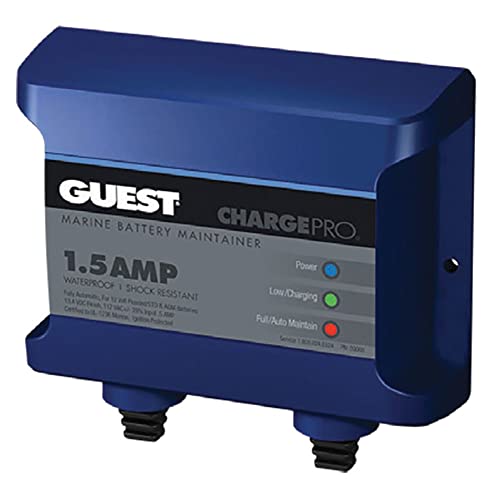
The Guest 2701A Maintainer provides a low-power 1.5A output ideal for keeping a single battery topped off when the vessel is idle. It supports charging for wet, gel, and AGM batteries and is suitable for a range of equipment beyond boats, including ATVs and lawn equipment. This unit is designed to maintain batteries without overcharging, which is useful for seasonal boats or off-season storage.
Best for: Situations where a simple, constant-maintenance charger is needed for one battery, including seasonal boats or auxiliary equipment.
Why selected: Its maintain-only role reduces risk of overcharging while preserving battery health during idle periods.
Limitations to note: Not designed for high-speed replenishment or multiple banks; not ideal for boats with several live systems requiring frequent charging.
NOCO Genius GEN5X2: 2-Bank 10A Onboard Charger

The GEN5X2 is a compact two-bank charger rated for a total of 10A (5A per bank). It supports multiple charging modes including 12V, 12V AGM, 12V Lithium, and a Repair Mode. This model is designed for reliability in harsh marine environments and can handle a range of lead-acid and lithium batteries.
Best for: Boats with diverse battery chemistries requiring independent bank control and precise charging modes.
Why selected: Its flexible charging profiles and space efficiency make it a versatile option for mixed battery fleets.
Limitations to note: For very large battery banks, consider a higher-capacity unit or more banks to avoid long charging times.
NOCO Genius GEN5X3: 3-Bank 15A Onboard Charger
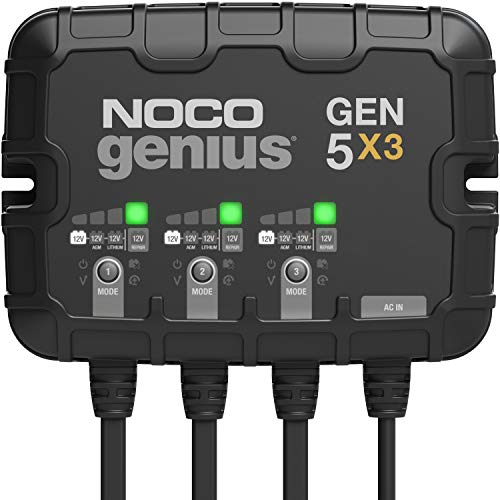
The GEN5X3 offers three banks with a total 15A capacity (5A per bank). It supports 12V lead-acid and lithium battery types with selectable modes for each bank, including AGM and Lithium options and a Repair Mode. The compact form and corrosion-resistant build are designed for demanding marine environments.
Best for: Boats with multiple battery banks or larger electrical systems needing independent monitoring and maintenance across three banks.
Why selected: The extended bank count provides greater scalability for boats with more complex power needs.
Limitations to note: Larger footprint and installation considerations compared to single-bank units; ensure space and wiring align with the three-bank configuration.
Buying Guide: How To Choose The Right On-Board Battery Charger
- Battery type compatibility: Confirm that the charger supports your battery chemistries (lead-acid, AGM, Gel, lithium). Some models include dedicated modes for 12V Lithium or AGM batteries.
- Voltage and banks: Match voltage (12V vs 24V) and number of banks to your boat’s battery arrangement. For boats with multiple banks, independent charging reduces cross-bank interference.
- Protection features: Look for reverse polarity, over-current, over-voltage, over-temperature, and ignition protection. Waterproofing (IP67) is beneficial in wet environments.
- Size and installation: Consider footprint, mounting options, and ease of installation on your vessel. Smaller boats benefit from compact two-bank units; larger vessels may require three-bank systems.
- Maintenance modes: Some models offer a Repair Mode or desulfation features that can help restore or maintain battery health over time.
- Future-proofing: If you anticipate adding batteries or moving to higher-demand systems, choose a charger with extra banks or higher amperage per bank.
Frequently Asked Questions
- What does IP67 mean for marine chargers? It indicates the unit is protected against immersion in water up to 1 meter for 30 minutes and offers dust-tight sealing, ideal for exposed boat environments.
- Is a multi-bank charger better than a single-bank charger? Yes, if your boat has multiple batteries. Independent banks prevent one battery’s state of charge from affecting the others.
- Can I use lithium batteries with these chargers? Many models support lithium 12V systems, but verify the exact mode compatibility for each unit.
- Should I choose 12V or 24V charging? Choose based on your boat’s system voltage. Some vessels run both; in that case, a dual-voltage or higher-flexibility charger is advantageous.
- What maintenance features should I look for? Features like temperature compensation, automatic safety shutoff, and a Repair/Desulfation mode can extend battery life.
- How do I size a charger for my needs? Calculate total battery amp-hour capacity and typical daily charging demand. A charger with 0.1C to 0.5C charging rate per bank is a common starting point for typical leisure boats.