Answering to boat owners seeking safe, organized electrical protection, these fuse boxes are designed for marine use and fit 12V or 24V systems. They are best for anglers, weekend sailors, RVers, and small cargo vessels that require clear fault indicators and neat wiring. The top picks below emphasize durable materials, LED fault indicators, and sufficient circuit capacity to protect essential electronics on board. A quick comparison table follows to help you scan capabilities at a glance.
| Product | |||
|---|---|---|---|
| Cyrico 12-Circuit Fuse Block | 12 | 30 A | LED indicator, negative bus, marine-grade materials |
| Blue Sea Systems ST Blade 12 Circuit | 12 | 30 A | Integrated negative bus, sturdy insulating cover |
| FastStorm 12-Way Fuse Block | 12 | 30 A | LED fault indicator, complete fuse kit |
| DaierTek 12-Way Fuse Block | |||
| DaierTek 12-Way Fuse Block with LED | 12 | 30 A | LED indicators, weather-ready cover |
Cyrico 12-Circuit Fuse Block with LED Indicator

Best for boaters needing organized 12-circuit protection with clear fault indication. This block uses durable PBT and PC materials, with nickel-plated copper busbars for reliable conductivity and corrosion resistance. It includes a negative grounding bus and a dust-splash resistant PC cover to extend lifespan. The LED indicator instantly shows which fuse has blown, speeding maintenance. A limitation is that the kit’s 100-amp capacity may be insufficient for larger systems without additional protection, so assess total load before installation.
- Strengths: Durable construction, neat 12-circuit layout, quick fault identification.
- Best for: Small to mid-size boats needing tidy wiring and visible fuse status.
- Be aware: Maximum 100 A panel capacity; plan branch loads accordingly.
Blue Sea Systems ST Blade Fuse Block, 12 Circuits

Better for higher-demand DC systems needing integrated grounding and a protective cover. The 12 circuits support up to 30 A per circuit with a total rating up to 100 A. It includes a clear insulating cover with a secure latch, spare fuse storage, and labeled areas for quick maintenance. The design emphasizes ease of circuit identification, making it a strong choice for boats with multiple electrical devices. A potential limitation is that it relies on standard blade fuses; users upgrading to nonstandard fuses should plan accordingly.
- Strengths: Integrated negative bus, protective cover with labeling space.
- Best for: Boats with higher power demands across many devices.
- Be aware: Requires standard blade fuses (ATO/ATC).
WUPP 12V Fuse Block with LED Warning
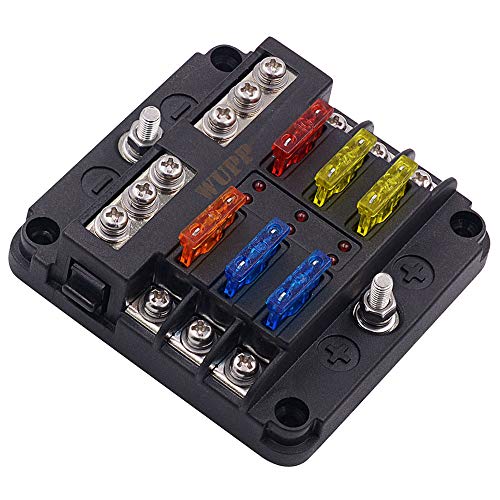
Best for boaters who want a compact 6-circuit layout with reliable LED fault indication. This block supports 12–24 V systems and includes a negative bus for grounded circuits. It emphasizes neat wiring with six dedicated fuses and six grounding points. A limitation is that the six-circuit count may be insufficient for boats with more devices, so buyers with larger electrical footprints may need a second block or a different model.
- Strengths: Damp-proof cover, clear LED fault indicators, organized wiring.
- Best for: Small to mid-size craft needing straightforward protection.
- Be aware: Only six circuits; expansion may be required for complex systems.
DaierTek 12 Way Fuse Block with LED

Choose this if you want a full 12-way block with LED indicators and a waterproof cover for marine use. It supports 12 V to 36 V systems with a maximum of 100 A and up to 30 A per circuit. A key benefit is the immediate red LED when a fuse blows, aiding rapid troubleshooting. Practical caution: ensure the layout aligns with your boat’s panel space and wiring routes before purchase, as mounting dimensions vary among marine enclosures.
- Strengths: LED fault indication, waterproof cover, ample circuit count.
- Best for: Boats needing clear fault signaling across many circuits.
- Be aware: Verify mounting dimensions fit your panel area.
BetyBedy 12-Way Fuse Block with LED

Best for boaters who want a complete kit with included fuses and stickers for circuit labeling. The 12-way design includes a ground bus, 100 A total panel capacity, and 30 A per fuse. It provides LED alerting for blown fuses and a protective casing to keep wiring neat. A limitation is that the package’s fuse assortment should align with the boat’s specific electrical load; some devices may need different fuse ratings not included in the kit.
- Strengths: All-in-one package, labeled circuit indicators, sturdy housing.
- Best for: Boats needing a ready-to-install kit with labeling aids.
- Be aware: Fuse ratings included may not fit every device; plan substitutions if needed.
Buying Guide: Key Considerations For Marine Fuse Boxes
- System voltage and current: Confirm whether your vessel runs on 12V or 24V (or both) and ensure the fuse panel supports the maximum circuit load you plan to protection.
- Circuits and layout: Assess how many devices require protection and whether a neat wiring design (dedicated slots and a grounding bus) helps your installation and maintenance routine.
- Indication and visibility: LED indicators speed fault identification and reduce downtime during troubleshooting, especially at sea.
- Durability and environment: Look for fire-retardant materials, moisture resistance, and a protective cover to shield terminals from splash and dust.
- Expansion potential: If you anticipate adding electronics, choose panels with more circuits or easy stacking/combination options.
- Fuse types and ratings: Check whether the panel uses standard blade fuses (ATO/ATC), and verify that included fuses meet the needs of your devices.
- Installation footprint: Measure mounting space and confirm that enclosure dimensions fit your boat’s dash or electrical locker.
FAQ
- What is the advantage of a negative bus in a fuse block?
It centralizes grounding for multiple circuits, simplifying wiring and improving fault isolation. - How many amps per circuit should I plan for on a boat?
Typical marine circuits range from 5 A to 30 A per device; total panel capacity should cover the combined load without excess strain. - Should I choose a fuse block with a protective cover?
Yes, a protective cover reduces splash exposure and helps prevent accidental shorts in marine environments. - Is LED fault indication essential?
It speeds troubleshooting and minimizes downtime by pinpointing blown fuses quickly. - Can I mix panels from different brands?
It’s possible but ensure voltage, current ratings, and fuse types are compatible with your boat’s electrical system. - Do these panels support both 12V and 24V systems?
Many marine fuse blocks support 12V and 24V; verify the product specs to confirm compatibility with your setup.