Answering the exact needs of boaters seeking dependable freshwater delivery, this guide highlights five top 12V or 110V pump choices for boats, yachts, RVs, and off-grid setups. These pumps are best for on-demand water systems, compact spaces, and reliability in marine environments. The selections vary by flow rate, pressure, power source, and noise level to fit different boat sizes and usage. This article helps buyers compare options, identify who each pump suits best, and understand practical trade-offs before purchasing.
Quick product snapshot:
- ECO-WORTHY 33-Series, 110V AC, 4.0 GPM, 50 PSI — ideal for compact boat setups needing AC power without a battery.
- Gidrox 12V RV Pumps (two variants: 4.0 GPM and 5.0 GPM) — versatile, off-grid capable, suitable for campers and boats with battery systems.
- SEAFLO 55 Series 12V, 5.5 GPM, 60 PSI — high-flow and NSF/UL compliant, built for daily boat and RV use.
- Hzhdven Upgraded 12V, 7 GPM, 70 PSI — high flow with a five-chamber diaphragm for quiet operation.
- Kohree 2026 Upgraded 12V, 7.5 GPM, 70 PSI — strong performance with improved durability and safe dry-run protection.
ECO-WORTHY 33-Series Industrial Water Pressure Pump
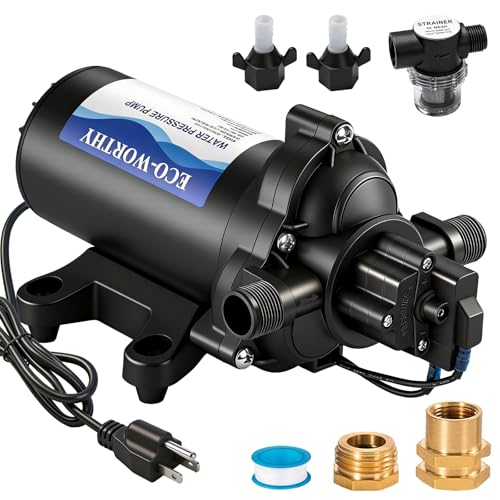
Best for boaters needing a reliable 110V AC pump without a marine battery. This self-priming diaphragm pump operates at 4.0 GPM with a 50 PSI threshold. It includes a smart pressure switch that starts on demand and stops when faucets close, helping reduce water hammer and energy use. It is suitable for RVs, marinas, and small to mid-size boats that have access to shore power. A key caution is its 110V requirement, which may limit off-grid use without an inverter.
Gidrox 12V RV Water Pump (4.0 GPM, 45 PSI)

Best for off-grid travel and small boats needing 12V DC operation. The pump delivers 4.0 GPM at 45 PSI with self-priming capability up to 10 ft and head up to 100 ft. It features overheating protection and a vibration-damping design to reduce noise. This makes it suitable for campers and boats with battery power and portable water systems. Limitation: overall flow is modest compared to high-flow marine systems, so it may be less ideal for larger demands.
Gidrox 12V RV Water Pump (5.0 GPM, 55 PSI)

Best for RVs and boats needing stronger water flow while remaining battery-powered. This 5.0 GPM pump achieves 55 PSI with self-priming and robust protection. It shares the same resilience features as the 4.0 GPM variant, including noise reduction and off-grid readiness. Choose this if your water usage includes multiple outlets or larger fixtures. Limitation: higher flow demands may require a larger power supply or battery capacity.
ECO-WORTHY RV Fresh Water Pump 12V DC 3.5GPM

Best for compact systems where 12V operation is essential. This pump provides 3.5 GPM at 45 PSI with an automatic on-demand pressure switch. It features thermal overload protection and dry-run capability without damage. It’s suitable for small boats, yachts, and RVs with limited electrical capacity. A limitation is its slightly lower flow compared to higher-GPM models, which may matter for showers and larger fixtures.
WASSERMANN RV Pump (4.0 GPM, 45 PSI)

Best for complete kit readiness with bundled adapters and debris filter. Delivers up to 4.0 GPM at 45 PSI with 12V DC power, making it versatile for RVs and boats. The included accessories support simple installations on standard hose lines. Limitation: kit contents may vary by listing, so verify included hardware before purchase.
Upgraded 12V RV Water Pump (7GPM, 70 PSI)

Best for high-demand onboard systems needing rapid water delivery. With a five-chamber diaphragm and a 70 PSI limit, this pump achieves 7 GPM and strong head pressure. It includes a heavy-duty pressure switch and a strainer for protection. Choose this if showers, multiple outlets, or large fixtures are used frequently. Caution: requires appropriate wiring and fuse sizing for sustained 12V operation.
2026 Kohree RV Fresh Water Pump (7.5GPM, 70 PSI)

Best for robust marine and RV systems needing high-flow and durability. The 7.5 GPM at 70 PSI, plus a 70 PSI setpoint and upgraded components, supports rapid water delivery for multiple outlets. It features a self-priming design, a durable five-chamber diaphragm, and smart overload protection. Choose this for frequent high-demand use. Limitation: higher power draw may require a larger electrical circuit in some installations.
Buying Guide
- Power source compatibility: Choose 12V for off-grid or battery-powered boats; 110V for shore-power setups. Some boats use inverters to run AC pumps.
- Flow rate and pressure: Match GPM and PSI to your needs. Higher GPM suits showers and multiple outlets; lower GPM can suffice for simple sinks.
- Self-priming and lift: Ensure the pump can prime from the tank and reach fountains or faucets located above the tank level.
- Protection features: Look for thermal overload protection, dry-run tolerance, and vibration dampening to extend life in marine environments.
- Noise and vibration: Vibration-damping bases and quiet designs improve onboard living comfort.
- Compliance and safety: NSF/UL ratings matter for potable water systems on boats and RVs.
- Installation considerations: Check hose barb sizes, fittings, and included adapters to avoid extra purchases.
FAQ
- What is the best pump type for a small boat?
Diaphragm pumps with self-priming capability are reliable for compact spaces and variable tank heights.
- Do I need a 12V or 110V pump on a boat?
12V is common for off-grid or battery-powered boats; 110V is convenient where shore power is available.
- Can these pumps run dry without damage?
Many models feature dry-run protection, but always consult the manual and avoid extended dry operation.
- Is higher GPM always better?
Higher GPM is beneficial for showers and multiple outlets, but it increases power draw and may require bigger wiring.
- What maintenance helps longevity?
Regular inspection of fittings, ensuring clean water, and avoiding running against closed faucets can reduce wear.
- Are these pumps suitable for potable water?
Some models comply with potable water standards; verify NSF/UL compliance for your specific installation.