If you need a floating handheld VHF radio with GPS and DSC for marine safety, this guide highlights five strong options and explains who each is best for. These radios are designed to stay buoyant, provide location data, and support distress signaling when seconds count. The selections cover coastal explorations, small boats, kayaks, and offshore adventures, focusing on models with GPS and DSC features where available. Read on to compare capabilities, usage scenarios, and practical trade-offs.
| Product | GPS / DSC | Best For | Why Pick |
|---|---|---|---|
| Retevis RM40 Marine Radio | GPS; DSC Distress Call | Coastal sailors and offshore anglers | Includes MOB alarm, real-time GPS, and one-button distress messages for quick rescue. |
| Uniden MHS338BT Floating VHF | GPS; NOAA Weather Alerts | Adventurers needing GPS and rugged submersible design | IPX8 submersible, emergency strobe, flashlight, and Bluetooth connectivity for quick setup. |
| Cobra BlueBound 350 | NA | General marine use on small to mid-size vessels | High visibility floating core, 6W power, day/night display, IPX7 waterproof. |
| Cobra BlueBound 150 | NA | Compact, budget-friendly floating radio | Floating core, 3W power, IPX7 waterproof, USB-C charging. |
| Uniden Atlantis 275 | NA | All-around floating VHF with large display | Floating, IPX8 submersible, big LCD and NOAA weather alerts. |
Retevis RM40 Marine Radio

The RM40 offers built-in GPS with real-time location updates and a DSC distress call system. It also supports MOB (Man Overboard) alarms to share coordinates with nearby vessels. This model is best for watermen who need fast distress signaling and precise positioning during offshore fishing, kayaking, or sailing. A key limitation is that DSC setup relies on preset messages, which may require initial configuration to maximize response efficiency.
Uniden MHS338BT Floating VHF Radio

The Uniden MHS338BT combines GPS capability with Bluetooth for mobile app integration and NOAA weather alerts. Its IPX8 submersible design, water-activated strobe, and optional flashlight support visibility and safety in poor conditions. It delivers full 6W transmit power for greater range when needed. Best for boaters who want GPS positioning and a connected experience via a smartphone, though it may be heavier to carry on small dinghies.
Cobra BlueBound 350 (White)

The White BlueBound 350 emphasizes a high-visibility floating core and 6W power for versatile range needs. It features a user-friendly LCD display designed for day or night viewing and is IPX7 waterproof. Suitable for boaters who want a reliable floating VHF with strong visibility and straightforward controls. It lacks DSC and GPS, so choose this if those features aren’t required.
Cobra BlueBound 350 (Black)

Similar to the white variant, the Black BlueBound 350 provides a high-visibility floating core with 6W power and IPX7 waterproofing. It is geared toward users who prioritize quick access and rugged performance in mixed weather. For DSC and GPS capabilities, consider models with those features if needed for safety signaling.
Retevis RM01P Marine Radio

The RM01P emphasizes portability and IP67 waterproofing with floating design. While it offers NOAA support and a rugged build, GPS functionality isn’t clearly listed among the features. It is best for quick, one-handed operation on closer-range coastal work, but avoid if you require DSC signaling or integrated GPS in your workflow.
Uniden Atlantis 275
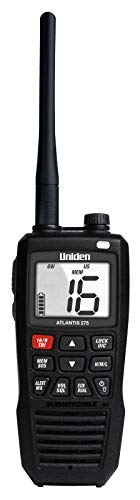
The Atlantis 275 is a floating, IPX8 submersible VHF with a large dual-color display and NOAA weather alerts. It is designed for users who want an all-weather handheld with a big screen for easier readability. GPS is not highlighted in the listed features, so users needing precise location sharing should verify GPS availability before purchase.
Buying Guide
- GPS and DSC: If DSC distress signaling and GPS location sharing are essential, prioritize RM40 or Uniden devices that explicitly list these features. DSC improves rescue response, while GPS provides precise coordinates.
- Waterproofing and buoyancy: Look for IP ratings and floating cores. IPX8 and IPX7 ratings indicate strong submersion resistance; floating cores help retrieval after a drop.
- Power and range: A 6W radio offers longer transmit distance than lower-power options. Consider your boating environment—open sea vs. inland waterways—when choosing power levels.
- Battery and charging: Rechargeable Li-ion packs and convenient charging docks reduce downtime. Ensure the device includes a reliable cradle or charging options for quick access.
- Display and usability: Large LCDs with day/night readability help visibility in rough conditions. Consider backlit displays if you’ll operate in low light.
- Additional features: NOAA weather alerts, strobe lights, SOS messages, and Bluetooth can add safety and convenience, but verify compatibility with your existing devices.
FAQ
- Do all floating VHF radios have GPS and DSC? No. Some models offer GPS and DSC, while others provide GPS or NOAA alerts without DSC. Check product specs carefully.
- Is IPX8 waterproofing necessary? IPX8 indicates submersible capability, which is beneficial if the radio might be dropped overboard or exposed to heavy spray.
- What is DSC distress signaling? DSC allows you to send a digital distress call with your position to coast guards and nearby ships, improving response time in emergencies.
- Should I choose Bluetooth-enabled radios? Bluetooth can help with app integration and setup, but ensure it doesn’t compromise waterproofing or battery life.
- Is 6W power always better? Higher power can extend range but consumes more battery. Choose a model with adjustable power to optimize battery use.
- What warranty considerations matter? Look for models with clear warranty terms and accessible customer support in the U.S. market.