Answering the question, these floating docks for saltwater are designed to handle harsh marine conditions while providing stable access to water activities. The top picks below cater to different needs: rigid, API-friendly floats for marinas and DIY docks; inflatable platforms for quick setup and portability; and modular systems for expanding your waterfront space. Ideal buyers include marina operators, homeowners with saltwater ponds or lakes, and boaters seeking easy-access platforms. The following table highlights the strongest options among the leading models reviewed here.
| Product | Best For | Key Benefit |
|---|---|---|
| Eagle Float Dock Float | DIY docks, marinas | Rigid, foam-filled core with UV-resistant shell |
| Taylor Made Dock Floats 24″x48″x16″ | Durable, heavy-use docks | Impact-resistant shell with EPS foam core |
| SPECRAFT Inflatable Floating Dock | Portable, versatile spaces | Expandable, non-slip PVC surface; 880 lb cap |
| HeySplash Inflatable Floating Dock | Family floats, lakes and pools | All-in-one ladder and platform; up to 675 lbs |
| Patriot Docks Low-Profile Floating Dock Section | Small, easy-access setups | Low-profile design; durable PE floats |
Eagle Float Dock Float

Best for: DIY docks and small to mid-size installations. This foam-filled float features a 100% virgin polyethylene shell, a solid EPS core, and a .15” nominal wall thickness. It ships with mounting slots molded into the top for straightforward attachment to docks or piers. The design emphasizes durability and weather resistance, helping maintain buoyancy in saltwater environments. Caution: mounting hardware is not included, so consider compatible hardware for your setup.
Taylor Made Dock Floats 24x48x16

Best for: durable, heavy-use saltwater docks. These floats use a UV-resistant black polyethylene shell filled with EPS foam to prevent sinking if the shell is compromised. They offer easy installation via mounting flanges and hardware slots and are available in multiple flotation ratings. Caution: higher-capacity models require adequate anchoring and may need more robust mounting hardware in exposed marine environments.
SPECRAFT Inflatable Floating Dock
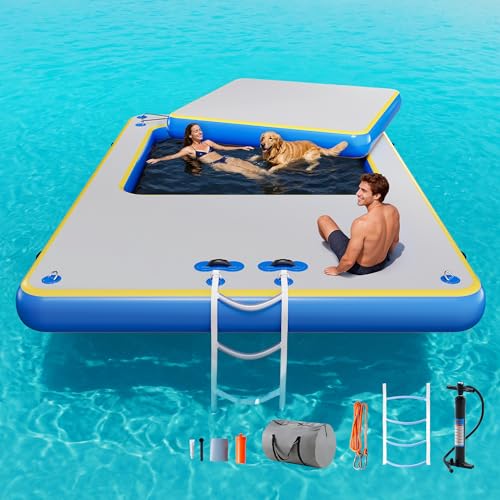
Best for: versatile, expandable floating spaces. The 12×8 ft platform uses brushed PVC with a reinforced drop-stitch core and a 6.1 inch thickness for puncture resistance and stability. It supports up to 880 lb and can be expanded by connecting additional platforms, ladders, or water toys. Limitation: inflation and setup require a suitable pump and careful monitoring of air pressure for optimal firmness.
HeySplash Inflatable Floating Dock

Best for: lakes, pools, and family water play. This 8×6 ft dock inflates to about 0.5 ft thick and supports up to 675 lbs. Built with high-density PVC and reinforced edges to resist punctures. It includes an integrated ladder for easy access and an EVA-coated platform for traction. Caution: weight limits can be exceeded with multiple adults or large gear; plan for a conservative load.
Patriot Docks Low-Profile Floating Dock Section

Best for: simple, close-to-water access. This low-profile section includes a 4×8 frame, two 48x24x12 floats, and mounting brackets for straightforward assembly. The design sits closer to the water, improving ease of access while maintaining buoyancy with high-density polyethylene floats. Caution: it’s a modular section and may require additional pieces to create a complete dock system in larger setups.
Buying Guide: Floating Docks For Saltwater
- Material and core: Rigid floats with EPS foam cores and UV-resistant shells resist salt exposure better and reduce the risk of water intrusion. Look for virgin-grade polyethylene or similarly durable shells for longevity.
- Buoyancy and load: Match flotations to your planned use. Safety and performance depend on adequate buoyancy for people, gear, and water conditions.
- Attachment options: Consider docks with built-in mounting slots or flanges for straightforward installation. Ensure hardware compatibility with your existing deck or pier.
- Portability vs. permanence: Inflatable docks offer portability and quick setup, ideal for seasonal waterfronts. Rigid floats are better for permanent, heavy-use installations.
- Maintenance and durability: Saltwater environments demand corrosion-resistant hardware and UV-stable coatings. Check for reinforced edges and puncture resistance.
- Expansion potential: If you foresee growth, choose modular or expandable systems that allow adding platforms, ladders, or water toys.
- Storage and care: For inflatables, local air pressure and seasonal deflation ease storage. For rigid floats, ensure proper cleaning and inspection to prevent deterioration.
FAQ
- What is the best type of floating dock for saltwater?: Durable, UV-resistant shells with EPS foam cores are favored for longevity in saltwater environments, especially in heavy-use settings.
- Do inflatables work well in saltwater?: Yes, but they require proper inflation, secure anchoring, and regular inspection for punctures in rocky or shell-strewn areas.
- Can I mix different floating dock types?: Yes, modular systems and mixed-faced docks can be combined, but ensure compatible connections and safe load distribution.
- How much maintenance do saltwater docks require?: Routine checks for leaks, hull integrity, and hardware corrosion help maximize lifespan in saltwater.
- Are there safety considerations for family use?: Choose platforms with slip-resistant surfaces and safe ladder designs, and adhere to weight limits and environmental conditions.
- What accessories help with docking stability?: Anchor lines, additional floats, and secure mooring hardware improve stability in currents and waves.