Flexible solar panels are ideal for boats thanks to their lightweight, bendable design that adapts to curved surfaces. These panels offer efficient power generation for marine applications, ensuring reliable off-grid electricity. Below is a summary table of top flexible solar panels perfect for boats, featuring various wattages, flexibility, and installation ease.
| Product | Brand | Wattage | Flexibility | Key Feature |
|---|---|---|---|---|
| Renogy 100W Flexible Solar Panel | Renogy | 100W | Bends up to 240° | Half-cut PERC cell technology for enhanced efficiency |
| ECO-WORTHY 260W Flexible Solar Panel Kit | ECO-WORTHY | 260W (2x130W panels) | Flexible polymer materials, lightweight | Includes 30A charge controller and cables |
| Topunive 100W Flexible Solar Panel | Topunive | 100W | Minimum bend radius 17.7 inches | 9 Busbar monocrystalline cell with 23% conversion efficiency |
| Newpowa 100W Flexible Solar Panel | Newpowa | 100W | Highly flexible and ultra lightweight | 10BB cell design and IP68 waterproof rating |
| TATOODAA 300W Flexible Solar Panel | TATOODAA | 300W | Curves up to 270° | High conversion efficiency of up to 24% |
Renogy 100W Ultra Flexible Solar Panel for Boats
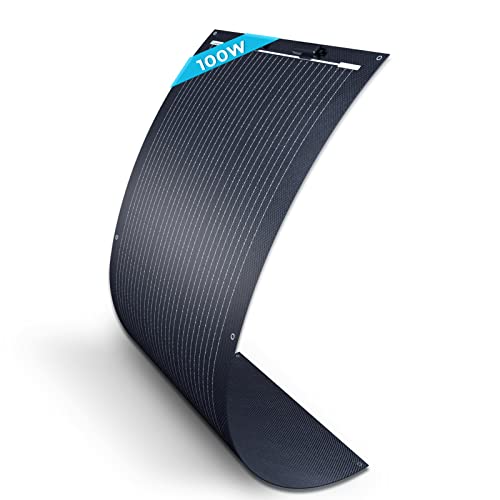
The Renogy 100W Flexible Solar Panel delivers a high power output of about 500 watt-hours daily, depending on sun exposure. It is lightweight and bendable up to 240 degrees, making it suitable for curved boat surfaces. This model uses half-cut PERC technology that improves electrical performance and increases output efficiency. Its all-black, glare-free finish provides a sleek look and minimizes reflection. The panel’s ease of transport and installation makes it a practical choice for marine environments, RVs, and more.
ECO-WORTHY 260W Flexible Solar Panel Kit with Controller

This 260W flexible solar panel kit by ECO-WORTHY includes two 130W monocrystalline panels, a 30A 12V temperature-compensated charge controller, and necessary cables. The kit produces up to 1040 watt-hours per day under strong sunlight, perfect for boats and other off-grid applications. Panels are made from advanced polymer materials, making them 70% lighter than traditional glass solar panels. Ideal for marine use, RVs, or uneven surfaces, it also features quick installation options and robust durability.
Topunive 100W 9BB Flexible Solar Panel for Marine Use

The Topunive 100W flexible panel offers extreme flexibility with a minimum bend radius of 17.7 inches, accommodating various boat and RV surfaces. It weighs just 4.4 pounds and is only 0.1 inches thick, simplifying installation and transport. The 9 busbar monocrystalline cells provide an excellent 23% conversion efficiency, enhancing power output. Pre-drilled holes and PV connectors assist mounting, making this panel efficient and user-friendly for marine and off-grid setups.
Newpowa 100W Portable Bendable Solar Panel for Boats

The Newpowa 100W flexible solar panel is designed with a 10 busbar cell layout that optimizes power efficiency up to 23%. This panel is extremely thin at 0.08 inches and weighs only 3.8 pounds, making it ultra-lightweight for easy boat installation. Its IP68 waterproof rating ensures durability in harsh marine environments. The high-quality monocrystalline cells are protected using advanced soldering techniques, reducing power loss and extending panel longevity.
TATOODAA 300W Ultra Lightweight Flexible Solar Panel

The TATOODAA 300W flexible solar panel offers an exceptional power output with up to 24% conversion efficiency thanks to grade A solar cells. Weighing just 8.6 pounds and only 0.11 inches thick, it is highly portable and fits a variety of curved surfaces with a bending capacity of up to 270 degrees. The ETFE coating provides excellent waterproofing and weather resistance, optimal for marine use and outdoor environments exposed to extreme temperatures.
Buying Guide: Choosing Flexible Solar Panels for Your Boat
Choosing the best flexible solar panel for your boat involves several important factors to consider. These will ensure you select a panel that balances efficiency, durability, and ease of installation for optimal marine use.
Wattage and Power Output
Assess your boat’s energy demands and select a panel wattage accordingly. Panels range from 100W to 300W or more. Higher wattages provide more power but can be heavier and more expensive. Consider whether you need a kit that includes charge controllers and cables for a complete solution.
Flexibility and Bend Radius
Boats often have curved or irregular surfaces. Opt for panels with a bend radius that matches your installation area. Models bending between 180 to 270 degrees offer versatility for most boat designs. Verify the minimum radius to avoid panel damage during installation.
Weight and Portability
Lighter panels are easier to transport, install, and less impactful on your boat’s balance. Flexible polymer and thin monocrystalline panels weigh significantly less than rigid glass panels. Panels around 3 to 9 pounds typically offer excellent portability.
Durability and Waterproofing
Marine environments expose panels to saltwater, humidity, and extreme weather. Look for panels with waterproof coatings such as ETFE or IP68 ratings to ensure resistance against corrosion, abrasion, and UV damage. Double fiberglass or reinforced backing increases impact resistance.
Solar Cell Technology and Efficiency
Monocrystalline cells with advanced designs (half-cut, PERC, multiple busbars) offer higher conversion efficiency, allowing you to generate more power in limited space. Panels with additional busbars reduce microcracks and improve lifespan.
Installation Features
Check for pre-drilled holes, metal grommets, or adhesive compatibility for straightforward mounting. Kits including charge controllers and connectors simplify setup. Non-permanent fixing options like velcro or removable tape may suit seasonal usage or rental boats.
Price vs. Performance
Balancing cost with features and durability ensures you maximize value. Investing in renowned brands with proven performance like Renogy or ECO-WORTHY can provide reliability and support. However, less expensive panels may offer decent performance for casual or occasional use.
Considering these perspectives will help you choose a flexible solar panel tailored perfectly for your boat’s energy needs and installation constraints.