Answering the most common buyer question: which electric thrusters deliver reliable forward propulsion for boats, kayaks, or paddle boards? This guide highlights five practical options and explains who each one is best for. It covers underwater thrusters and jet-style systems, focusing on installation simplicity, thrust levels, and suitability for fresh water or mixed-use craft. Use the quick reference table below to compare core specs at a glance.
| Product | Best For | Key Benefit |
|---|---|---|
| ApisQueen U92 Pro Underwater Thruster | Kayakers, fishing boats, inflatables | High thrust with multi-voltage support |
| ApisQueen 12-24V U5 Underwater Thruster | Freshwater inflatables and kayaks | Strong thrust in a compact build |
| Kedean Directional Kayak Belly Boat Propulsion | Paddle boards and belly boats | Advanced steering for precise control |
| Kedean 360W 24V SUP Underwater Motor | SUPs, kayaks, belly boats | Jet-like propulsion with longer battery life |
| LICHIFIT RC Jet Boat Underwater Motor | DIY RC boats and small submarines | Compact, high RPM thruster |
ApisQueen U92 Pro Underwater Thruster Set

The U92 Pro is a 24V brushless thruster designed for kayaks, inflatables, and light fishing boats. It combines an inner rotor with a dynamic sealing design to resist mud and water intrusion, enabling longer operation in challenging environments. It supports 12V and 24V systems, delivering up to 15.9 lbs of thrust on 12–16V and 44.1 lbs on a full 24V supply. It is described as ready-to-use when connected to power, emphasizing simple installation for quick setup.
Best for: small to mid-sized boats requiring strong thrust with straightforward installation. It is a versatile choice for users who want higher thrust without complicated mounting. Better for users who can supply either 12V or 24V power and need reliable performance in fresh or slightly muddy waters.
Caution: data indicates high thrust at 24V, but real-world performance depends on battery health and propeller compatibility. Ensure correct polarity when wiring to avoid motor damage.
ApisQueen 12-24V Underwater Thruster U1 Set
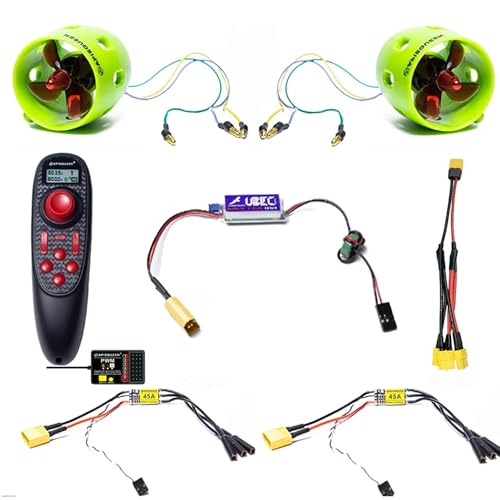
The U1 set includes directional thrusters with ESCs and a receiver, designed for freshwater use and small ROV-style setups. It uses brushless motors and emphasizes a compact, light design with non-waterproof remote control and a simple hand-off to power. It is best for hobbyists developing underwater projects in calm freshwater and for DIY enthusiasts building small, controlled submersibles or inflatables that require precise propulsion control.
Best for: freshwater applications, basic DIY projects, or small ROVs. Choose this if you want a compact kit with both CW and CCW configurations for flexible mounting. Limitation: the remote control is non-waterproof, which restricts use in deeper or wetter environments without extra protection.
Kedean Directional Belly Boat Propulsion

This 360W DC24V motor version is designed for belly boats, SUPs, and similar craft. It ships without a battery and includes a direct power lead to connect to a 24V source. The propulsion system features an advanced steering function for precise direction changes and a hydrodynamic propeller design to maximize thrust with lower drag. It claims longer battery life for a given power level due to efficient propulsion.
Best for: users who want precise steering on a belly boat or SUP with a ready-to-connect power setup. Choose this if you value control and plan to use a 24V battery. Caution: this model requires a matched 24V battery and careful handling of exposed wiring when mounting on lightweight craft.
Kedean Electric Engine Trolling Motor For SUP

Designed for SUPs, kayaks, and belly boats, this 360W DC24V motor emphasizes a mix of high thrust and efficient water flow. It notes higher speeds than standard propeller motors due to aerodynamic and hydrodynamic tuning. Battery life is framed as improved with the efficient propeller, making it possible to run a smaller, lighter pack for a similar runtime as larger motors.
Best for: riders seeking faster speeds and efficient power use on SUPs and kayaks. Choose this model if you want jet-like performance without sacrificing overall portability. Limitation: requires a 24V battery and careful water compartment sealing to prevent moisture ingress in rough conditions.
LICHIFIT RC Jet Boat Underwater Motor

The LICHIFIT unit is a compact underwater thruster suitable for DIY micro ROVs, small RC boats, and light underwater work. It emphasizes a 3-blade propeller design and high RPM, allowing for rapid responsiveness in controlled environments. The kit nature suits hobbyists assembling compact underwater propulsion systems with easy integration into light craft or experimental setups.
Best for: hobbyists building small RC boats or underwater robots where compact form and quick response matter. Choose this if you need a high-RPM thruster in a small package. Caution: compatibility with larger craft is limited; this is best for micro or RC-scale projects rather than full-size boats.
Buying Guide
What to consider when choosing an electric thruster for boats:
- Power and voltage compatibility: Determine whether you need 12V, 24V, or dual-voltage support based on your battery and craft size. Higher voltage generally provides more thrust, but requires appropriate wiring and battery capacity.
- Thrust vs. weight: Match the expected thrust to your boat’s weight and intended speed. Heavier inflatables or larger kayaks need more thrust for reliable planing or maneuvering.
- Water environment: Freshwater use is common for many thrusters, but salt or muddy water can affect seals and bearings. Look for models with robust seals and corrosion resistance for longer life.
- Mounting and installation: Some thrusters are “plug-and-play” for quick setup, while others require brackets or custom mounting. Consider how easily you can attach to your craft and access power wiring.
- Control and steering: If precise steering is essential, prioritize models with advanced steering functions or directional control. Non-waterproof remotes are a limitation in wet environments.
- Battery considerations: Ensure your battery capacity aligns with your intended runtime. Newer high-efficiency propellers can extend battery life, but always plan for reserve power.
- Maintenance and durability: Look for brushless motors and robust seals. Consider materials that resist rust and corrosion for longer service life in marine environments.
Frequently Asked Questions
- Do electric thrusters work well in saltwater?
Answer: Many are designed for freshwater use; check seals and corrosion resistance before using in saltwater or mixed conditions. - Is it easy to install a thruster on a kayak or inflatable?
Answer: Some kits are ready-to-use with straightforward wiring, while others require brackets or mounts. Always follow manufacturer instructions. - What battery should I choose?
Answer: Choose a battery that matches the motor’s voltage requirement and provides enough capacity for the desired runtime. Higher voltage usually means more thrust but heavier weight. - Can I upgrade my existing craft with a new thruster?
Answer: Yes, many thrusters support common mounting patterns, but verify motor shaft size, mounting holes, and power wiring compatibility first. - Are these thrusters safe for beginners?
Answer: Some models are beginner-friendly with plug-and-play setup, while others cater to DIY enthusiasts with more complex wiring and control options. - What maintenance is required?
Answer: Regularly inspect seals, bearings, and propellers for wear. Clean after use in freshwater, especially if used in muddy or brackish water.