Looking for an electric boat motor kit that’s quiet, reliable, and easy to maintain? This guide highlights five top options that fit a range of boats and budgets. It’s ideal for anglers, recreational boaters, and DIY enthusiasts seeking efficient propulsion without fuel or excessive noise. The selections emphasize portability, range, and user-friendly controls, making them suitable for saltwater and freshwater use where applicable.
| Product | Best For | Key Advantage |
|---|---|---|
| Newport NT300 Electric Outboard | A serious all-around outboard for salt and freshwater | High thrust and long range with digital throttle |
| Newport NV-Series 55lb Thrust | Trolling for larger boats | Strong low-end torque with adjustable mount |
| Newport NV-Series 36lb Thrust | Kayaks, small boats, and canoes | Lightweight, economical battery use |
| Electric Trolling Motor for SUP (Kedean) | Stand-up paddleboards and SUP/kayak hybrids | Jet-style propulsion for higher thrust with compact form |
| ApisQueen Underwater Thruster U2 Set | R&D projects, small ROVs, or hobby builds | Brushless, compact, and highly controllable thrust |
Buyer tip: Consider your boat size, battery availability, and the typical water conditions you encounter. For saltwater use, check corrosion resistance and ease of maintenance. For smaller craft, weight and battery life are often deciding factors.
Newport NT300 Electric Outboard Motor

The Newport NT300 delivers 3HP-equivalent power from a 1300W, 36V system, producing about 110 lb of thrust. This motor is designed for both saltwater and freshwater use, with a digital throttle and an LCD display for clear control feedback. Its shaft length is 24.6 inches, and it uses a 9.8-inch 2-blade composite propeller. Trim/tilt options include 0°, 7°, 14°, and 21° with a 70° range, enabling adaptable performance in various water conditions. The NT300 tops out around 6.5 MPH and can cover up to 66 miles on a single charge, depending on boat type and conditions.
Best for: Boaters seeking a robust, quiet, general-purpose electric outboard suitable for mixed waters and longer trips. Better for anglers and recreational users who want a balance of range, power, and ease of maintenance.
Limitation: Battery capacity and weight influence range; on larger vessels, efficiency depends on load and sea state. Consider a supported 36V battery system with adequate amperage for extended trips.
Newport NV-Series 55lb Thrust Saltwater Trolling Motor

This 12V electric trolling motor offers 55 pounds of thrust, with a 30-inch shaft and a 3-blade propeller. It includes a 5-LED battery meter and a 6-inch telescoping tiller handle. The motor provides eight speeds (5 forward, 3 reverse) and allows for adjustable mount height and direction. Built for trolling, its top speed is modest, but torque is reliable for steady movement and silent operation in both saltwater and freshwater environments.
Best for: Larger boats or anglers seeking stable, all-day trolling with clear battery monitoring. Choose this if you need strong low-end torque with adjustable control for steady fishing trips.
Caution: The top speed is limited by design for stability; expect slower speeds in rough chop or heavier boats. Ensure compatible mounting hardware for your craft.
Newport NV-Series 36lb Thrust Trolling Motor
This 36-pound-thrust trolling motor is designed for small boats, kayaks, canoes, and inflatables. It runs on 12V or 24V, delivering quiet, reliable propulsion with corrosion-resistant build ideal for real-world saltwater and freshwater use. The model features a 30-inch shaft, LED battery indicator, and a 2-blade propeller optimized for battery life. It’s lightweight enough for portable setups while providing enough power for light to moderate loads.
Best for: Small craft operators who need a lightweight, portable motor with predictable battery use and straightforward operation. Choose this if you prioritize ease of transport and simple setup.
Limitation: Not a high-speed solution; better suited for calm waters and shorter trips. Consider expansion options if you anticipate heavier loads or stronger currents.
Electric Trolling Motor For SUP And Kayak

This motor is designed for stand-up paddleboards and fishing kayaks, delivering propulsion with a compact form. It’s a 360W DC24V motor (battery not included) that requires a 24V battery for operation. The design emphasizes aerodynamic and hydrodynamic efficiency to maximize thrust while minimizing drag, potentially extending battery life. It’s positioned as a higher-thrust option for lightweight, portable platforms and faster planing on calmer waters.
Best for: SUP and kayak users who want a compact electric motor with improved thrust and shorter setup times. Choose this if you prioritize compact size and a motor designed for smaller craft.
Limitation: Requires a compatible 24V battery and careful wiring. Not ideal for larger boats or heavy loads where higher thrust is needed.
ApisQueen 12-16V Underwater Thruster U2 Set
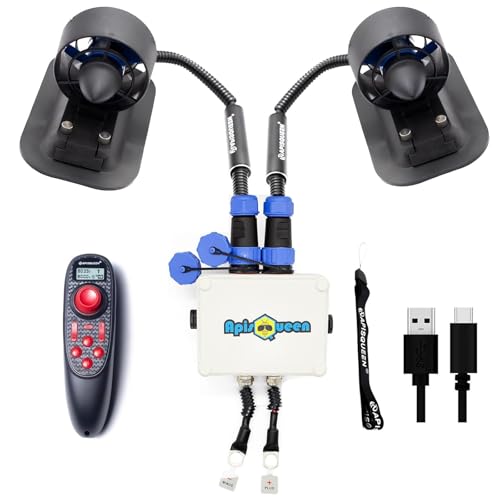
The U2 underwater thruster set is designed to realize forward, backward, left, and right movements with a 7.5 LBS thrust total at up to 1-3 km/h. It supports up to 16V (4S LiPo) but does not include batteries. The brushless design provides durable operation and anti-corrosion properties, making it suitable for marine and freshwater environments in experimental or hobby projects. The kit includes five-core silicone cables and a straightforward wiring approach for DIY builds.
Best for: DIY enthusiasts and hobbyists exploring small-scale propulsion projects, ROVs, or experimental boat builds. Choose this if you want precise directional control and a compact, brushless setup.
Limitation: Not a ready-to-run boat motor. Requires additional power sources and integration work for practical boating applications.
Buying Guide: Key Considerations For Electric Boat Motor Kits
- Boat size and weight: Larger boats demand higher thrust and battery capacity. Match motor power to the vessel and typical load to maintain efficient operation.
- Power source and battery life: Check voltage requirements and runtime expectations. Higher thrust often means higher current draw and faster battery depletion.
- Water conditions: Saltwater corrosion resistance matters for longevity. If you operate in saltwater, ensure components are designed for marine environments.
- Control systems: Digital throttles and LCD displays aid precision. Consider the visibility of battery indicators, speed control, and trim/tilt adjustments for optimal handling.
- Portability: If you frequently transport or store your motor, weight and shaft length are important. Lighter setups improve handling for small craft.
- Maintenance and parts availability: Look for motors with straightforward maintenance and readily available replacement parts, especially for propellers and seals.
- Installation complexity: Some kits include mounting hardware and quick-attach features (like the INTEX motor mount). Others require custom mounting solutions.
- Compatibility: Ensure the motor is compatible with your boat’s transom or mounting system and that battery connections match your setup.
FAQ: Quick Answers For Electric Boat Motor Kits
- What should I consider before buying an electric boat motor kit?
Assess boat size, typical loads, desired speed, battery availability, and operating conditions (saltwater vs freshwater). Choose a kit with compatible mounting, adequate thrust, and proven reliability.
- Are electric motors suitable for all weather conditions?
Electric motors perform well in calm to moderately choppy waters. In harsh conditions, higher thrust and robust mounting help, but always follow safety guidelines and ensure corrosion resistance for saltwater use.
- Do I need a dedicated battery for every motor?
Most motors specify voltage ranges; using the correct battery type is essential. Some setups allow multiple battery configurations, but confirm compatibility with your motor’s voltage and amperage requirements.
- Can I upgrade from a small motor to a larger one later?
Upgrades are often possible but may require new mounting hardware and different battery configurations. Plan for compatibility with your boat once.
- Is a motor mount necessary for all electric kits?
Many inflatable and small-boat kits require mounts (such as heavy-duty composite mounts). A proper mount improves stability and reduces vibration during operation.
- What is the typical maintenance for electric outboard motors?
Regularly inspect propellers, seals, and connectors. Clean corrosion-prone parts after saltwater use and store batteries and controllers away from moisture when not in use.