Find the right downrigger for a pontoon boat with a focus on reliability, ease of use, and suited-for-pontoon performance. This guide highlights five top options, each chosen for sturdy mounting, straightforward operation, and good retrieval control. Ideal buyers include weekend anglers who want simple setup, mid-size boats that need space-conscious gear, and users seeking dependable manual or electric models for steady bait depth.
Buyer quick guide: the following table summarizes the five recommended downriggers, highlighting the best use case and the type of angler each serves best.
| Product | Best For | Key Advantage |
|---|---|---|
| Cannon 1902305 Magnum 10 Electric Downrigger | Electric operation fans | High retrieval speed and push-button weight retrieval |
| Scotty 1073DP Laketroller Manual Downrigger | Compact, lightweight setups | Versatile mounting and durable stainless steel cable |
| Cannon 1901020 Easi-Troll Manual Downrigger | Simple, precise control | Effortless 1.5:1 retrieval with one-handed clutch |
| Cannon Uni-Troll 10 STX | Fast deployment and control | 2:1 retrieval and enclosed boom end for line protection |
| Cannon 1901250 Lake Troll Manual Downrigger | Smaller boats and straightforward operation | Compact boom and reliable 1:1 retrieval |
Cannon 1902305 Magnum 10 Electric Downrigger

The Cannon Magnum 10 Electric is designed for ease of use with electric retrieval and a 20-lb weight capacity. It features a 250 ft per minute retrieval rate and a push-button weight retrieval for quick bait positioning. Positive ION control helps attract fish by aligning the line with the bait. IP68 waterproof connections support reliability in saltwater or freshwater conditions. Best for anglers who want fast, automated depth control and straightforward operation on pontoon boats that handle rough water well.
Best for: anglers who prefer electric operation and quick line recovery. Why selected: high-speed retrieval and simple one-button controls suit busy days on a pontoon. Caution: electric units require battery management and splash protection checks after use.
Scotty 1073DP Laketroller Manual Downrigger
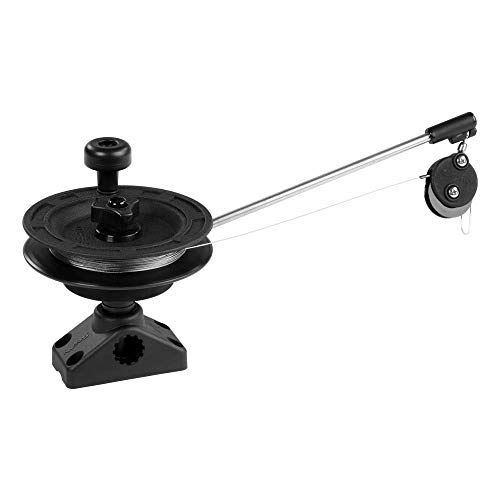
The Scotty Laketroller is a compact, post-mount manual downrigger with a simple deployment process. It includes a durable mounting bracket suitable for flat decks, gunnels, or transoms. It ships with 100 ft of premium 150-lb test stainless steel cable, balancing strength with manageable weight. Best for: pontoon setups needing a low-profile, easy-to-mount option without electronics. Caution: manual operation requires more physical effort and attention to line handling during deep retrieves.
Cannon 1901020 Easi-Troll Manual Downrigger

The Easi-Troll uses a fast, effortless 1.5:1 retrieval speed and a One-Hand Clutch Deploy for controlled, precise bait positioning. The ergonomic crank handle supports extended trolling sessions with less fatigue. Best for: anglers who want quick line release and simple depth control, without electrical components. Caution: manual systems can be slower to deploy and may require more attention in rough water.
Cannon Uni-Troll 10 STX

The Uni-Troll 10 STX offers a 2:1 retrieval speed for fast line-out, plus a One-Hand Clutch Deploy for precise bait positioning. Its stainless steel telescopic boom extends from 24″ to 53″ with an enclosed end to prevent line jumping during deployment or retrieval. Best for: pontoon anglers seeking rapid line management and a robust, extendable boom. Caution: larger booms may require more deck space and sturdy mounting.
Cannon 1901250 Lake Troll Manual Downrigger

The Lake Troll emphasizes a standard 1:1 retrieval rate for straightforward operation. It features a One-Hand Clutch Deploy for controlled descent and a compact 18-inch composite boom suitable for smaller boats on tight docks. Best for: pontoon owners with limited space who still want reliable depth control. Caution: 1:1 retrieval means slower line deployment compared with higher gear ratios.
Buying Guide: Key Purchase Considerations
What size pontoon deck can mount a downrigger securely? Prioritize models with robust mounting options and corrosion-resistant components for frequent exposure to water and spray. Electric vs. manual operation depends on how often you troll, battery access, and how much deck space you have for controls.
How important is retrieval speed? Higher gear ratios recover line quickly, reducing drift time. Manual units rely on user effort but can be highly reliable with fewer electrical components. Consider retirement of line from water and bait depth control when choosing a model.
What boom length and stability matter? A longer, enclosed boom reduces line jump but demands more deck space. Shorter booms are compact but require careful deployment, especially in rough water.
In which conditions will the downrigger be used? Freshwater lakes may tolerate lighter cables; saltwater setups benefit from stainless steel components and IP-rated connections for durability. Budget for maintenance and periodic inspection of cables and pulleys.
How should you mount it on a pontoon? Opt for post or gunnel mounting with secure brackets. Check alignment so the line travels smoothly over the roller and does not foul on rails or seating. Consider a model with a swiveling head or adjustable boom to adapt to pontoon layouts.
FAQ
- What is the typical retrieval speed to look for? Look for higher gear ratios like 2:1 or 1.5:1 for faster line out and retrieval, especially when targeting deeper depths.
- Do I need an electric downrigger on a pontoon? Electric units provide convenience and speed, but manual models are reliable, cost less, and may suit smaller pontoons or casual anglers.
- Can a downrigger be mounted on any pontoon deck? Most pontoons permit post, gunnel, or transom mounting, but confirm deck space and weight capacity before installation.
- What maintenance is required? Inspect cables for frays, lubricate moving parts, clean electrical connections, and replace worn components to ensure smooth operation.
- Is a longer boom better for pontoon boats? A longer boom reduces line jump but needs more deck space and careful alignment with seating and rails.
- What safety considerations are essential? Keep hands clear of the reel during deployment, secure weight retrieval, and maintain clear access to controls during trolling.