The top picks below are 12V solar chargers that fit deep cycle marine batteries, providing efficient maintenance and trickle charging for boats, RVs, and other marine applications. This guide helps boat owners and outdoor enthusiasts choose the right charger based on power needs, durability, and charging efficiency. Each product is evaluated for best use cases, reliability, and practical limitations.
Summary of chosen products:
| Product | Power | Best For | Why Pick It |
|---|---|---|---|
| SUNER POWER 50W Pro | 50W | Large boats, high-use batteries | Highest power, advanced MPPT |
| SUNER POWER 20W Pro | 20W | Moderate maintenance, small to mid-size boats | Balanced efficiency and size |
| SOLPERK 20W Kit | 20W | All-weather durability, universal battery types | Waterproof, rugged frame, smart controller |
| Voltset 20W 12V Kit | 20W | Versatile 12V systems, caravans and boats | Comprehensive protection, universal compatibility |
| ECO-WORTHY 10W Charger | 10W | Budget setups, small craft | Simple, reliable low-power option |
SUNER POWER 50W 12V Solar Battery Charger & Maintainer PRO

Best for high-demand marine setups, this unit uses Ultra-Smart MPPT technology to maximize power point tracking. It delivers up to 99% tracking efficiency and 98% peak conversion efficiency, aiming to boost utilization by about 20-30% compared with non-MPPT controllers. The three-stage charging algorithm (bulk, absorption, float) supports safe, efficient recharge and longer battery life. It stops charging once full and resumes when voltage drops, reducing maintenance. Suitable for larger boats with recurrent charging needs. Limitation: higher power systems may require sturdier mounting and wiring considerations to optimize performance in rough seas.
SUNER POWER 20W 12V Solar Battery Trickle Charger & Maintainer PRO

Best for medium-sized boats and caravans with steady charging needs. The 20W setup uses Ultra-Smart MPPT for efficient tracking and a three-stage charging cycle to protect and prolong battery life. It’s designed for automatic maintenance, stopping at full charge and resuming when discharge occurs. Choose this if you want reliable, low-maintenance charging in varied marine environments. Caution: ensure mounting is secure to withstand wind and salt exposure.
SOLPERK Solar Panel Kit 20W 12V
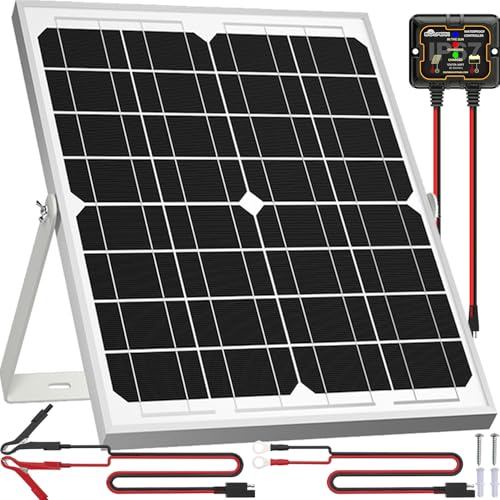
Best for rugged marine environments and a wide battery mix, this kit features a 20W monocrystalline panel with robust corrosion-resistant framing. It supports 12V batteries including LiFePO4, Lithium Ion, AGM, and more. The controller includes three-stage charging and indicators to track status. It’s water-friendly and built to withstand weather, making it a solid all-around choice for boats, RVs, and trailers. Limitation: heavier wind-driven movement may require secure mounting and regular checks for salt buildup.
Voltset 12V Solar Battery Charger Kit 20W

Best for versatile 12V systems, this 20W kit uses an advanced MPPT controller to deliver 20-30% faster charging for a wide range of battery chemistries, including LiFePO4 and AGM. It emphasizes protection with built-in safeguards against overcharge, over-discharge, and short circuits. It is a strong all-around choice for RVs, boats, and trailers seeking dependable charging with universal compatibility. Caution: confirm battery type compatibility before use to ensure optimal performance.
ECO-WORTHY 10W Solar Battery Charger Maintainer
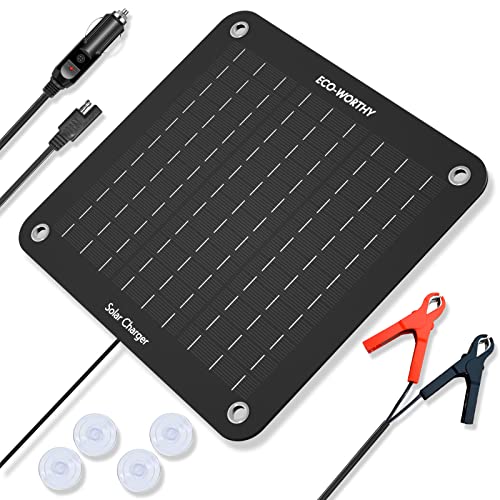
Best for budget-conscious users and small crafts, this 10W charger provides essential trickle charging for 12V batteries. It includes a blocking diode to prevent reverse charging and operates effectively in daytime and low-light scenarios. It is a straightforward option for maintaining smaller marine batteries when space and funds are limited. Limitation: lower power output may be insufficient for larger deep cycle batteries or heavy daily use.
Buying Guide: Key Considerations For Marine Battery Solar Chargers
- Power needs: Match panel wattage to battery bank size and expected daily discharge. Larger boats typically benefit from 20-50W kits; smaller crafts may be fine with 10-20W.
- MPPT vs PWM controllers: MPPT controllers maximize energy conversion, especially in partial shade or cooler days. PWM is simpler and often cheaper but less efficient.
- Battery compatibility: Check compatibility with LiFePO4, AGM, Gel, Flooded, and other chemistries. Some chargers advertise universal compatibility but verify specifics for your battery type.
- Durability and weather resistance: For marine use, look for waterproof, corrosion-resistant framing, tempered glass, and robust mounting options.
- Automation and maintenance: Features like automatic float charging and restart on discharge reduce manual intervention and extend battery life.
- Installation considerations: Ensure proper wiring gauge, fuse protection, and secure mounting to withstand marine environments and wind loads.
- Size and weight: Consider space on deck or in the cabin; larger panels deliver more power but require more space.
Frequently Asked Questions
- What is the difference between MPPT and PWM solar chargers? – MPPT chargers optimize energy conversion and are more efficient in variable conditions, while PWM chargers are simpler and generally cheaper but less efficient.
- Can these chargers be used for all marine battery types? – Many listed options support multiple chemistries, but always verify compatibility with your specific battery type and capacity.
- Do I need a charge controller with a solar panel? – Yes. A controller manages charging to prevent overcharging and prolongs battery life; some panels include an integrated MPPT controller.
- Will a higher-wattage panel always charge faster? – Not always. Charging speed depends on sunlight, panel efficiency, and battery state. MPPT controllers help maximize available energy.
- How should I mount a marine solar panel? – Mount on a stable, corrosion-resistant surface with proper tilt to maximize sun exposure; seal all mounting points to prevent water ingress.
- Is it safe to leave solar chargers connected all the time? – Many models support automatic maintenance, but verify manufacturer guidance for continuous use with your battery chemistry and charging setup.