Looking for a reliable deep cycle battery to power a trolling motor? This guide highlights five solid 12V options, focusing on longevity, weight, and maintenance needs. The best picks include both AGM and LiFePO4 styles to suit different priorities like ease of use, weight savings, and overall life cycles. The right choice depends on how you use your boat—casual weekend sails, long-haul fishing sessions, or remote off-grid setups. Below, see who each product is best for and why it stands out in the field.
| Product | Type | Best For |
|---|---|---|
| Newport 12V50Ah Deep Cycle AGM | AGM | Lightweight trolling-motor power with sealed, leak-proof design |
| Eiiev 12V 100Ah LiFePO4 | LiFePO4 | Long lifespan and high run-time for extended trips |
| WEIZE Deep Cycle AGM 100Ah | AGM | Maintenance-free setup with solid self-discharge control |
| CHITOLI 12V 100Ah LiFePO4 | LiFePO4 | Smart BMS with strong cycle life and safety features |
| SUPER EMPOWER 12V 100Ah LiFePO4 | LiFePO4 | Drop-in replacement with high cycle life and compatibility |
Newport 12V50Ah Deep Cycle AGM Battery

Best for: boaters seeking a lightweight, sealed AGM option that is easy to transport and install. Why selected: 32 lbs makes it notably lighter than many lead-acid alternatives, and its sealed AGM construction minimizes leakage risk on coastal and inland waters. It is explicitly trolling-motor compatible, offering reliable power for day trips and moderate excursions.
Caution: As a lead-acid AGM, it may have lower cycle efficiency than LiFePO4 options, leading to more frequent replacements in high-cycle use.
Eiiev 12V 100Ah LiFePO4 Battery

Best for: users prioritizing longevity and high runtime in a compact, lighter package. Why selected: LiFePO4 cells deliver thousands of cycles and a lighter weight (about 24 lbs), with a flat discharge curve that sustains voltage. The built-in BMS supports protection against overcharge and discharging, enhancing safety on long trips.
Caution: Requires careful matching with compatible BMS and charging setups to maximize cycle life.
WEIZE 12V 100Ah AGM Deep Cycle Battery
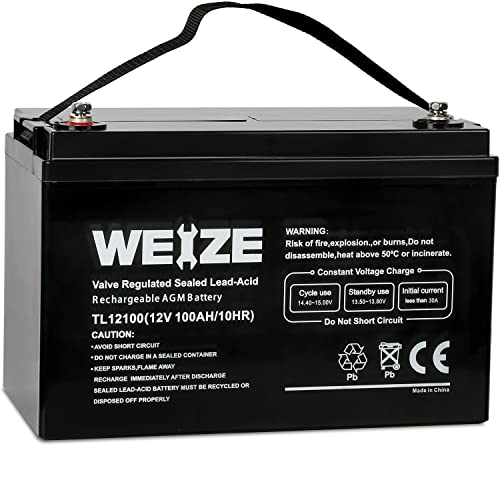
Best for: boaters needing a maintenance-free, sealed lead-acid option with solid self-discharge control. Why selected: AGM design minimizes leakage and allows for a broad operating temperature. It’s a practical all-around choice for RVs, solar setups, and trolling motors where convenience matters.
Caution: AGM performance can drop more quickly under heavy, frequent cycling compared to LiFePO4 options in the same weight class.
CHITOLI 12V 100Ah LiFePO4 Battery

Best for: users who want a smart LiFePO4 option with a robust BMS and high cycle life for trolling motors and camping setups. Why selected: The battery emphasizes a built-in smart BMS preventing over-charge/discharge and short circuits, plus a weight around 22.57 lbs, making it a strong drop-in for Group 24 boxes.
Caution: Not intended for engine starting; designed for energy storage and auxiliary power rather than crank applications.
SUPER EMPOWER 12V 100Ah LiFePO4 Battery

Best for: those seeking a drop-in LiFePO4 replacement with high cycle life and broad compatibility. Why selected: The 100Ah capacity supports longer trolling-motor run times, while a compact footprint and 21.6 lbs weight enable easier storage in standard boxes. It’s designed for RV, marine, and solar uses with a built-in BMS.
Caution: UL/FCC compliance is stated, but prospective buyers should confirm box-fit with current battery compartments before installation.
Buying Guide: Key Considerations for Deep Cycle Trolling Motor Batteries
What should you prioritize when choosing a deep cycle battery for a trolling motor? Consider chemistry (AGM vs LiFePO4), weight, cycle life, and maintenance needs. LiFePO4 delivers longer lifespans and lighter weight at a higher upfront cost, while AGM offers lower up-front costs and ease of use with sealed leakage resistance. Battery capacity, discharge depth (DOD), and the included BMS affect run-time and safety on the water. Ensure your charger is compatible with the battery chemistry and that your boat’s battery box size accommodates the unit.
How to compare options quickly: match the weight to handling needs, verify the maximum discharge current aligns with your trolling motor, and confirm any mounting or space constraints. For long trips, LiFePO4 is typically more economical over time due to its cycle life even if the initial price is higher.
Practical notes: if you require minimal maintenance and easy installation, AGM is a solid choice. If you want maximum run-time and the ability to deep-cycle repeatedly, LiFePO4 options are preferable, with some models offering built-in BMS protections for safer operation in cold or hot environments.
Frequently Asked Questions
- What is the difference between AGM and LiFePO4 for trolling motors? AGM is maintenance-free and leak-resistant, but LiFePO4 offers longer life and lighter weight with higher overall run-time per cycle.
- Can I use any 12V battery with a trolling motor? Yes, as long as the battery voltage matches and the battery box fits the battery’s size and terminals; ensure compatible BMS if LiFePO4.
- How many amp-hours should I choose for a trolling motor? Choose based on desired runtime, motor size, and boat type; larger boats and higher thrust require more capacity.
- Do LiFePO4 batteries work in cold weather? They perform well but may require temperature management; some models include low-temperature protection in the BMS.
- Is a built-in BMS important for LiFePO4 batteries? Yes, it protects against overcharge, over-discharge, and short circuits, extending life and safety in various conditions.