Answering the question for boaters and RV travelers: these CO2 detectors provide real-time monitoring of carbon dioxide along with related air-quality data, helping you stay safe in enclosed or semi-enclosed spaces. The top picks below suit sailors, weekend boaters, and long-term travelers who need portable, reliable monitoring without relying on shore power. Each option is chosen for portability, battery life, alert systems, and clear display, making them suitable for cabins, cockpits, and small compartments.
| Product | Best For | Key Benefit | Limitations |
|---|---|---|---|
| LSENLTY USB Carbon Monoxide Detector | Boats needing USB power on the go | 0–1000 ppm range, portable USB power | Limited to CO monitoring with USB power |
| Pumwry 2 Pack Travel CO Detector | Multiple levels or cabins | Battery powered, portable, no socket required | Co-detection emphasis on CO with basic alerts |
| Dienmern 5-in-1 CO2 Monitor | Offices, boats, and tents needing full AQI data | CO2, AQI, temp, humidity, Swiss sensor | Higher cost, larger display |
| ASIEIT 4-in-1 Portable Detector | Travel, camping, RVs | CO/CO2/Temp/Humidity with 3-level light cues | Requires manual calibration awareness |
| GasDoc DS-100PRO | All-in-one safety in a compact form | CO, CO2, temp, humidity with dual alarms | Magnet/recharger options may vary by setup |
LSENLTY USB Carbon Monoxide Detector for Boats
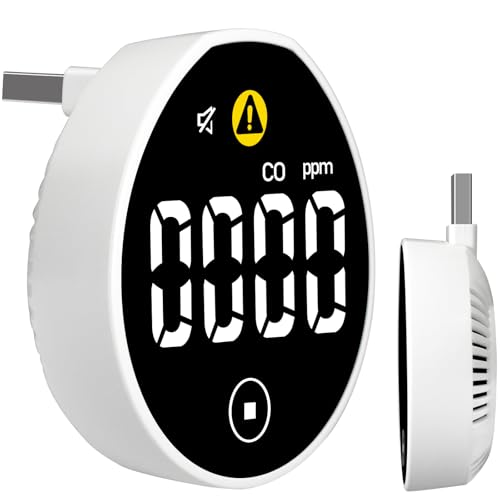
Best for boaters who need a compact, USB-powered CO detector. It weighs about the size of a credit card (2.1 x 2.8 inches) and can run off portable power banks or small energy storage devices. The device covers a CO range of 0–1000 ppm with ±5% accuracy and includes an audible alarm over 85 dB when CO levels exceed 50 ppm. The high-definition screen provides clear color-coded alerts—green (0–49 ppm no alarm), orange (50–99 ppm warning), red (100–1000 ppm danger). This makes it ideal for tight cabins or cockpit compartments where mains power is unavailable and quick visual cues matter.
Best for: sailors needing a compact, USB-powered detector for temporary or backup monitoring. Limitation: relies on USB power; not a standalone battery option unless paired with a power bank.
Pumwry 2 Pack Travel CO Detector

This battery-powered CO detector is designed for travel with no socket required. It’s suitable for cabins, hotel compartments on boats, RVs, and cars. It emphasizes portability and continuous operation during power outages, with a low-battery warning to ensure you’re never left without alerts. The device helps keep you protected on board or during overnight trips where access to power might be limited.
Best for: travelers who need a stand-alone detector on each level of a vessel or in each sleeping area. Caution: this product stresses CO detection; verify if you also need CO2 monitoring in your setup.
Dienmern 5-in-1 CO2 Detector
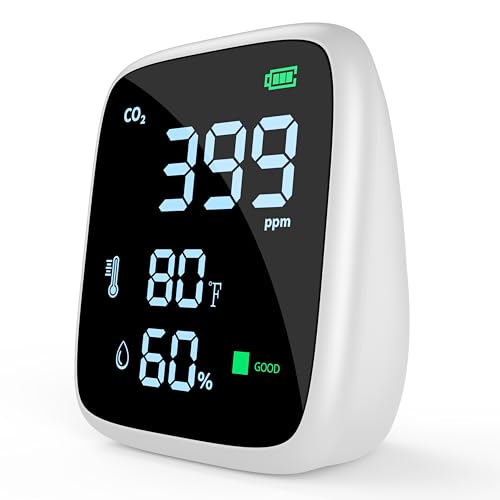
This unit combines CO2 monitoring with ambient temperature and humidity tracking, plus a CO2 alarm. It features a Swiss-made CO2 sensor with a 400–5000 ppm detection range and ±50 ppm accuracy. Real-time data helps you manage ventilation in a confined space such as a boat cabin or small galley. The alarm triggers when CO2 rises above safe levels, guiding you to ventilate promptly.
Best for: boat operators seeking a high-accuracy CO2 readout along with temperature and humidity data. Limitation: higher price and a larger footprint than single-function CO detectors.
ASIEIT 4-in-1 Portable CO/CO2 Detector
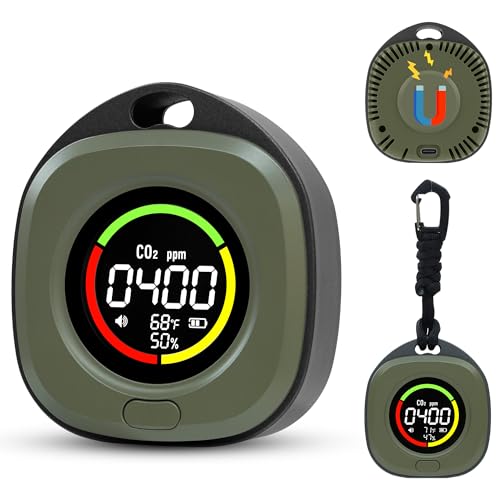
ASIEIT offers a compact, travel-ready 4-in-1 detector that monitors CO, CO2, temperature, and humidity. It uses high-precision sensors and displays data clearly, with three-level visual indicators (green, yellow, red) for CO and CO2. Weighing about 0.22 pounds, it includes a lanyard and back-mount possibility for easy placement on a boat, RV, or tent. It supports quick power-up and alerts for dangerous conditions.
Best for: boaters who want a multi-parameter monitor in a small, portable form. Caution: users should be mindful of calibration needs to maintain accuracy over time.
GasDoc DS-100PRO Portable CO & CO2 Detector
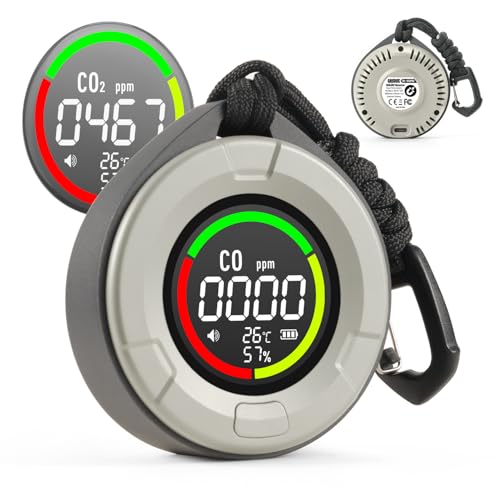
GasDoc DS-100PRO provides 4-in-1 monitoring for CO, CO2, temperature, and humidity with audible and visual alarms. It is compact and travel-friendly, featuring a magnet mount and a lanyard for hands-free carrying. The device supports up to 72 hours of continuous operation once powered and is suited for boats, campers, and small work areas. It offers configurable alarm thresholds for different contexts, making it versatile for personal or shared spaces on a vessel.
Best for: users who want a single, all-in-one detector for CO, CO2, temperature, and humidity with strong visual and audible alerts. Limitation: continuous operation depends on battery and power setup; verify battery life for long trips.
Buying Guide: CO2 Detector Considerations For Boats
What should you prioritize when choosing a boat CO2 detector? Consider power options, measurement scope, alarm features, and portability. For boats with limited power, battery-powered or USB-powered devices paired with a portable power bank are ideal. If you need a broader set of data, choose units that report CO, CO2, temperature, and humidity. Visual and audible alarms should be prominent and easy to interpret in dim cabin lighting. Look for clear displays, fast response times, and a reliable alarm threshold you can customize for your space.
Power and Portability
Portable detectors with battery operation or USB power are best for boats. If you don’t want to rely on mains power, select compact, battery-powered models with long life and low energy consumption.
Coverage: CO, CO2, Temperature, Humidity
CO detectors focus on carbon monoxide only, while CO2 detectors often include temperature and humidity sensors. For a boat cabin, a 4-in-1 device can provide a comprehensive view of air quality and comfort, helping you identify ventilation needs.
Alarms and Alerts
Choose detectors with loud audible alarms and clear LED indicators. Three-level or color-coded alerts help quick interpretation under motion or low light. Consider whether you want adjustable alarm thresholds to match your boat’s occupancy and ventilation patterns.
Display and Readability
High-contrast screens and large digits improve readability from a distance. Some units use color-coded indicators to simplify interpretation at a glance, especially during sleep or night-time voyages.
Maintenance and Calibration
Some devices require manual calibration to maintain accuracy. If you prefer low-maintenance units, prioritize models with self-calibration features or simple calibration steps that can be done quickly when docked.
Installation and Mounting
Consider whether you want a device with a magnetic mount, lanyard, or wall- or shelf-mounted design. Boats often benefit from flexible mounting options to position detectors in sleeping cabins, galleys, and engine rooms without obstructing movement.
Why These Models Make Sense For Boats
The selected options provide portability, battery versatility, and clear alerting suitable for marine environments. They balance CO and CO2 monitoring with temperature and humidity data, helping you manage ventilation in tight boat spaces and RV cabins during travel.
Quick FAQ
- Do I need a CO detector on a boat? Yes. CO detectors help identify dangerous gas buildup in enclosed spaces such as cabins and galleys.
- Should I monitor CO2 on a boat? CO2 monitoring supports indoor air quality and ventilation management, which is useful in sealed or poorly ventilated areas.
- Can I use USB-powered detectors on boats? USB-powered detectors work well with a portable power bank, offering flexibility when shore power is unavailable.
- How many detectors should I have on a boat? Place detectors in sleeping areas, galleys, and engine rooms for comprehensive coverage and to avoid blind spots.
- What is the difference between CO and CO2 detectors? CO detectors sense carbon monoxide gas; CO2 detectors measure carbon dioxide levels and often track temperature and humidity for air quality.
- Are two devices better than one? Having multiple portable detectors allows monitoring in separate zones, which is advantageous on larger boats or where air can stagnate.