Answering the common question “which bus bar is best for boat wiring?” this guide highlights five marine-grade 12V distribution blocks designed to simplify DC power management on boats, RVs, solar setups, and automotive projects. These units are ideal for boaters needing clean wiring, reduced risk of shorts, and easy fault isolation. They accommodate both positive and negative lines, support up to 150A or more, and feature secure terminal connections. The buyer profiles below show who benefits most from each option, along with practical pros and limitations.
| Product | Best For | Key Benefit |
|---|---|---|
| RVBOATPAT Power Distribution Block 12V 150A | Around-the-boat power hubs, general marine wiring | Solid 150A rating with 12V design and dual bus bars |
| Avelis Bus Bar 12V 150A | Clean solar/marine wiring with secure covers | Locking covers for vibration and shorts |
| RVBOATPAT Marine Bus Bar 12V 150A | Rugged installations with fast setup | Bottom buckle design for cover security |
| Joinfworld 250A/12V Distribution Blocks | Higher-current or larger-cable setups | Thicker copper plate for wider cable range |
| Joinfworld 400A 12V Distribution Block | High-current marine or automotive wiring | Largest current rating in this list |
RVBOATPAT Power Distribution Block 150A

The RVBOATPAT 12V bus bar uses a heavy-duty design with a maximum 48V DC rating and continuous 150A capacity. It features 12 stainless M4 terminal screws and a 1/4″ (M6) terminal stud with nut for straightforward installation. This setup includes separate positive and ground bus bars, plus protective covers and copper lugs for organized, low-resistance wiring. Best for boaters who need a compact, reliable distribution hub for a mid-range power system. A limitation is that installation may require precise routing to avoid interference with other components.
- Best for: General marine electrical hubs, boat projects with multiple DC loads
- Why selected: Balanced current rating, clear separation of positive/ground, and simple installation
- Caution: Ensure compatible lug sizes and avoid over-tightening
Avelis Bus Bar 12V 150A
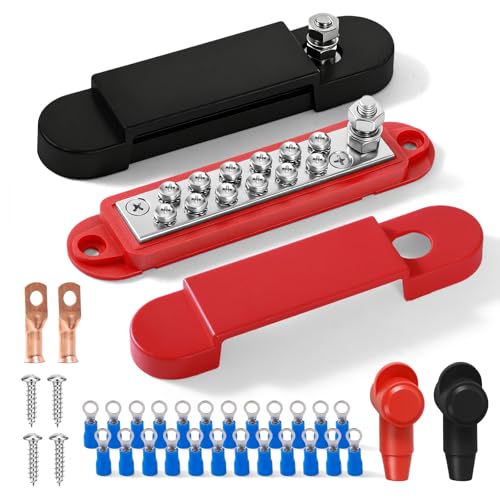
The Avelis distribution block uses a solid tinned copper bus bar and rigid base to minimize resistance across connections. Rated for 150A and up to 48V, it is well suited for solar interfaces, marine inverters, and DC accessories. Locking snap covers secure the terminal area against vibration and shorts, while the centralization of leads helps simplify troubleshooting. A potential trade-off is a slightly bulkier footprint compared with ultra-compact models.
- Best for: Solar/waveguide rigs on boats demanding clean, professional wiring
- Why selected: Secure covers, centralized wiring, low-resistance connections
- Caution: Check available space on your mounting surface
RVBOATPAT Marine Bus Bar 150A With 12 V Negative Block

This RVBOATPAT unit pairs a 12V negative bus bar with a black cover, designed for robust marine wiring. It uses 12 M4 stainless steel screws and a 1/4″ (M6) terminal bolt and nut. The bottom buckle design helps secure the cover, making installation quick and reliable. Best for installations with negative-side requirements and where a secure cover is essential. A limitation is that the data focuses on hardware details rather than integrated diagnostic features.
- Best for: Negative-side distribution in boats with straightforward layout
- Why selected: Durable construction, secure cover, straightforward mounting
- Caution: Verify compatibility with cable lug sizes in your setup
Joinfworld 250A Power Distribution Block

This unit adds 4 x 5/16″ (M8) studs and three #8 screw terminals, built to handle larger cables and higher current within 12V systems. It comes in both red and black for positive and negative channels and uses a thicker copper bus plate for lower resistance. Best for users who need a higher current rating (250A) and a more substantial terminal footprint. A caution is that the larger design requires more mounting space.
- Best for: Higher-current marine or automotive wiring projects
- Why selected: 250A rating with wider terminal options
- Caution: Ensure mounting area can accommodate the larger unit
Joinfworld 400A 12V Power Distribution Block
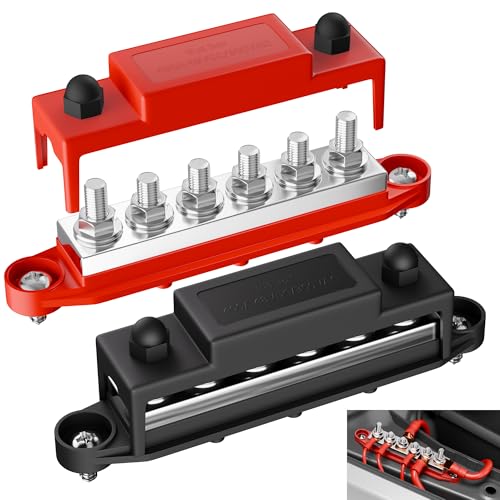
The 400A model from Joinfworld is designed for the heaviest 12V to 48V DC loads, featuring six 5/16″ (M8) studs and a sturdy nylon base. It supports both positive and negative layouts and uses an upgraded thick copper bus plate to handle demanding power distribution tasks. Best for large boats or vehicles with multiple high-draw devices, solar arrays, or auxiliary power needs. A limitation is that the unit’s size and weight may require reinforced mounting and careful cable routing.
- Best for: High-current marine or automotive layouts
- Why selected: High 400A rating and durable construction
- Caution: Plan cable routing to manage tight fits and heat
Buying Guide: What To Look For In A Boat-Wiring Bus Bar
- Current rating and voltage: Choose a bus bar whose continuous current matches your loads and stays within the system voltage (commonly 12V or up to 48V on boats).
- Number and size of terminals: Consider how many wires you will connect and whether the studs support larger lugs (5/16″, 3/8″, etc.).
- Materials and durability: Copper bus bars and stainless screws improve conductivity; a flame-retardant nylon base helps safety in harsh marine environments.
- Protection and covers: Locking or snap-fit covers reduce short risks during service and vibration from marine movement.
- Mounting space and layout: Ensure your chosen unit fits the available space and aligns with your cable routing strategy.
- Negative vs. positive blocks: Some dual-block designs provide separate positive and negative buses for neat, error-free wiring.
How To Choose Between Models
- For moderate systems with multiple loads but limited space, the RVBOATPAT 150A or Avelis 150A offer a compact, reliable solution.
- For higher current needs or larger cable sizes, consider Joinfworld’s 250A or 400A blocks, noting the mounting footprint and weight.
- If vibration and secure closure are critical, prioritize models with locking or buckle covers to minimize accidental shorts during movement.
Installation Notes
- Use appropriate lug sizes and torque per hardware specifications to avoid loosening or overheating.
- Route cables to minimize cross-over, reduce clutter, and ease troubleshooting in the future.
- Verify the system’s total current draw to avoid surpassing the bus bar’s rating.
FAQ
- What is a boat bus bar used for? It consolidates multiple DC connections into a single, organized power distribution point, reducing wiring complexity on boats.
- Can a bus bar handle solar power wiring? Yes, many models support solar wiring up to their rated current and voltage, aiding clean solar array integration.
- Which bus bar is best for high-current loads? Models rated at 250A or 400A are better for high-current demands and larger cables.
- Are locking covers necessary? Locking covers improve safety by preventing accidental contact and shorts during movement or service.
- Should I choose a 12V or 48V rated unit? Most boats use 12V systems, but some include higher-voltage components; match to your vessel’s electrical configuration.
- What maintenance does a bus bar require? Periodic inspection for corrosion, loose connections, and clean contacts helps maintain reliability.