Answering the question, this guide highlights the best bus bars for boats, focusing on 12V distribution blocks that handle high current, offer sturdy construction, and resist marine vibration. The top picks suit boat owners needing reliable power distribution for automotive, solar, and inverter setups. Ideal buyers include offshore sailors seeking durable marine wiring, DIY boat remodelers aiming for clean layouts, and RV/boat owners upgrading shore power and battery banks. Below is a quick summary of the five products selected for clear comparison.
| Product | Best For | Current Rating | Voltage Range |
|---|---|---|---|
| RVBOATPAT Power Distribution Block 12V 150A | Compact, mid-load marine setups | 150A | Up to 48V DC |
| Blue Sea Systems ST Blade Fuse Block 12 Circuit | Integrated DC circuits with ground | 100A total capacity | DC 12V systems |
| RVMARINEPAT 12V Bus Bar 250A | Higher current demanding systems | 250A | Up to 48V DC |
| Avelis Bus Bar 12V 150A | Solid copper, marine wiring with covers | 150A | Up to 48V |
| DaierTek 300A Bus Bar 12V Marine | |||
| DaierTek 300A Bus Bar 12V Marine | High-current marine installations | 300A | Up to 48V DC |
RVBOATPAT Power Distribution Block 12V 150A

The RVBOATPAT 12V bus bar is designed for up to 48V DC and 150A continuous current. It uses 12 stainless M4 terminal screws plus a 1/4″ (M6) terminal stud and nut for flexible wiring routes. This setup ships with separate positive and ground bus bars, plus protective covers and copper lugs for straightforward installation. Best for compact marine electrical systems or solar setups that need dependable power distribution without excessive footprint. Consider potential spacing needs for larger wire gauges in tight engine rooms.
Who it’s best for: boaters with moderate power needs, small to mid-size systems, and those prioritizing a compact, easy-to-install bus layout. Limitations: fewer high-current channels than larger blocks; plan for expansion if you need more circuits.
Blue Sea Systems ST Blade Fuse Block 12 Circuit

This block provides twelve fused circuits with an integrated negative bus and a clear insulating cover. It supports up to 100 amps total capacity and up to 30 amps per circuit when used with standard blade fuses. The insulating cover includes a push-button latch, spare fuse storage, and recessed areas for circuit labeling. Best for larger vehicles or boats needing organized, centralized circuit protection and straightforward maintenance. A potential drawback is its fixed circuit count, which may limit future expansion without replacing the unit.
Who it’s best for: boats with multiple 12V accessories requiring organized protection and easy circuit identification. Limitations: fixed twelve circuits; not ideal if more expansion is anticipated.
RVMARINEPAT 12V Bus Bar 250A

The RVMARINEPAT block features six 5/16″ (M8) terminal studs, rated up to 48V DC and 250A, with a round corner base for stability and improved airflow. Its design emphasizes open areas for 180° wire lug installation, enabling versatile connection methods. Best for high-current setups or when a robust, accessible terminal layout is required. Limitations include a larger footprint compared to smaller blocks, so ensure mounting space is adequate.
Who it’s best for: power-hungry marine systems, solar arrays, or engine compartments needing a sturdy, high-capacity bus bar. Limitations: bigger size may not fit tight installations.
Avelis Bus Bar 12V 150A
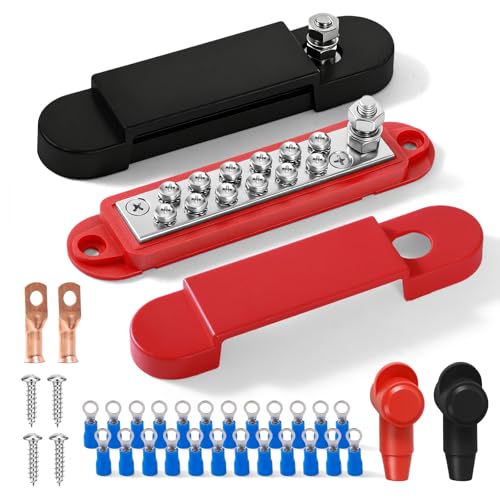
The Avelis bus bar uses solid tinned copper and a rigid base to minimize resistance in battery cable connections. Rated for 150 A and up to 48 V, it includes 1/4″ studs and 12 terminals with secure locking covers to resist vibration. Best for boats needing a durable, marine-grade distribution block with good protection during service and transport. One caution is to confirm mounting space and cable clearance prior to purchase.
Who it’s best for: DIY boat builders and saltwater crews who value low resistance connections and vibration resistance. Limitations: requires careful measurement of space before installation.
DaierTek 300A Bus Bar 12V Marine

The DaierTek 300A bus bar is built for high-current marine applications, featuring six M10 (3/8″) studs and a round-corner base. It supports up to 300 A at up to 48 V DC and up to 300 V AC, making it suitable for heavier-duty setups or power-hungry accessories. Best for boats with large battery banks or high-power DC equipment. A potential limitation is the heavier weight and larger footprint that may challenge installation in compact helm stations.
Who it’s best for: vessels with demanding power requirements, inverter/charger-heavy systems, or expansive solar arrays. Limitations: heavier and larger; verify available mounting area.
Buying Guide: Key Considerations For Boat Bus Bars
- Current rating: Match the bus bar’s amperage capacity to your total draw. Overloading a smaller block can lead to overheating.
- Voltage tolerance: Ensure the block supports your system voltage (often up to 48V DC for marine use).
- Terminal type and quantity: Check stud sizes, screw terminals, and whether you need additional lugs or covers for protection.
- Protection and enclosure: Look for locking covers or corrosion-resistant finishes for saltwater environments.
- Installation space: Measure mounting area and cable clearance to accommodate lug sizes and cable gauges.
- Expandability: If you anticipate new circuits, choose a block with extra terminals or higher rating.
- Vibration resistance: Marine settings demand secure covers and robust mounting to prevent shorts during movement.
Frequently Asked Questions
- What is a boat bus bar used for?
– It distributes 12V/24V DC power from the battery to multiple circuits with a common ground, simplifying wiring and protection. - Should I choose a high-current bus bar for my boat?
– If you run many accessories, high-current devices, or inverters, a higher current rating provides better reliability and less voltage drop. - Do I need a fused fuse block or a plain bus bar?
– A fused block adds circuit protection; a plain bus bar is ideal when you already have separate fusing or dedicated protection per circuit. - How much space do I need for a boat bus bar?
– Plan for terminals, lug lengths, and clearance for maintenance; larger blocks require more mounting depth and width. - Can I mix vendors for bus bars and fuses?
– Yes, but consider moisture exposure, material compatibility, and consistent grounding practices to avoid corrosion or poor connections. - Is tin-plated copper better for boats?
– Tin plating resists corrosion and improves solderability, beneficial in saltwater environments.