When selecting a boat wiring harness plug, the right option depends on your trailer type, needed pin configuration, and environmental durability. This guide highlights five compatible choices, explaining who each is best for and why. It also includes a quick product table to compare essentials at a glance.
The following table summarizes the five highlighted products, focusing on compatibility, wiring style, and key strengths to help you pick quickly:
| Product | Configuration | Length | Best For |
|---|---|---|---|
| CheeMuii 7 Way Trailer Wiring Harness Kit | 7 Pin | 8 ft | Tractors and utility trailers needing robust single- and double-prong reliability |
| FLETERGIB 26FT 4 Pin 5 Wire | 4-Way Flat, 5 Wire | 26 ft | Boat trailers and RVs requiring long reach and easy splicing-free install |
| MECMO 4-Way Flat Trailer End Connector 25 Inch | 4-Way Flat | 25 in | Trailer end replacement with durable color-coded leads |
| Oyviny 5 Way Flat Trailer Wiring Harness | 5-Way | 22 in | Marine and RV trailers needing versatile 5-pin control |
| ATQYZLM 22FT 4 Pin 5 Wire Harness | 4-Pin, 5-Wire | 22 ft | Wide trailers requiring corrosion resistance and easy installation |
CheeMuii 7 Way Trailer Wiring Harness Kit

The CheeMuii 7-pin harness uses a copper double-prong design with a weatherproof outer wrap. It includes a junction box with 7 color-coded terminals to simplify wiring and identify functions. The copper power cord enhances electrical and thermal conductivity for reliable operation of vehicle lights, including turn signals and brakes. This kit is best for buyers who want a durable, all-in-one 7-pin solution for trailers, RVs, and heavy-duty towing applications.
Who it’s best for: Trailer owners needing a rugged, weatherproof 7-pin system with clear color coding and a protective junction box. Why selected: It combines a robust double-prong plug with a durable junction system to reduce corrosion exposure and improve wiring clarity. Caution: The kit’s complexity may be more than needed for simple 4-pin setups.
FLETERGIB 26FT 4 Pin 5 Wire Harness
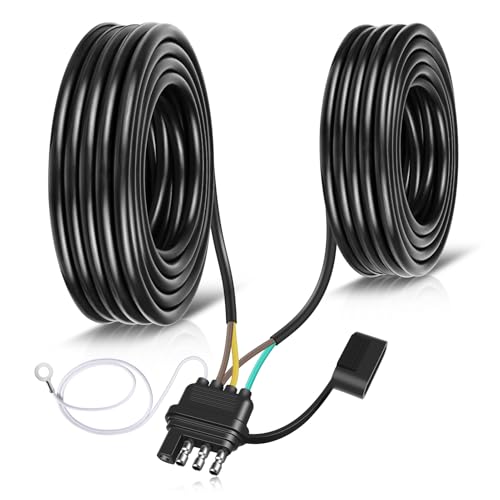
The FLETERGIB harness features a Y-shaped design that splits power to both taillights on each side without extra splicing. It uses a PVC jacket for waterproofing and durability, along with 16-gauge copper wires for low resistance and better current flow. The system is rated for harsh conditions and wide temperature ranges, making it suitable for boat trailers and RVs exposed to the elements.
Who it’s best for: Users who want straightforward dual-side power distribution with minimal assembly. Why selected: The Y-split design and durable jacket simplify installation and long-term reliability. Caution: The 26-foot length could be excessive for very small trailers, potentially complicating routing.
MECMO 4-Way Flat Trailer End Connector 25 Inch

This MECMO 4-Way Flat end connector provides a standard 4-wire setup with color-coded leads and a dust cover for protection. The 25-inch length helps reach across trailer axles and undercarriages for easier installation. It’s a practical replacement for worn or damaged 4-pin connections on many trailers including boat trailers and utility trailers.
Who it’s best for: Trailer owners replacing a worn 4-pin end with a straightforward, ready-to-splice solution. Why selected: Strong color coding and a dust cover help prevent miswiring and moisture ingress. Caution: It’s a basic 4-wire system; upgrade to a 5-wire if you need separate brake and turn signal functions.
Oyviny 5 Way Flat Trailer Wiring Harness

The Oyviny harness provides a 5-pin connector with 22 inches of wire lead, color-coded to map functions for tail, brake, turn, reverse, and ground. It uses corrosion-resistant brass and tin-plated terminals with copper wires for conductivity and a dust cover to improve waterproofing and longevity. The compact 22-inch lead is ideal for mid-sized trailers where routing space is limited.
Who it’s best for: Marine and RV trailers needing a versatile 5-pin setup in a compact form. Why selected: Clear color-coding and a protective dust cover enhance reliability in challenging environments. Caution: The shorter lead may require more careful routing on larger trailers.
ATQYZLM 22FT 4 Pin 5 Wire Harness

This ATQYZLM kit sports a thick PVC-coated 18AWG copper wire with a black nylon mesh tube over the conductors for extra protection against moisture and abrasion. It uses a forked design to minimize splicing, includes color-coded labels, and provides 22 feet of length for easy routing around large trailers. It’s well-suited for RVs and utility trailers that require a clean, weatherproof installation.
Who it’s best for: Trailer owners who want easy routing with robust weatherproofing and a straightforward, professional-looking install. Why selected: The forked design reduces the need for splices and ensures continuity across longer runs. Caution: The 22-foot length may be overkill for small trailers and could complicate short installations if not managed carefully.
Buying Guide: Key Considerations for Boat Wiring Harness Plugs
- Pin configuration: Ensure the harness matches your trailer’s lighting setup—4-pin, 5-pin, or 7-pin configurations are common. Higher-pin systems support separate brake and reverse functions.
- Durability: Look for copper conductors, weatherproof jackets (PVC or similar), and dust/water protection to withstand rain, splashes, and road debris.
- Length and routing: Choose length that accommodates trailer length and routing paths from the tow vehicle to the rear lights without excess slack that could snag or wear.
- Installation features: Forked or Y-split designs can simplify wiring by reducing splicing. Color-coded wires help prevent miswiring during installation.
- Connector protection: Dust covers and junction boxes extend life by reducing exposure to moisture and contaminants.
- Compatibility: Verify compatibility with your vehicle’s trailer socket type and the trailer’s lighting requirements (tail, brake, turn, reverse).
Practical Tips for Installing a Boat Wiring Harness
- Plan wire routing before cutting, marking each wire with its function for easy wiring.
- Use heat shrink or waterproof connectors at junctions to minimize moisture ingress.
- Test all functions (tail lights, brake lights, turn signals, reverse) before finalizing routing.
- Label wires clearly near the connector for future maintenance or replacement.
FAQ
What’s the difference between 4-pin and 7-pin harnesses?
A 4-pin harness controls tail lights, brake lights, and turn signals, while a 7-pin adds separate circuits for additional functions, such as reverse lights or auxiliary power.
Which is best for a boat trailer?
A 5-pin or 7-pin system is often preferred for boats with more complex lighting needs; consider a waterproof, corrosion-resistant design.
Do I need a junction box?
A junction box helps organize and protect wire connections, improving durability in dusty or wet environments.
How long should trailer wiring last?
Durability depends on exposure and quality. Look for weatherproof jackets and copper conductors for longevity.
Is splicing avoidable with these harnesses?
Many harnesses feature forked or Y-shaped designs that minimize or eliminate the need for splicing during installation.
Can I install these myself?
Yes, most videos and guides show straightforward, tool-free or minimal-tool installations for common trailer configurations.