If you need a reliable fuel level reading for boats, RVs, trucks, or marine equipment, start with a compatible fuel sending unit. This guide highlights five solid options that cover common tank depths and output standards, helping you pick the right sender for your vessel. Best for anglers and boat owners who want flexible depth adjustment; best for DIY installations; best for corrosion resistance in harsh marine environments.
| Product | Tank Depth | Output | Best For |
|---|---|---|---|
| Marine Fuel Sending Unit — CLLOMAGY (4-28 Inch) | 4-28 inches | 33-240 ohms | Flexible depths, general marine use |
| Marine Fuel Sending Unit — CLLOMAGY (6-12 Inch) | 6-12 inches | 33-240 ohms | Standard marine tanks |
| SEACHOICE 15461 — 6 In to 12 In | 6-12 inches | 33-240 ohms | Gas or diesel tanks |
| RUPSE Fuel Sender Unit — 6″ (150mm) | 6 inches | 33-240 ohms | Stainless steel, durable |
| OXCANO 7″ (180mm) — 240-33 Ohms | 7 inches | 33-240 ohms | Wide applications |
Marine Fuel Sending Unit — CLLOMAGY 4-28 Inch Depth

The CLLOMAGY fuel sending unit for marine tanks covers 4 to 28 inches, suitable for a wide range of tanks. It provides gas and water level readings, helping operators avoid running dry or overfilling. The unit is designed to be cut or rotated to match tank depth, which makes it a flexible choice for irregular installations.
Best for: boat owners needing adjustable depth and a mid-range depth range. This model is advantageous when you aren’t certain of your tank depth or when you have a multi-vehicle setup.
Caution: Cutting or rotating the sender requires careful alignment to prevent incorrect readings. Ensure seals are properly tightened after adjustments.
Marine Fuel Sending Unit — CLLOMAGY 6-12 Inch Depth

This CLLOMAGY model is tuned for 6 to 12 inches of tank depth with a 33-240 ohm output range. It is presented as an easy replacement for a broken sending unit and emphasizes flexibility in tight spaces. The unit is adjustable via the center screw and can be cut to fit the tank depth.
Best for: users who know their tank depth falls in the 6–12 inch range and want a straightforward swap compatible with standard gauge readings.
Caution: Overextension beyond the recommended depth might require additional wiring adjustments to maintain accuracy.
SEACHOICE 15461 Marine Fuel Sending Kit

The SEACHOICE 15461 kit provides an electric sending unit designed for 6 to 12 inches of tank depth and supports both gas and diesel fuels. It delivers accurate fuel level information, offering a reliable option for standard marine tanks. The kit is designed for installations where a dash gauge connection is present.
Best for: boat owners seeking a ready-to-install kit with a proven 6–12 inch depth range and diesel or gasoline compatibility.
Caution: Verify gauge compatibility before installation to ensure the 33-240 ohm range matches your meter.
RUPSE Fuel Sender Unit — 6 Inch (150mm)
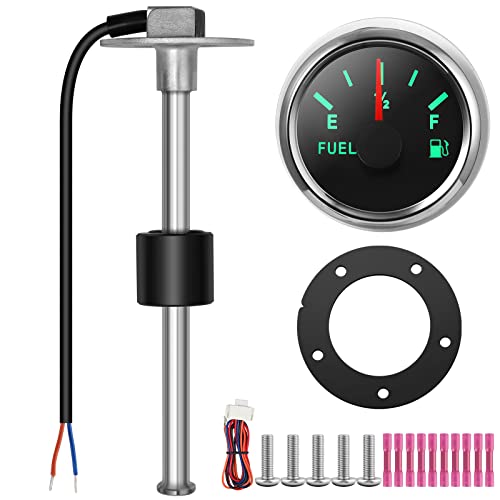
The RUPSE 6″ model uses stainless steel housing and reed-switch sensing for precise readings. It supports gasoline, diesel, water, and other liquids, with 8 backlight color options and IP67 waterproofing. It uses SAE 5-hole mounting and includes gaskets and screws for easier installation.
Best for: users needing corrosion resistance and clear backlit readings in marine environments. The stainless steel build and IP67 rating support long-term use in harsh conditions.
Caution: Ensure that the gasket and mounting screws are tightened properly to maintain water resistance.
Rupse Fuel Sender Unit — 6″ (150mm)

The 6″ Rupse sender mirrors the stainless steel construction and reed-switch control, delivering durable performance with an IP67 waterproof rating. It emphasizes easy installation with SAE 5-hole mounting, NBR gasket, and a wiring diagram for quick setup. It supports multiple fuels and liquids.
Best for: buyers who want a compact 6″ option with robust waterproofing and clear, backlit display options for low-light readings.
Caution: Double-check the wiring diagram during installation to avoid incorrect gauge readings.
Moeller 035722-10 Fuel Tank Sending Unit

The Moeller 035722-10 is calibrated to the industry standard 33-240 ohms. It requires connection to a dash-mounted gauge and uses internal components designed to resist rust and corrosion, offering a stable reading.
Best for: traditional marine setups where the dash gauge expects the standard 33-240 ohm range and where rust resistance is important for longevity.
Caution: This unit assumes a standard gauge; verify that your dash gauge matches the 33-240 ohm range for accurate readings.
OXCANO 7-Inch Fuel Sending Unit

The OXCANO unit uses a 240-33 ohm range and features a durable doughnut float design that reduces moving parts, improving reliability. It’s suitable for boats, cars, and various engines, and claims easier integration without tank adjustments.
Best for: buyers seeking a robust, long-life sender with fewer fragile components and wide application beyond boats.
Caution: The design emphasizes durability; ensure mounting clearance and float arm movement won’t contact tank walls in your specific setup.
Fuel Sending Unit 240-33 Ohms with Float — MAIMEIMI

The MAIMEIMI unit follows the US standard 240-33 ohms, with an aluminum alloy body and corrosion-resistant construction. It offers adjustable float arm height (5″ to 27″) to fit various tank depths and includes clear wiring instructions for installation.
Best for: those who need a highly adjustable sender that can fit many tank depths and require a robust aluminum-plastic blend for durability.
Caution: Adjusting height should be done with the bushing screw loosened; re-tighten securely to maintain readings and prevent movement during operation.
Buying Guide
What tank depth do I need? Start with the tank depth range printed on the unit and compare it to your tank height. Depth compatibility ensures accurate readings and avoids mechanical interference.
Which ohm range should I pick? Most gauges use 33-240 ohms. Confirm your dash gauge compatibility before purchasing to avoid mismatches that yield wrong readings.
Is durability important in a marine environment? Yes. Stainless steel, gasket quality, IP ratings, and corrosion resistance matter for long-term reliability in saltwater or humid conditions.
How flexible should the unit be? If your tank depth varies or you install in multiple vehicles, choose a model with adjustable height or a unit that can be easily cut to fit.
What about installation complexity? Some units include mounting hardware and wiring diagrams, which simplifies DIY installation. Others may require more custom wiring or dash gauge adjustments.
Do I need water or fuel compatibility? If you operate both gas and diesel engines, look for units rated for multiple fluids or check compatibility notes to avoid corrosion or measurement errors.
Frequently Asked Questions
- What is a fuel sending unit?
A fuel sending unit measures the fuel level in a tank and sends a corresponding signal to a gauge or monitor.
- Do I need a specific ohm range for my gauge?
Yes. Most gauges use 33-240 ohms; confirm your gauge’s input range before purchasing.
- Can these senders be cut to fit my tank?
Many models are designed to be cut or adjusted to fit different depths; follow manufacturer instructions.
- Are these units suitable for diesel and gasoline?
Several models support both fuels; always verify fuel compatibility in the product details.
- Is installation easy for a first-timer?
Some units include wiring diagrams and mounting hardware; others may require professional installation for optimal accuracy.
- What maintenance is required?
Regular inspection of seals, gaskets, and wiring helps maintain accuracy and prevent leaks.