Find reliable fuel level gauges that provide clear readings, easy installation, and compatibility with common senders. This guide compares five top options for boats, cars, yachts, and RVs. It helps skippers choose gauges that minimize guessing, improve navigation planning, and prevent running out of fuel. Best for: boaters needing stable readings in rough seas, DIY dashboard builders, and anyone replacing an aging gauge.
| Product | Brand | Signal Range | Notes |
|---|---|---|---|
| 100TECH Boat Fuel Gauge | 100TECH | 240-33Ω, 0-190Ω, 240-30Ω, 0-180Ω, 10-180Ω | Stable readings, wide compatibility, 52mm installation |
| Sierra 57902P Fuel Gauge | Sierra | 12 VDC | Classic dial design, scratch-resistant glass |
| BLLYOGU 2″ Fuel Level Gauge | BLLYOGU | 12V, 0-190Ω etc. (adapter signals) | LED backlight, durable build |
| HEETHYCOOL 2″ White Signal Selectable | HEETHYCOOL | 5 resistances including 240-33Ω, 0-190Ω, 240-30Ω, 0-180Ω, 10-180Ω | Automatic signal matching, IP-rated and 3 finishes |
| RUPSE 2″ Fuel Level Gauge | RUPSE | 8-color backlight, 240-33Ω etc. | Backlit options, versatile installation |
Note: This introduction highlights five options chosen for broad compatibility, readability, and dashboard customization. Each product below includes a concise rationale, best-use scenarios, and any limitations to consider before purchasing.
100TECH Boat Fuel Gauge For Marine Use

The 100TECH gauge features multi-signal compatibility (240-33Ω, 0-190Ω, 240-30Ω, 0-180Ω, 10-180Ω) and a 52mm installation diameter. It emphasizes precision with an anti-vibration needle and an 8-level fine scale for improved accuracy. It suits boaters who operate in rough seas or high-vibration environments and want a straightforward install with clear E-F indication. Best for: DIY installers seeking a universal aftermarket gauge with a stable readout. Limitation: might require calibration to match your specific sender type.
Sierra 57902P Fuel Gauge

Structured with a black dial, red graduations, white numerals, and a vivid white pointer, this gauge uses glass for scratch resistance and a near-flush bezel to provide a clean dashboard look. It operates on 12 VDC and is best for traditional dashboards or replacements in older vessels. Best for: sailors who prefer a classic, easy-to-read mechanical appearance. Limitation: uses a fixed design that may not offer as many backlight options as modern LED alternatives.
BLLYOGU 2″ Fuel Level Gauge

The 2″ gauge by BLLYOGU emphasizes 12V compatibility with a white LED backlight for all-dark conditions. It offers high-sensitivity readings and smooth needle movement, making it a good replacement when an original sensor fails. Best for: DIY dashboards and upgrades where backlit readability is essential. Limitation: may require exact sender compatibility confirmation for fit and range alignment.
HEETHYCOOL 2″ White Signal Selectable Gauge
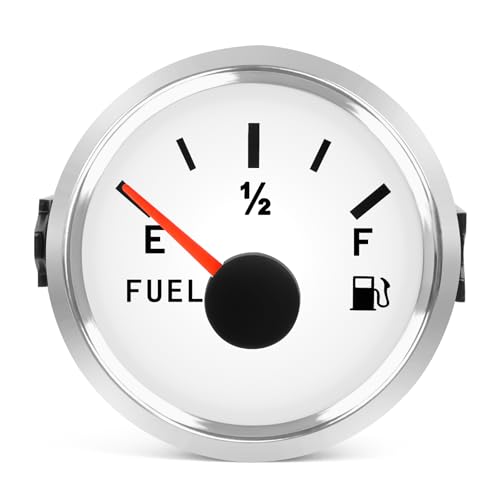
This model features automatic signal matching that self-detects from five common resistances, simplifying installation on boats, cars, trucks, RVs, and motorcycles. It also offers three finishes (Black, Gold, Silver) to match dashboards. Best for: users seeking plug-and-play setup with flexible aesthetics. Limitation: the purple wire caution note indicates certain signal value requirements for correct operation; misconfiguration could lead to inaccurate readings if not followed.
RUPSE 2″ Fuel Level Gauge With Backlight

The RUPSE gauge provides eight-color backlighting options and supports multiple signals, with IP67 stainless steel framing for durability in marine environments. It is suitable for boats requiring a customizable glow and robust water resistance. Best for: operators who want dashboard personalization and reliable outdoor use. Limitation: backlit color selection must be aligned with the existing dashboard lighting plan to avoid visual misreads in bright daylight.
Buying Guide
What should you consider when choosing a boat fuel gauge?
- Signal compatibility: Ensure the gauge supports your senders’ impedance (common values include 240-33Ω, 0-190Ω, 240-30Ω, 0-180Ω, 10-180Ω). Check your current sender type before purchasing.
- Installation size: Most 52mm (2-1/16″) gauges fit standard dashboards, but verify diameter and mounting depth for your boat or vehicle.
- Readability: Consider dial vs. digital styles, backlighting, and contrast. LED backlights improve visibility at night or in low-light conditions.
- Durability: For marine use, IP ratings, stainless steel framing, and scratch-resistant lenses help withstand exposure to salt and splash.
- Accuracy and stability: A needle that moves smoothly with minimal bounce is preferable, especially in rough seas or when the vessel experiences vibration.
- Aesthetics: Finishes (Black, Silver, Gold) and bezel styles should match your dashboard design for a cohesive look.
How do you decide between mechanical dial gauges and digital backlit gauges?
- Dial gauges are often easier to read at a glance and suit traditional dashboards.
- Digital backlit gauges provide color customization and can be easier to read in varying light conditions.
What installation considerations matter most?
- Calibration: Some gauges require calibration to the sender’s range. Follow the included instructions for accurate readings.
- Sealing: Ensure the gauge’s back wiring is protected from water ingress and that connections are sealed to prevent corrosion.
Frequently Asked Questions
- What does the 240-33Ω range mean?
– It refers to the electrical resistance range the sender provides. Gauges are designed to interpret these ranges to display fuel level accurately. - Is backlighting necessary for daytime use?
– Backlighting helps readability in low light or night conditions, but visibility in bright daylight is often achieved through high-contrast dials or indicators. - Can I mix different brands on the same dash?
– It’s best to use gauges that support the same signal range to ensure consistent readings across instruments. - Do all gauges fit 12V systems?
– Most marine gauges are designed for 12V systems, but verify the working voltage in the product specs before purchase. - Are IP67 or higher ratings important?
– Yes, for any gauge mounted where seawater exposure or splashes are possible, higher IP ratings offer better water resistance. - What’s the advantage of automatic signal matching?
– It reduces the need for manual setup and helps ensure compatibility with a variety of sender units.