If you’re looking to prevent battery drain and enhance safety on boats, a reliable boat cut off switch is essential. This guide highlights five practical options suited to different needs—from universal emergency kill switches to battery disconnects for reducing parasitic draw. Best for new boat owners, seasoned captains, and weekend boaters seeking quick power isolation, these picks balance durability, ease of installation, and clear safety benefits. The table below summarizes each product’s core role to help you compare at a glance.
| Product | Best For | Key Benefit |
|---|---|---|
| Nilight Battery Disconnect Switch | Heavy-duty boats and RVs | High current ratings and waterproof design |
| Five Oceans Universal Emergency Cut-Off | Jet skis and small to mid-size boats | Coil lanyard with buoy for visibility |
| Joinfworld Top Post Battery Disconnect | ease of wiring on classic battery layouts | Simple negative-ground installation |
| SEACHOICE Battery Select Switch | Two-battery systems | Parallel and isolation options |
| Blue Sea Systems m-Series | Compact panels and tight spaces | Removable knob for safety |
Nilight – 90015A Battery Switch

Best for: Boats or campers that require robust DC isolation with high current capability. This switch supports 275 A continuous and 455 A intermittent at DC 12V, with 1250 A momentary capability. The ABS housing and rear insulation reduce short-circuit risk, and four bolt terminals simplify installation. It can stand alone or lock with other switches for layered safety. This is a strong choice when reliability and electrical isolation are priorities in demanding marine environments.
Caution: Ensure wire sizing matches the high current specification; improper wiring can negate safety benefits. It’s designed for DC 12–48V systems, so compatibility with non-DC setups should be verified.
TXRXIZ Universal Boat Safety Lanyard Kill Switch
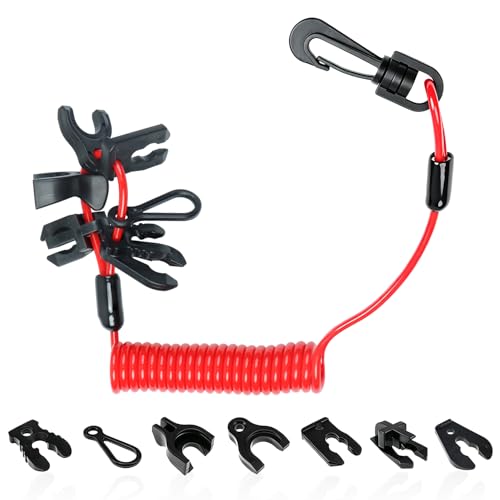
Best for: Smaller boats and personal watercraft that need universal compatibility. The lanyard includes seven keys to fit Mercury, Yamaha, Honda, Tohatsu, Johnson, Evinrude, and Suzuki systems, providing a straightforward engine kill in emergencies. Made with PU rope and ABS, the cord is designed to withstand water exposure and bending. It’s a practical add-on for crew safety and rapid shutdown if the operator is separated from the helm.
Limitation: This is primarily a tethered kill switch accessory; ensure your main power isolation is complemented by a proper battery disconnect as needed.
Five Oceans Universal Emergency Cut-Off Switch

Best for: Boats or jet skis needing an integrated safety kill switch that can be wired for ignition or magneto kill. The package includes a red coil extendable lanyard, snap hook, connectors, and a buoy for visibility. It supports dual circuitry, making it adaptable for various ignition configurations. It’s a solid pick when you want an all-in-one safety option with on-boat visibility and straightforward installation.
Limitation: The dual circuitry option requires proper wiring knowledge to match your ignition type and electrical system layout.
Joinfworld Battery Disconnect Switch 12V-48V

Best for: Vehicles and boats with space constraints, thanks to its side-post design. Rated at 275 A continuous and 1250 A cranking, with M10 copper studs and a robust ABS body. The included copper conductive sheet and clamps improve electrical connectivity and reliability. It’s a reliable mid-range option for secure power isolation in limited spaces.
Limitation: Side-post installations can be trickier in cramped panels; plan routing to avoid interference with wiring bundles.
Blue Sea Systems m-Series Battery Switch

Best for: Compact panels where space is at a premium. The m-Series switch emphasizes a removable knob to prevent accidental current flow and offers versatile mounting options for different panel layouts. This makes it ideal for dash panels and tighter engine rooms where safety and space savings matter.
Limitation: The compact design may limit high-current performance compared with larger marine switches; verify the current needs of your system before choosing.
Buying Guide
What type of cut off switch do I need?
Consider whether you need a battery disconnect (to reduce parasitic draw when unused) or a kill switch (for immediate engine shutoff in an emergency). Battery disconnects are better for long-term prevention of battery drain, while kill switches are essential safety features for on-water emergencies.
How much current does my system require?
Check your boat’s electrical draw and select a switch rated above the peak current. Higher current ratings provide more margin for safety and future equipment upgrades.
What about installation and space?
Side-post and top-post designs suit different battery layouts. Measure mounting space and consider whether you want a compact unit in a dashboard or a larger, more serviceable switch in a cabin wall.
Wiring and safety features
Look for features like insulated rear covers, corrosion-resistant terminals, and clear wiring diagrams. Some switches offer negative-ground installation or mounting versatility to improve safety and reliability.
Visibility and accessibility
Kill switches with visible lanyards or buoy markers reduce the chance of leaving the switch engaged or losing the lanyard in the water. This is especially important for on-deck safety and emergency readiness.
Maintenance and durability
Choose switches with weatherproof housings and robust plastics designed for marine environments. This reduces corrosion risk and extends service life in salty or humid conditions.
FAQ
- What does a boat cut-off switch do? It isolates the battery or cuts engine power to prevent battery drain and improve safety by providing a quick shutdown method.
- Can I install a cut-off switch myself? Yes, with basic electrical knowledge and proper safety precautions. Always disconnect the battery before wiring and follow manufacturer instructions.
- Is a kill switch the same as a battery disconnect? Not always. A kill switch typically cuts ignition to stop the engine, while a battery disconnect isolates the battery from the system to prevent drain.
- What rating should I look for? Choose a rating that exceeds your system’s peak current. Higher ratings offer more headroom and safety margin.
- Where should I place the switch? Place it where you can reach it quickly from the helm or a safe location on deck, with clear visibility and minimal exposure to splashes.
- Do these switches require professional installation? Most installations are straightforward for those with basic electrical skills, but consult a professional if you are unsure about wiring or the electrical layout.