Best for marine and off‑grid electrical projects, these fuse blocks and distribution panels organize DC circuits safely and accessibly. This guide highlights five solid options from Blue Sea Systems and compatible brands, explaining who each is best for, and noting any limitations. It helps buyers choose by capacity, number of circuits, water resistance, and ease of wiring.
| Product | Circuits | Max Capacity | Best For |
|---|---|---|---|
| Blue Sea Systems ST Blade Fuse Block 12 Circuit with Ground and Cover, 100 Amps, 5026 | 12 | 100 A | High‑demand DC systems with many loads |
| Blue Sea Systems ST Blade Fuse Block 6 Way Circuits with Negative Bus and Cover, 100 Amps, 5025 | 6 | 100 A | Compact, mid‑size needs with a shared ground |
| Blue Sea Systems ST Blade Fuse Block Dual 12 Circuit with Ground and Cover, 100 Amps, 5032 | 12 | 100 A | Separation of two bus groups for multiple load types |
| Blue Sea Systems 5056 ST‑Blade Water‑Resistant 4 Circuit Fuse Block | 4 | 80 A per block / 25 A per circuit | Water‑contacted or exposed installations |
| Siapupy 12V/24V 6‑Circuit Waterproof Marine Fuse Box | 6 | 150 A total | Compact, waterproof marine use with LED indicator |
Blue Sea Systems ST Blade 12‑Circuit Fuse Block (5026)

The 12‑circuit design provides a built‑in negative bus and a capable 100‑amp total capacity. This block supports up to 30 amps per circuit when using standard ATO/ATC blade fuses, making it suitable for higher‑demand DC systems with numerous accessories. The insulating cover features a push‑button latch and recessed label areas for quick circuit identification and maintenance. Best for boaters or RV owners who need extensive circuit protection in one compact unit.
Who this is best for: skippers or mobile power systems with many loads and a dedicated fuse per circuit. Why selected: it combines twelve fused outputs with a solid ground bus and a clear, lockable cover for easy service. Limitation: larger footprint may require more panel space on small vessels.
Blue Sea Systems ST Blade 6‑Way Fuse Block (5025)
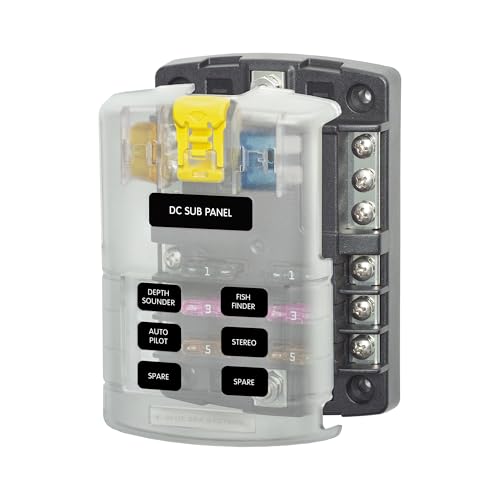
This block offers six fused circuits with a negative bus and a 100‑amp total capacity. The clear insulating cover includes a push‑button latch, spare fuse storage, and labeled areas for organization. Best for mid‑size electrical systems where a dedicated ground channel and compact footprint are priorities. Choose this if you want straightforward wiring with easy circuit labeling. Caution: fewer circuits than a 12‑circuit block means planning is needed for future expansion.
Blue Sea Systems ST Blade 12‑Circuit Dual Bus (5032)

This dual bus design splits twelve fused outputs into two electrically isolated groups, enabling separate management of switched and 24‑hour loads. It still supports up to 30 amps per circuit and a total of 100 amps. Best for power systems that require distinct control over different load groups or zones. Choose this if you need separate fused circuits for critical equipment and constant loads. Limitation: more complex wiring than single‑bus units.
Blue Sea Systems 5056 ST‑Blade Water‑Resistant 4 Circuit Fuse Block

Cleanly designed for water‑resistant applications, this four‑circuit block supports up to 80 amps per block or 25 amps per circuit. It’s built to handle vibration and exposure, common on boats. Best for small to mid‑sized systems where water exposure is a concern. Better for limited circuits where reliability in damp environments matters. Caution: fewer circuits means less room for expansion.
Blue Sea Systems 5502 Class T Fuse Blocks

Class T fuse blocks are known for fast response to short circuits and ABYC/USCG compliance. This model is designed for high‑voltage DC systems up to 160V and provides a robust fuse solution for high‑power inverters. Best for heavy‑duty installations where quick protection is essential. Limitation: intended for larger, higher‑voltage setups; may be overkill for simple 12V systems.
12V Fuse Box 6‑Way 12V/24V With LED Indicator (Tigerwin)
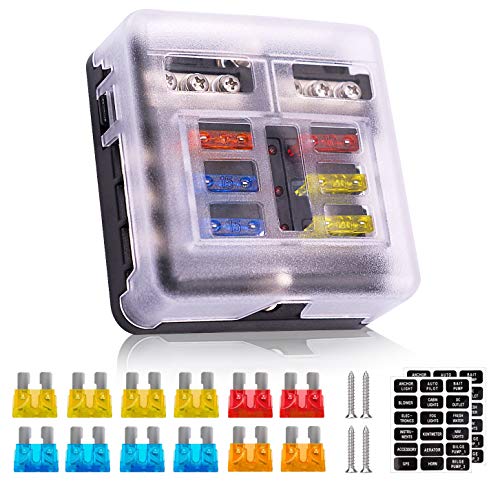
This six‑way fuse block includes an LED indicator for blown fuses and is designed for 12V or 24V systems. It uses a fire‑resistant PBT body and metal components for reliability. Best for DIYs where immediate visual indication of a blown fuse is valuable. Choose this if you want quick troubleshooting; beware: LED may require separate wiring to function in certain installations.
Blue Sea Systems 5005 ANL Fuse Block

The ANL fuse block accepts 5/16″ ring terminals and is designed for systems up to 32V DC. Its swing‑out design makes fuse replacement straightforward without removing fasteners. Best for rugged installs where space and serviceability matter. Limitation: not ideal for higher voltage or very dense circuit layouts; space to access may be limited in tight compartments.
Buying Guide: Key Considerations For Choosing A Fuse Block
- Number of Circuits: Match the block to your planned load count. If you anticipate growth, choose a higher‑circuit model even if you don’t use all positions now.
- Total Capacity: Ensure the total amperage rating covers your maximum loads. Consider both per‑circuit and overall limits.
- Grounding And Bus Design: A dedicated negative or ground bus helps organize wiring and improves fault isolation. Dual bus designs can simplify complex power management.
- Water And Vibration Resistance: For boats and outdoor rigs, water resistance and robust mounting are critical. Look for IP ratings or explicit marine design notes.
- Ease Of Wiring And Maintenance: Clear labeling, spare fuse storage, and accessible covers reduce maintenance time and error.
- Physical Footprint: Check panel size and screw layouts to ensure it fits your space on bulkheads or panels.
- Indicator Features: LEDs or clear visual cues help quickly identify blown fuses during operation.
- Future Upgrades: If upgrading systems (e.g., adding more accessories), prefer blocks with room to expand or modular options.
Frequently Asked Questions
- What is the difference between a single‑bus and dual‑bus fuse block?
A: A single‑bus block has one ground/return path for all circuits, while a dual‑bus block provides two separate ground groups, which helps isolate critical and noncritical loads or different power domains. - Can I use standard ATO/ATC fuses in these blocks?
A: Yes, most Blue Sea blocks support standard ATO/ATC blade fuses up to 30 amps per circuit, but always verify the specific product’s fuse compatibility. - Are these blocks suitable for saltwater boats?
A: Many are designed for marine use with protective covers and robust construction. Check for water resistance features and mounting options. - What should I consider when upgrading from a 4‑circuit to a 12‑circuit block?
A: Ensure your wiring harness can reach all terminals, the panel has space for mounting, and the total amperage capacity meets your loads. - Is a higher amp capacity per circuit always better?
A: Not necessarily. Choose a rating that matches the actual fuse size required by each circuit to avoid unnecessary load on circuits. - How important is an insulating cover?
A: It protects fuses and connections from accidental contact, reduces short‑circuit risk, and helps with labeling during maintenance.